References up front: This explainer draws on background material from CBC Radio on the biscuit tin ballot, AP News features on the Members’ bill draw, NZ Parliament and Ministry of Justice guides to law-making and Standing Orders, Walk Free’s analysis of modern slavery policy timing, New Zealand legislation pages for key Acts, RNZ coverage of omnibus bills, NZ History, Elections NZ, and broad press reporting on recent Treaty debates. No single source is quoted verbatim.
I. A cookie tin that sets the agenda
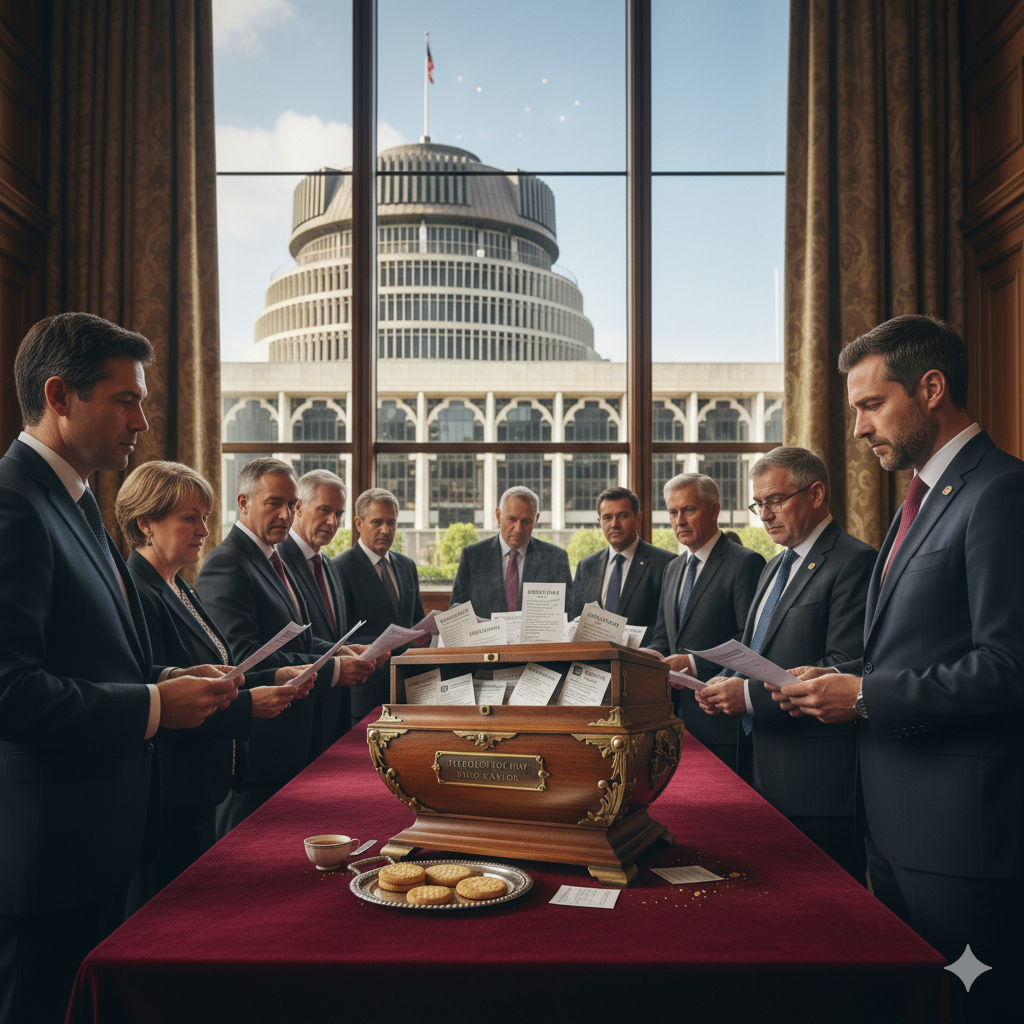
New Zealand’s Parliament mixes Westminster formality with very Kiwi practicality. A perfect example is the biscuit tin ballot, a real tin filled with numbered tokens that decides which non-minister MPs get their bills onto the debating list when slots open. The idea began in the 1990s to stop MPs queuing at dawn to file bills. The tin is simple, visible, and trusted. People can watch a neutral official draw the tokens, so the process feels fair.
Why it matters: Only Ministers control most of the House time. The ballot gives backbench MPs a real, if unpredictable, chance to put ideas on the floor, from technical fixes to big conscience questions.
II. Random, fair, and sometimes slow
Random selection protects against gatekeeping, yet it also means timing is luck. A bill with cross-party support can wait months for a draw. Campaigners for modern slavery reporting have made this point often. They argue that large companies should disclose supply-chain risks and that clear rules are urgent. The system has nudged Parliament to evolve. A recent rule lets a Member’s bill skip the ballot if 61 non-executive MPs sign on, a practical safety valve when there is obvious consensus.
Track record: The ballot has helped landmark social reforms reach the floor in the past. It also teaches patience. In New Zealand’s system, fairness and speed do not always travel together.
III. The other highway: Government and omnibus bills
Set the biscuit tin beside the Government’s main tools. Ministers introduce most bills, control the schedule, and can group many small changes into a single omnibus bill. That keeps the statute book tidy and saves time. Critics warn that very wide packages can smuggle in low-profile changes that deserve more debate. Standing Orders place limits, and select committees examine the details, but the contrast is clear: the tin is slow and egalitarian, the Government route is fast and centrally managed.
Bottom line: New Zealand balances two needs, inclusive access for MPs with ideas, and efficient maintenance of complex laws.
IV. When process meets identity and power
Some proposals trigger national debate that goes far beyond procedure. Recent efforts to recast how the Treaty of Waitangi is framed sparked rallies, legal analysis, and intense media scrutiny. Even cultural protest, such as haka performed in and around Parliament, became part of the political story. Whatever one’s view, these moments show that New Zealand’s rules are robust enough to host tough arguments in public, then record a clear vote.
Civic lesson: Process is not a side show. It is the stage on which big arguments are held in the open.
V. Parliament, in short
- Age and model: Parliament dates to 1854, follows Westminster practice, and sits for terms of up to three years.
- Voting system: MMP produces proportional results and usually coalition or support deals.
- Buildings and culture: The Beehive houses the Executive. The library survived a 1907 fire thanks to a heavy iron door. The Speaker polices “unparliamentary language,” which has produced some creatively phrased rulings.
- Public trust: Visible rituals help. People can see the biscuit tin draw. Select committees take public submissions. Votes are recorded.
VI. What the biscuit tin tells us about New Zealand
A small, inexpensive tin sits at the center of a big idea: power should be seen to be shared. The ballot keeps a door open for non-minister MPs and for subjects that Governments may sideline. The newer 61-signature bypass shows Parliament can tune rules without losing that spirit. Alongside the Government’s faster track for complex maintenance and budget work, the tin helps keep the system both practical and fair. In classic Kiwi fashion, the method is humble, the purpose is serious, and the message is simple: let people see how choices are made.