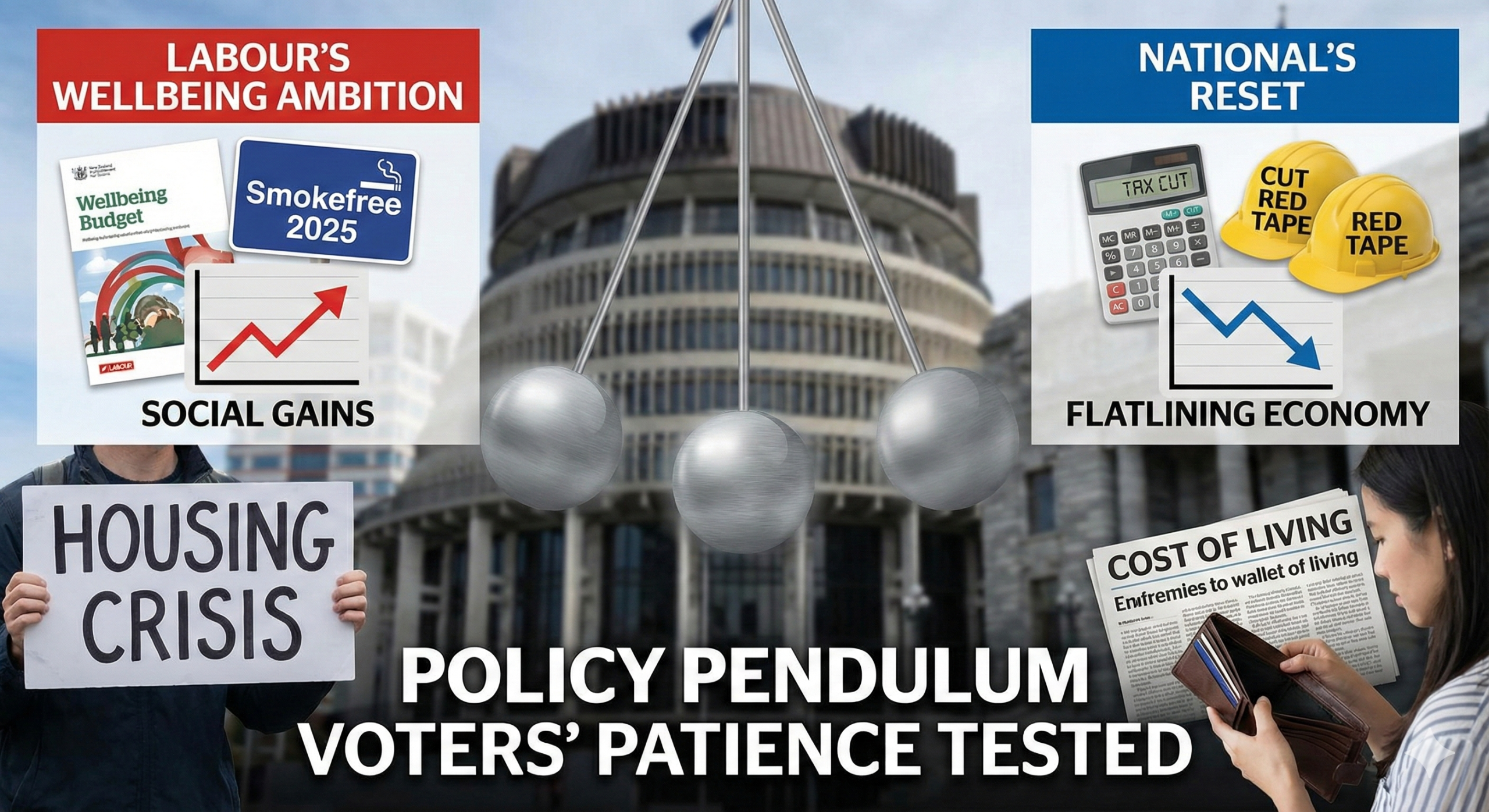
From wellbeing budgets to red tape cuts, from Smokefree laws to tax cuts, Aotearoa has moved through two very different visions of government in less than a decade. The result is a country stuck in economic headwinds and a mood of deep political volatility.
I. Two Governments, Two Stories: From Wellbeing To “Cut The Red Tape”
The change of government in November 2023, from the Sixth Labour Government to the Sixth National Government, did more than swap faces on the Beehive steps. It flipped the underlying story about what a government is for.
Labour’s Wellbeing Ambition
Under Jacinda Ardern and Finance Minister Grant Robertson, Labour tried to move New Zealand away from a narrow focus on GDP and toward a broader concept of success.
Their “Wellbeing Budget” framework attempted to measure natural, social, and human capital, not just economic output. The goal was simple to state but hard to deliver:
- Reduce child poverty
- Improve health outcomes for Māori and Pasifika
- Respond seriously to climate change
- Use economic growth as a tool, not a goal in itself
Labour pointed to high suicide rates, visible homelessness, and persistent child poverty as proof that older models of economic management had failed to build a fair society.
National’s Reset
The Sixth National Government, led by Prime Minister Christopher Luxon and supported by ACT and New Zealand First, has set out a very different priority list.
The new message is clear:
- Restore “fiscal discipline”
- Cut personal income tax
- Roll back what it sees as excessive regulation
- Support business confidence and investment
Key early moves included:
- Restoring mortgage interest deductibility for landlords
- Reworking housing policies in favour of investors and developers
- Promising major infrastructure investment, but in a more conventional public–private style
- Delivering a tax package worth about $3.7 billion a year
National argues that cutting red tape and putting more money back into people’s pockets will eventually deliver stronger growth than Labour’s large, centralised reforms.
The Fragility Of Big Reforms
One lesson from the last eight years is how fragile major reforms can be in a system without strong cross-party consensus.
Two of Labour’s most symbolic reforms were:
- The creation of the Māori Health Authority (MHA)
- The Smokefree Endgame law, which would have effectively banned legal tobacco sales for future generations
Both were reversed at speed by the new government. The Smokefree changes were pushed through under urgency in February 2024, bypassing public submissions, despite advice from the Ministry of Health and strong support among health experts.
These reversals underline a hard truth. In New Zealand’s current political climate, even “world-leading” reforms can disappear in a single parliamentary term if they are not deeply embedded in a shared political centre.
II. Labour’s Legacy: Social Gains, Delivery Gaps
Labour’s record looks very different depending on which part you focus on.
Real Progress On Child Poverty And Māori Health
On child poverty, the Government did move the dial.
- Working-age benefits were boosted
- The Child Poverty Reduction Act set binding three and 10-year targets that future governments must report against
- A 2024 UNICEF report recognised New Zealand’s “good progress,” even as rates remained stubbornly high among Māori and Pasifika children
On health, Labour tried to confront long-standing inequities:
- Māori were prioritised for some new diabetes drugs
- Telehealth services expanded
- More Māori doctors were supported in the system
- The MHA was created to directly address gaps in outcomes
The Smokefree Endgame law was a centrepiece of that agenda. It was designed with Māori in mind, where 19.9 percent smoked daily, compared with 7.2 percent of non-Māori, and where lung cancer remains a leading killer of Māori women.
Housing And Infrastructure: A Trust-Destroying Failure
The other side of Labour’s record is far more brutal.
- KiwiBuild promised 100,000 affordable homes and delivered less than 5 percent of that target
- The Auckland Light Rail project stalled for years before dying in a tangle of cost, complexity, and public confusion
At the same time, cost pressures were eating away at the gains from higher benefits and wages.
From June 2020 to June 2024:
- Average disposable income rose 24 percent
- Average annual housing costs jumped 31 percent
In practice, rent and mortgage costs soaked up much of the extra income that welfare and wage policies had provided. For many households, the feeling of “getting ahead” never arrived.
Social stress showed up in darker statistics. By April 2025, crimes against people experiencing homelessness had spiked by 81 percent since 2017. When housing is unaffordable, the ripple effects hit mental health, safety, and community cohesion.
III. National’s First Two Years: Deregulation Meets A Stalling Economy
The National-led coalition arrived with a clear plan: unwind Labour’s agenda, cut tax, and let business lead.
Big Reversals: Three Waters, Climate Tools, Smokefree
One of the earliest moves was the repeal of Three Waters in February 2024. Labour had planned to shift water services into a small number of specialist entities capable of borrowing heavily for long-term upgrades. Councils complained about losing “local voice” and control.
With the repeal, responsibility for drinking water, wastewater, and stormwater has shifted back to councils, many of which lack the capital base to fund the billions of dollars of work experts say is needed. The likely outcome is higher rates, especially in smaller rural districts, and continued infrastructure strain.
On climate and environment, the pattern has been similar:
- The Clean Car Discount ended on 1 January 2024, and low-emission vehicle sales fell sharply
- The Government pulled back from supporting a global limit on bottom trawling seamounts, pleasing parts of the fishing industry but worrying environmental scientists
- Work on a national Gas Transition Plan was abandoned
Despite this, the Government insists New Zealand remains on track for its 2050 net zero target and existing emissions budgets. That claim rests on updated projections and a suite of nine Government Targets set in 2024. Critics argue that taking away key decarbonisation tools while promising the same climate outcomes relies more on optimistic modelling than on structural change.
The Economic Dashboard: Red Lights Flashing
The bigger challenge for the coalition is that the economic data does not match its growth story.
From the table you provided, the mid-2025 snapshot looks like this:
| Indicator | National Mid-Term (Year Ending June 2025) |
|---|---|
| GDP Quarterly Growth (QoQ, chain-volume) | -0.9% (June 2025 quarter) |
| GDP Annual Growth (Year on Year) | -1.1% (to June 2025) |
| GDP Per Capita Change (Annual) | -2.1% (to June 2025) |
| Unemployment Rate | 5.2% (June 2025 quarter) |
| Average Annual Housing Cost Increase (vs June 2020) | 31% (up to June 2024) |
Behind those numbers:
- Manufacturing output is down 3.5 percent
- Construction is down 1.8 percent
- Unemployment has edged up from 5.1 to 5.2 percent in just one quarter
Per capita GDP falling by more than 2 percent is especially painful. It means that, on average, New Zealanders are getting poorer in material terms, not richer.
Tax Cuts Now, Surplus Later
National’s flagship response is its tax plan:
- Personal income tax cuts worth $3.7 billion a year
- Funded partly by scrapping or scaling back Labour-era programmes and tightening spending elsewhere
The Government hopes that easing the tax burden will soften the cost-of-living blow and lift confidence. However, weaker than expected GDP has already forced it to push out the return-to-surplus target from 2027 to 2029, according to the 2024 Half-Year Economic and Fiscal Update.
At the same time, removing schemes like Three Waters pushes large infrastructure costs back onto councils and, indirectly, onto households through higher rates. The risk is that short term political wins from tax cuts are cancelled out by long term pressure on local services and bills.
IV. Public Mood In Late 2025: Angry, Tired, And Hard To Please
If the Government hoped its rapid pivot would create a sense of momentum, the opinion polls suggest something different: volatility and frustration.
A Close Contest, But A Fragile Mandate
Polling in October 2025 shows a tight race:
- Government bloc (National, ACT, NZ First): 49.5 percent party vote intention
- Opposition bloc (Labour, Greens, Te Pāti Māori): 45.0 percent
On paper, that is enough for a comfortable-looking 63 seat majority. In reality, a swing of just a few percentage points would put the next election back into true toss-up territory.
More striking than the headline numbers is the inversion of trust.
Historically, National has owned the “best at managing the economy” label. Yet by late 2025:
- Voters now rate Labour as better on economic management
- Labour is also seen as stronger on 15 of the top 20 issues facing the country
In other words, the coalition has lost its traditional strongest card at the exact moment it needs it most.
The harsh reaction to reversals like Smokefree and the Māori Health Authority appears to have created political pain without a clear economic payoff. Many voters see those changes as ideological cuts rather than practical cost-of-living fixes.
Leaders Under Pressure
Approval numbers tell the same story.
- Prime Minister Christopher Luxon sits on a net approval of -14 in the October 2025 1News Verian poll, a drop of seven points since March
- Labour leader Chris Hipkins is in slightly better shape at +1, but his rating has also swung around sharply over the year
The public is not enthusiastic about either leader. Instead, there is a broader feeling that politics, in general, is failing to match the scale of the economic problem.
Voters who expected the new government to “fix” the cost-of-living crisis now face:
- A shrinking economy
- Rising unemployment
- Continued high housing costs
That mismatch between promise and lived reality feeds the view that Luxon is “out of touch” and does not fully understand everyday struggles, particularly among renters and low to middle income households.
V. Margins That Matter: When Hundreds Of Votes Decide The Direction Of The Country
Under New Zealand’s Mixed Member Proportional system, the party vote decides most of the final picture. But in a tight landscape, single electorates can still flip the balance of power.
Special Votes And Slender Wins
The 2023 election provided a clear example:
- About 567,000 special votes were cast
- Once those were counted, National lost two seats, forcing it to rely on New Zealand First to secure a majority
In this climate, local campaigns, candidate selection, and turnout strategies matter more than ever, especially in marginal seats.
From your screenshot, two electorates stand out as case studies.
Table: The Marginals – Closest Electorate Results (2023 General Election)
| Electorate | Winning Candidate (Party) | Runner-up (Party) | Official Margin (Votes) | Turnout |
|---|---|---|---|---|
| Banks Peninsula | Vanessa Weenink (National) | Tracey McLellan (Labour) | 396 | 84.10% |
| Auckland Central | Chlöe Swarbrick (Green) | Mahesh Muralidhar (National) | 3,896 | 78.66% |
Banks Peninsula: A Seat On A Knife Edge
Banks Peninsula is the clearest illustration of how small shifts can rewrite the political map.
- A swing of fewer than 200 votes would have kept the seat in Labour’s hands
- Turnout was high at just over 84 percent, which means both parties were effective at getting their voters to the polls
For National, keeping seats like Banks Peninsula will require not only delivering on national promises but also managing the local consequences of its reversals.
Take Three Waters as an example. Returning water assets to councils may be popular in theory, but if it leads to steep rate rises to fund mandatory upgrades, local MPs will wear the political cost.
In such seats, ideological purity becomes a luxury. MPs will need to secure practical funding arrangements, advocate for their communities inside Cabinet, and show visible results on the ground.
VI. A Country In An Age Of Volatility
Looking across the 2017 to 2025 period, New Zealand appears to be living through an “age of volatility” on three fronts.
- Policy volatility
- Large reforms are passed, then torn down within a term
- Climate and health policy swings create uncertainty for sectors that need long horizons
- Economic volatility
- A pandemic shock, followed by inflation, housing pressure, and now contraction
- A tax-cutting government operating in an environment of shrinking per capita GDP and delayed fiscal recovery
- Electoral volatility
- Tight blocs, fragile mandates, and seats decided by hundreds of votes
- A public that has shifted its trust on economic management from National to Labour, yet is not fully convinced by either side
What Comes Next
If the current economic pattern holds into 2026, the National-led coalition will face an uphill battle to argue that its model is working. The risk for the Government is clear:
- Voters may decide that tax cuts and deregulation were the wrong answers to a cost-of-living crisis that still feels unsolved.
For Labour and its allies, the challenge is different:
- They must show that they have learned from failed delivery on housing and infrastructure, and can match their social ambitions with credible implementation.
The next election is likely to be decided not just by big national slogans, but by:
- How water bills look in small towns
- Whether job losses continue in manufacturing and construction
- Whether voters in places like Banks Peninsula feel better or worse off than they did three years earlier
In a country where a few hundred votes can flip an electorate, and special votes can change who sits at the Cabinet table, every economic line item and every local project now carries national weight.
New Zealand has entered an age where policy, economics, and politics are closely intertwined, and none of them feels particularly stable. The only certainty, as 2026 approaches, is that the electorate is wide awake and watching the numbers very closely.