ANALYSIS | As New Zealand heads towards the 2026 election, two ordinary conversations in Auckland raise a much bigger question about how we choose governments
Sometimes the most revealing political conversations do not happen in Parliament, television studios or polling companies.
They happen over coffee, at work, inside a shop, at a community event or during an ordinary conversation between two people.
Recently in Auckland, I had one of those conversations.
A man told me that he had voted Labour at the previous election because, in his words, Labour had “given us PR”.
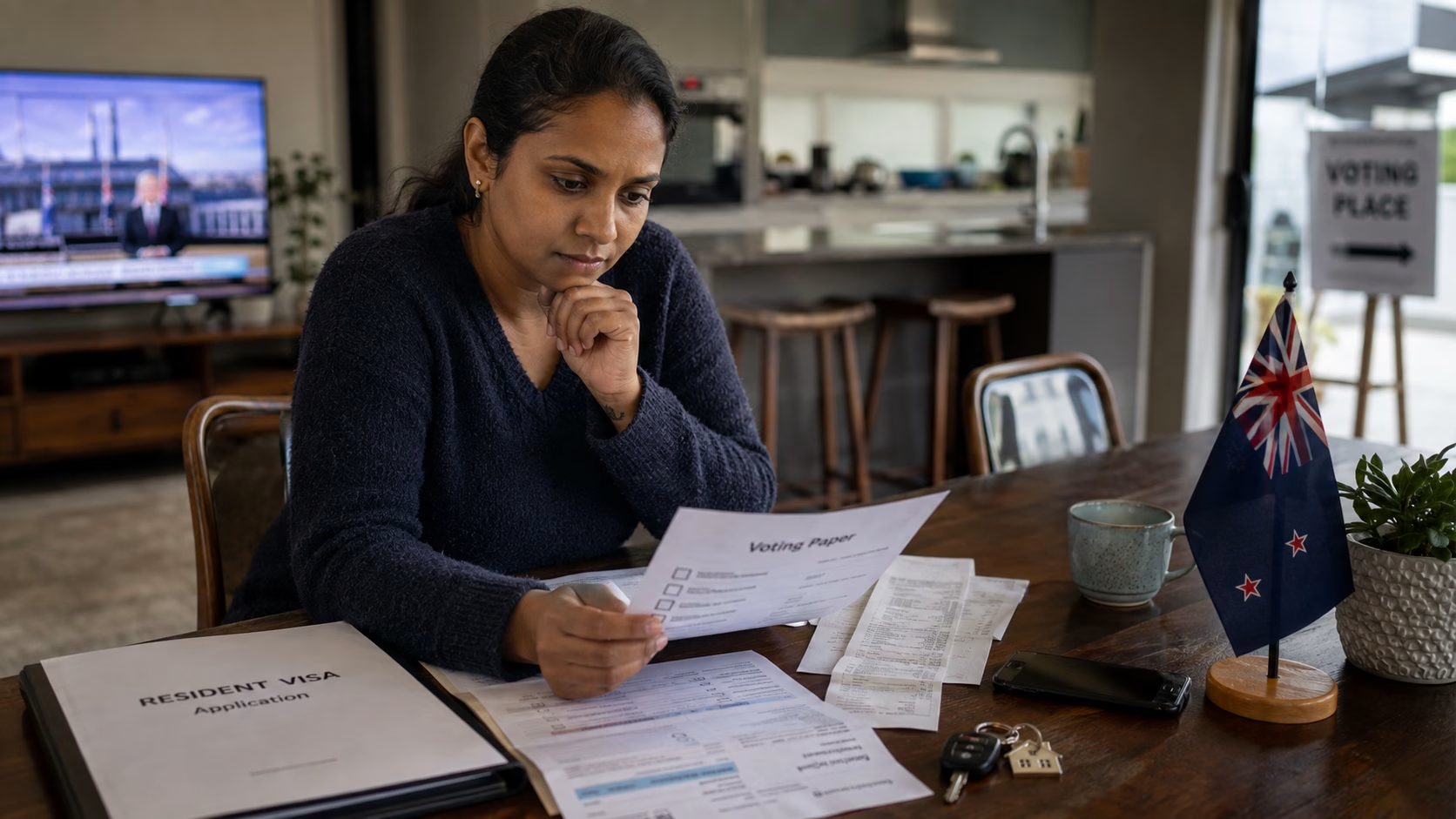
What he was referring to was the Labour Government’s one-off 2021 Resident Visa, a pathway introduced during the Covid period that gave tens of thousands of migrant workers and their families a route to residence after years of uncertainty.
Technically, it was not a free visa. Immigration New Zealand charged NZ$2,160 for the application, and a Resident Visa is also different from a Permanent Resident Visa.
But that was not really his point.
His point was much simpler.
A government decision had directly changed his family’s life, and he remembered it when he voted.
Fair enough.
Then came the interesting part.
Talking about the coming 2026 election, the same person said he was now considering moving his vote from Labour to National.
Why?
Because Indian Prime Minister Narendra Modi had come to New Zealand, Prime Minister Christopher Luxon’s Government had built a visibly closer relationship with India, and he liked what he saw.
That conversation left me thinking.
Not about whether Labour or National deserves his vote.
Something much bigger.
What exactly are we voting for?
Are we voting for the government that improves our lives?
Are we voting out of gratitude?
Are we voting based on economics?
Our children’s education?
Healthcare?
Crime?
Housing?
Immigration?
Our businesses?
Or can a handshake, a photograph, a visiting leader or a moment of cultural recognition change our political loyalty?
That question matters more than ever as New Zealand approaches the general election on 7 November 2026. The election is close, the political environment is unsettled, and neither of the two traditional major parties currently commands anything close to majority support.
The “PR vote” tells us something important
The 2021 Resident Visa was politically significant because it affected people’s lives in an unusually direct way.
It was introduced as a one-off pathway for migrants who had been caught in the disruption of Covid-19 and who met specific eligibility requirements. Immigration New Zealand said the policy was intended to provide certainty to migrant families and help retain skills needed by New Zealand businesses.
For someone who had spent years worrying about visas, employers, family security and whether New Zealand would remain home, residence was not some theoretical policy written in Wellington.
It could mean buying a home with greater confidence.
Building a career.
Keeping children settled in the same school.
Planning for ageing parents.
Stopping the constant fear that one immigration rule change could turn life upside down.
So when somebody says, “I voted Labour because they gave us residence,” it may sound transactional.
But think about it carefully.
Aren’t most votes transactional at some level?
A homeowner might vote according to interest rates and taxes.
A nurse might care most about staffing and health funding.
A business owner might vote around regulation and economic growth.
A parent might vote around education.
A beneficiary may care about welfare policy.
A landlord and a tenant can look at exactly the same housing policy and reach opposite conclusions.
Democracy has always contained an element of self-interest.
The harder question is whether self-interest alone is enough.
Then Modi arrived
Fast-forward to 2026.
Narendra Modi’s July visit to Auckland was historic. Reuters described it as the first visit by an Indian prime minister to New Zealand in four decades.
During the visit, India and New Zealand elevated the relationship to a strategic partnership, with greater cooperation spanning diplomacy, defence and maritime security. It came after the Luxon Government had already signed the New Zealand-India Free Trade Agreement in April.
For many Indian New Zealanders, seeing the Indian prime minister welcomed at the highest level was understandably significant.
There is identity involved.
There is pride involved.
There is also the feeling that India and the Indian diaspora are being taken seriously by Wellington.
And politics understands the power of that feeling.
But this is exactly where voters need to separate diplomacy from domestic politics.
Modi visiting New Zealand does not amount to an endorsement of New Zealand’s National Party.
Governments deal with governments.
Prime ministers meet leaders from countries governed by parties they may have almost nothing ideologically in common with.
Diplomatic warmth is part of governing.
A photograph between two prime ministers may represent an important relationship between two countries without telling you whether your electricity bill will rise, whether your GP will be available, whether your child is learning enough maths, whether your business will survive or whether you can afford your mortgage.
That distinction is crucial.
The uncomfortable test
Here is perhaps the simplest test before voting.
Remove the politicians’ names.
Remove their photographs.
Remove their ethnic backgrounds.
Remove the rallies.
Remove the party colours.
Remove Modi, Trump, Albanese and every other overseas political personality.
Now put the policies on a blank piece of paper.
Which ones would you choose?
That is a much harder exercise.
And probably a much healthier one.
Because political branding is powerful precisely because it saves us from doing difficult thinking.
It gives us shortcuts.
“They respect our community.”
“They helped my family.”
“My parents always vote for them.”
“They came to our temple.”
“He attended our festival.”
“She knows people from our community.”
“That party invited our leader.”
“This politician took a photograph with someone I admire.”
All of those things can matter.
None should automatically settle an election.
Indians are no longer a tiny political audience
There is another reason this conversation matters.
According to the 2023 Census, 292,092 people identified with the Indian ethnic group in New Zealand. That makes Indian New Zealanders a substantial part of the country’s social and economic fabric.
Not all are citizens, not all are eligible to vote, and describing hundreds of thousands of people as a single “Indian vote” would be nonsense.
Indian New Zealanders differ by age, religion, region, income, occupation, migration history and political philosophy.
A 25-year-old software developer who recently became a citizen may have little politically in common with a 65-year-old business owner who has lived here for 30 years.
Nor should they.
A mature community does not vote as a herd.
It argues.
It disagrees.
It changes its mind.
New Zealand itself is changing politically
The 2023 election demonstrated how dramatically political loyalty can move.
National won about 38 percent of the party vote, while Labour fell to about 27 percent after its extraordinary majority victory in 2020.
Now the ground is moving again.
The latest 1News Verian poll, conducted from 8 to 11 August 2026, put Labour at 30 percent and National at 29 percent. ACT was at 9 percent, the Greens at 12 percent and the emerging Opportunity Party had jumped to 8 percent.
That is significant.
It suggests voters are not simply moving between Labour and National.
Some appear to be questioning the traditional two-party choice altogether.
And there are real pressures behind that dissatisfaction.
Stats NZ says unemployment reached 5.6 percent in the June 2026 quarter, with about 171,000 people unemployed. Annual inflation was 4.1 percent.
Those numbers are not political theatre.
They enter people’s kitchens.
They enter mortgage payments.
They enter supermarket trolleys.
They enter business payrolls.
They enter conversations between couples wondering whether they can afford another child.
They enter the mind of someone who has sent 40 job applications without getting an interview.
That is where elections eventually live.
Gratitude is human, but governments are not charities
There is nothing wrong with remembering which government introduced a policy that helped your family.
Politicians should be judged on what they actually did.
If Labour’s immigration decisions materially improved someone’s life, that is legitimate information for that voter to consider.
Likewise, if the National-led Government deepens trade with India, creates economic opportunities, improves immigration settings or strengthens New Zealand’s international position, voters can legitimately give it credit.
But gratitude cannot become permanent political debt.
A political party is not doing you a personal favour.
It is governing the country using powers temporarily given to it by voters.
And voters owe no party lifelong loyalty in return.
Every election is a fresh performance review.
Ask a tougher question
Instead of asking:
“Which party likes my community?”
Perhaps ask:
“Which policies will make New Zealand a better country to live in for the next three years?”
Instead of:
“Who attended our cultural event?”
Ask:
“Who has a credible plan for jobs, healthcare, housing, education and public safety?”
Instead of:
“Who stood beside a leader I admire?”
Ask:
“What changed after the photograph?”
Did exports increase?
Did businesses gain opportunities?
Were qualification barriers addressed?
Did travel become easier?
Did the relationship produce measurable outcomes?
That is how symbolic politics becomes accountable politics.
And this applies far beyond Indian New Zealanders
The temptation to vote emotionally is not an Indian issue.
It is human behaviour.
People everywhere vote because they dislike a leader’s personality.
Because they like somebody’s confidence.
Because of one tax cut.
One benefit.
One scandal.
One television debate.
One viral video.
One badly worded sentence.
One charismatic speech.
Sometimes we vote against somebody more strongly than we vote for anyone.
The problem begins when one emotional event overwhelms every other consequence of government.
Maybe the real question is this
If a party helps you obtain residence, does it deserve your vote?
Possibly.
If another government strengthens relations with the country you came from, does that deserve consideration?
Certainly.
But neither should end the conversation.
Because once you become a New Zealander, your political interest becomes bigger than the country you left behind.
Your vote is also about the hospital your family will need.
The school your children attend.
The road you drive on.
The tax you pay.
The business you are trying to build.
The rent or mortgage waiting at the end of the month.
The safety of your street.
And the country your children may inherit.
Maybe the most dangerous vote is not a Labour vote.
It is not a National vote.
It is not an ACT, Green, New Zealand First, Te Pāti Māori or Opportunity vote.
The most dangerous vote is an unexamined vote.
A vote cast because somebody shook the right hand.
A vote cast because somebody attended the right function.
A vote cast because of gratitude from five years ago.
A vote cast because your WhatsApp group told you what to think.
A vote cast without asking what the decision will actually mean for your life.
On 7 November, New Zealanders will choose another Parliament.
Before then, perhaps every voter should ask one uncomfortable question:
If nobody told me the name of the party behind these policies, would I still vote for them?
The answer might surprise us.
References
Electoral Commission New Zealand, Official Results for the 2023 General Election.
Stats NZ, 2023 Census ethnic group data.
Stats NZ, Labour Market Statistics, June 2026 quarter.
Immigration New Zealand, 2021 Resident Visa information and policy background.
Ministry of Business, Innovation and Employment, 2021 Resident Visa fee policy.
New Zealand Government, announcement of the 7 November 2026 General Election.
New Zealand Government, New Zealand-India Free Trade Agreement announcements.
Reuters, coverage of Narendra Modi’s July 2026 visit to New Zealand.
1News Verian Poll, 12 August 2026.