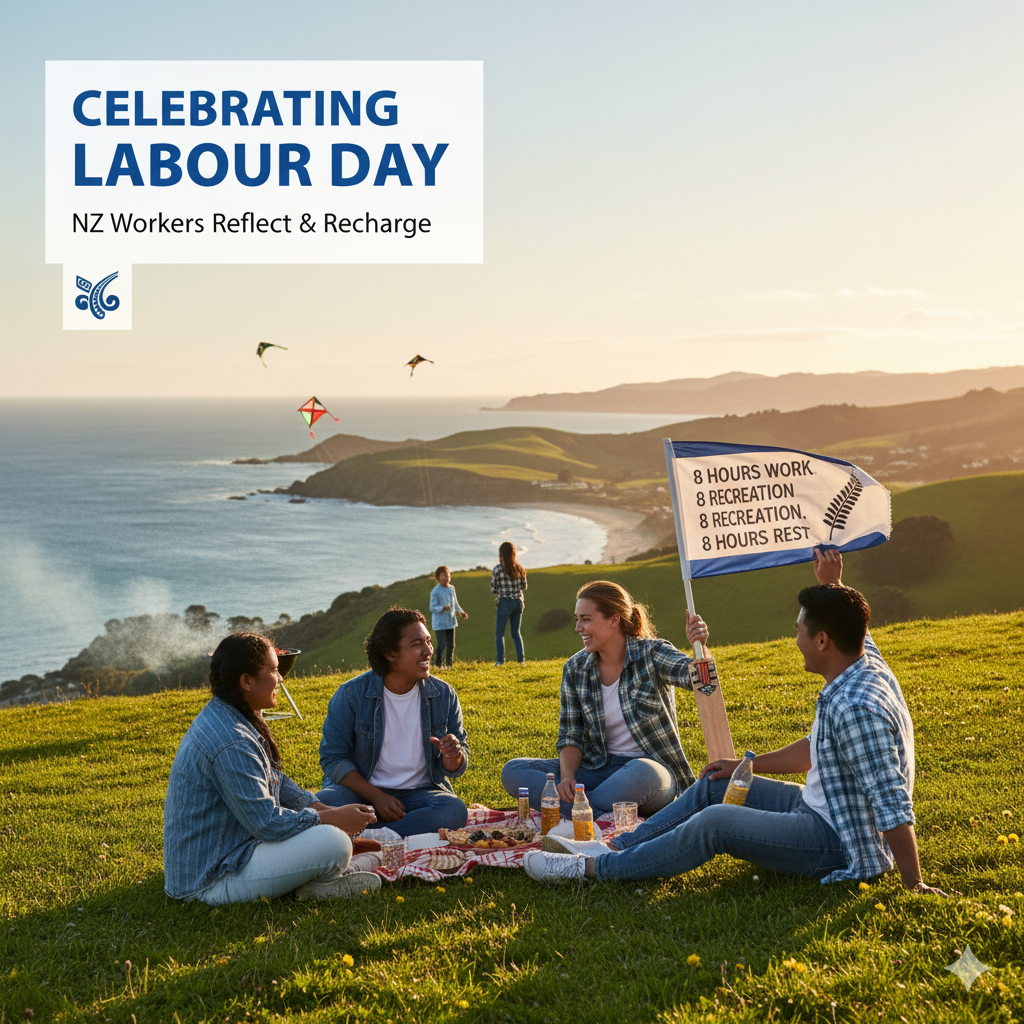
Dek: Labor Day is more than a long weekend. It began with one carpenter’s stand for time, dignity, and balance at work and still shapes the rights New Zealanders enjoy today.
Byline: Webfit News Editorial | Published 27 October 2025
Key Points
- Labor Day falls on the fourth Monday in October.
- The eight-hour day began in 1840 with Samuel Parnell’s famous refusal to work longer hours.
- Public celebrations in 1890 helped secure the Labor Day Act 1of 899.
- The date moved to a Monday in 1911, creating the familiar long weekend.
- Today, employees who work on Labor Day earn time-and-a-half pay and, if it is an otherwise working day, an extra paid day off.
Introduction: An extra day off with a deep story
Every fourth Monday in October, New Zealanders enjoy a spring long weekend. Yet Labor Day represents far more than a day of rest. It honors the historic struggle that won the eight-hour working day and established work-life balance as a national value.
When Parliament passed the Labor Day Act 1of 899, the country created its first public holiday not linked to religion, royalty, or provinces. This law came even before Anzac Day or Waitangi Day. Understanding Labor Day means tracing its roots back to a Wellington beach in 1840.
The birth of balance: Samuel Parnell and his stand in 1840
London carpenter Samuel Duncan Parnell arrived at Pito-one (Petone) in February 1840. Soon after, a merchant asked him to build a store. Parnell agreed—but only if the working day lasted eight hours. His words became legend:
“There are twenty-four hours in a day—eight for work, eight for sleep, and eight for recreation.”
When the merchant replied that London’s bell rang at 6 a.m., Parnell answered, “We are not in London.”
His idea spread quickly. At Port Nicholson, he met arriving settlers and told them not to accept longer hours. By October 1840, Wellington workers had agreed to the eight-hour custom. When employers tried to break it, road-builders in the Hutt Valley went on strike and won.
Still, this was a local habit, not law. Only skilled tradesmen benefited. True protection would come later through union organization and national legislation.
From custom to law: Union power and public momentum
During the 1800s, many laborers still faced endless days. Trade unions demanded national standards. Although early bills failed, they achieved progress through measures such as the Employment of Females Act 1873, which limited women’s hours.
The first great Labor Day celebration on 28 October 1890 marked both the 50th anniversary of Parnell’s stand and the first birthday of the Maritime Council. Thousands marched through Auckland, Wellington, Christchurch, and Dunedin with banners and floats. Even the elderly Parnell attended. The government gave its staff the day off, signaling support.
In 1899, Parliament passed the Labor Day Act, turning the day into a statutory holiday. It was first held on the second Wednesday in October. A decade later, the Public Holidays Act 1910 moved it to the fourth Monday to create a reliable long weekend. Parades gradually gave way to private leisure, but the meaning endured.
Legislative Milestones
| Year | Event | Significance |
|---|---|---|
| 1840 | Samuel Parnell’s demand | Introduced the eight-hour day custom |
| 1890 | First national celebrations | Mass demonstrations built union unity |
| 1899 | Labour Day Act | Shifted date to the Monday long weekend |
| 1910 | Public Holidays Act | Shifted date to Monday long weekend |
| 1936 | Industrial Conciliation & Arbitration Amendment | Created an official public holiday |
The ongoing fight for fair work
The eight-hour idea eventually became the 40-hour, five-day week. The Industrial Conciliation and Arbitration Amendment Act 1936 made it standard, and the Minimum Wage Act 1983 still reflects that norm.
Before 1944, when annual leave became law, holidays such as Labour Day were precious because they offered rare paid rest.
Labour rights grew through conflict. The Great Strike of 1913 saw about 16,000 workers challenge long hours and unsafe conditions. Later advocates like Helen Kelly and Sonja Davies carried the movement forward, campaigning for safety, equality, and fair pay. Even without compulsory unionism, the tradition of standing together continues.
Your rights on Labour Day 2025
Under the Holidays Act 2003, public holiday rules are clear.
If you do not work that day
- When Labour Day is an otherwise working day for you, you receive your normal daily pay.
If you do work that day
- You must be paid time-and-a-half for the hours worked.
- If Labour Day is normally a working day for you, you also receive a paid alternative holiday.
Shift work and split shifts
- Time-and-a-half applies to all hours falling on the public holiday.
- If the shift includes an otherwise working day, you still earn an alternative holiday.
Taking the alternative holiday
- It never expires.
- You and your employer agree when to take it.
- If you cannot agree, the employer may set the date with 14 days’ notice.
| Situation | Minimum pay | Extra time off |
|---|---|---|
| Works on Labour Day and it is an otherwise working day | Time-and-a-half | One paid alternative holiday |
| Works on Labour Day but it is not an otherwise working day | Time-and-a-half | None |
| Does not work on Labour Day and it is an otherwise working day | Paid relevant daily pay | None |
Why it still matters
Labour Day is a living reminder that time for life is a right, not a luxury. It symbolises respect for every worker’s need for rest, recreation, and family. For employers, it underlines the value of fair pay and safe staffing. For policymakers, it marks New Zealand’s leadership in social progress.
Conclusion: The legacy of balance in modern Aotearoa
The story began in 1840 with Samuel Parnell’s demand for fairness. Through marches, strikes, and laws, New Zealand built a system that values people as much as productivity. Today’s long weekend is both a celebration and a promise—to protect the progress made and to keep improving working life for future generations.