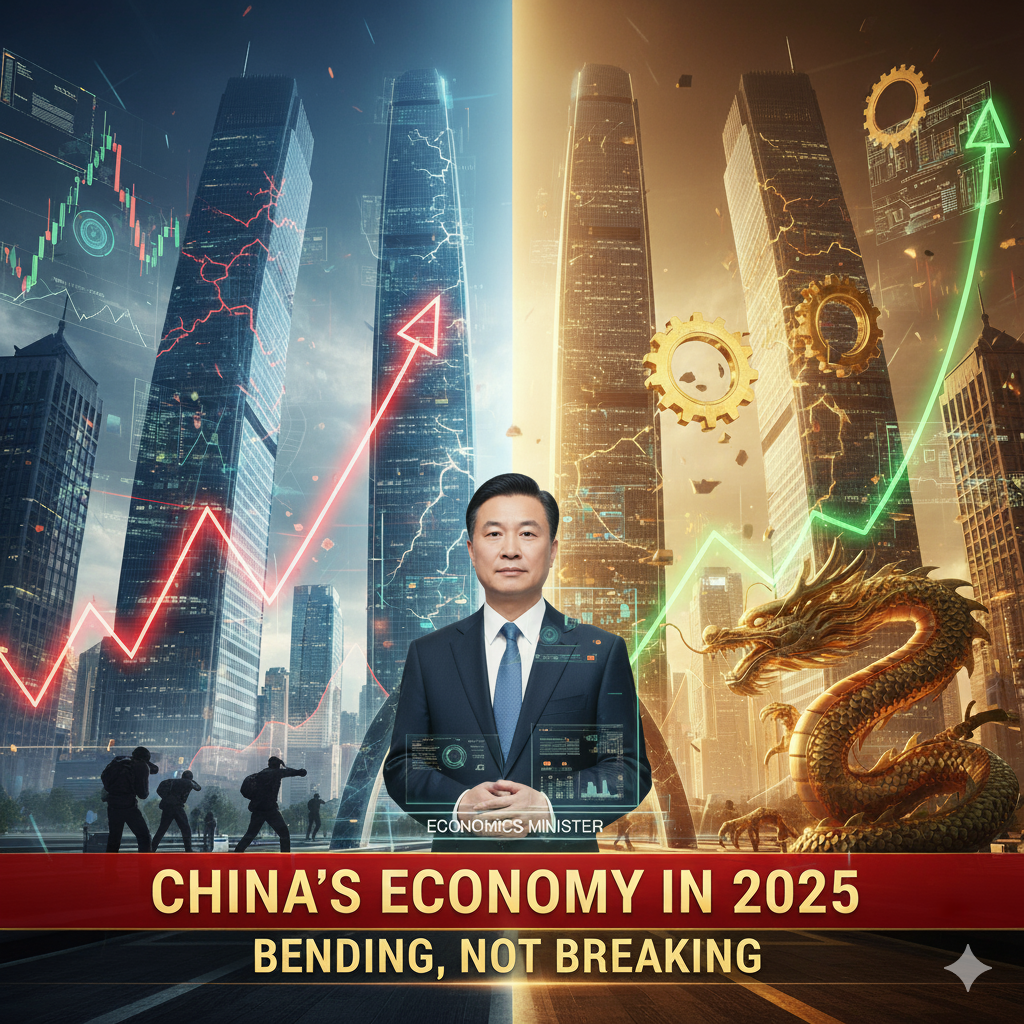
Growth slowed to 4.8 percent in Q3 2025 as property stress, local debt, weak prices, and tariff pressure weighed on demand. Beijing is focusing on targeted easing and industrial upgrades to maintain stability.
Beijing | November 2025
China’s economy continues to expand, but the pace is slower than last year. Official data show that GDP grew 4.8 percent year on year in the third quarter, down from 5.2 percent in the second. Analysts say this slowdown reflects a long property slump, weak consumer spending, and ongoing trade friction with the United States. Even so, Beijing remains confident that growth will stay close to its five percent target for 2025.
Property Shock Continues to Depress Confidence
Real estate once made up a quarter of total output and remains the main store of household wealth. The sector’s slump has lasted several years, intensified by court-ordered liquidations and frozen trading in major developers. The result is deep caution among homebuyers and investors.
Falling property prices encourage higher savings and lower spending, which weakens domestic demand. Although authorities have approved new lending programs and expanded project “whitelists,” progress is slow. Many families prefer to wait before buying, which limits the recovery in confidence.
Local Government Debt Has Become a Key Risk
Local Government Financing Vehicles (LGFVs) were created to fund infrastructure projects when official borrowing limits were tight. They now face severe pressure. Land-sale revenue, once their main funding source, has dropped sharply.
Independent research estimates total LGFV debt at more than 78 trillion yuan, about 58 percent of China’s GDP. Central programs and state bank support have so far contained defaults, but banks are carrying the burden through thinner profit margins and weaker balance sheets.
This financial stress adds another layer of risk to the economy. In simple terms, local debt problems mean less money for new investment and slower support for small businesses.
Deflation Adds to the Challenge
Prices across many sectors are barely rising, and some are falling. Economists call this disinflation—a sign that companies struggle to raise prices or wages. When prices stay low, profits shrink, and governments collect less tax.
As a result, households save more and spend less. This makes it harder for China to shift from investment-led growth to a consumption-driven model. Policymakers are responding with small interest rate cuts and liquidity injections, hoping to keep credit available while avoiding a return to risky real estate lending.
Global Headwinds Are Growing
Trade tensions remain a major challenge. Tariffs and technology restrictions continue to reshape supply chains. The average U.S. tariff on Chinese goods stood above 50 percent in mid-2025, while China’s own duties on U.S. imports averaged around one-third. These policies have reduced two-way trade and pushed Chinese exporters to seek new markets.
Exports to the United States have fallen, but shipments to ASEAN and Europe have increased. Still, global demand remains uneven, and rising trade barriers limit how much exports can help offset domestic weakness.
New Productive Forces Offer Partial Relief
Beijing’s strategy now focuses on what officials call “new productive forces.” This includes electric vehicles, batteries, and solar energy components. These industries support manufacturing and jobs and help offset some losses from construction.
However, the rapid buildup in production has led to overcapacity. When factories make more than markets can absorb, prices fall and profit margins shrink. Therefore, China’s challenge is to direct investment toward efficient, high-value firms while preventing a new round of industrial oversupply.
What to Watch Next
- Housing recovery: monitor completion rates of pre-sold homes and any signs of price stability in major cities.
- Debt management: track the rollout of local debt swaps and bank capital buffers to reduce off-budget borrowing.
- Consumer demand: follow retail sales and service activity to gauge spending momentum.
- Trade relations: watch for durable tariff adjustments or new supply-chain deals outside the U.S. market.
Outlook: Slow but Steady
China remains a slow-grind economy rather than a crisis economy. Growth is bending under pressure from property, debt, and trade, but it is not collapsing. If housing deliveries improve, local debt stays under control, and global demand steadies, China can hold near its 2025 growth target.
If not, weak prices and cautious consumers may keep the economy stuck below potential into 2026.