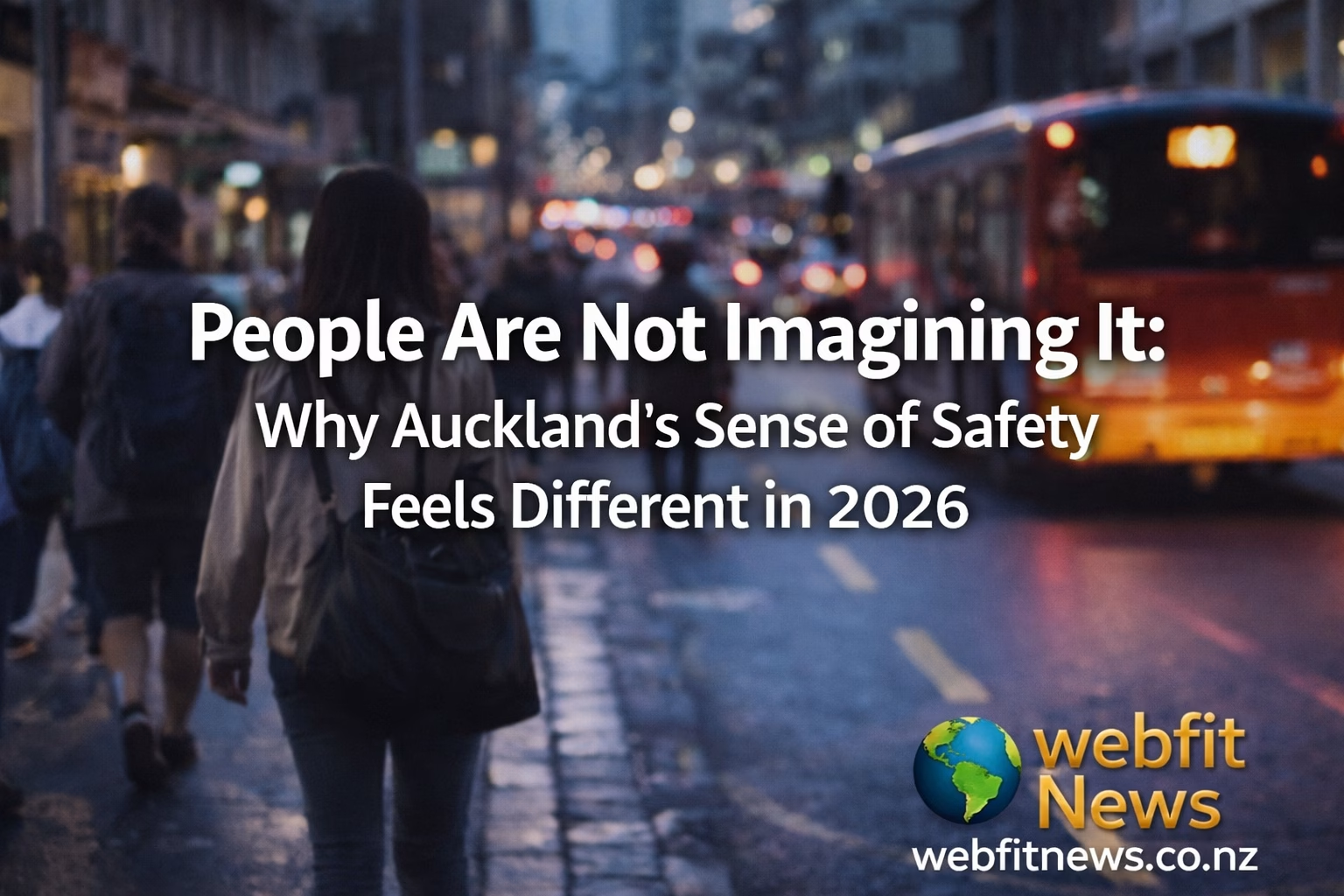
Auckland is not experiencing a crime wave in the traditional sense.
Police statistics fluctuate, headlines come and go, and official statements continue to stress that overall crime trends are complex and often stabilising.
Yet across the city, something has shifted.
People are walking faster at night.
Parents are changing school pickup routines.
Commuters are choosing different bus stops, different times, or different routes altogether.
This is not about numbers.
It is about perception. And perception drives behaviour.
How Everyday Safety Behaviour Has Shifted in Auckland
| Indicator (Public-facing, relatable) | 2023 | 2024 | 2026 | What This Suggests |
|---|---|---|---|---|
| Widespread across the city | Occasional | Common in some suburbs | Widespread across city | Safety perception now affects mobility choices |
| People are avoiding public transport late evening | Rare | Increasing | Normalised | Trust in public spaces has weakened |
| Community WhatsApp alerts about suspicious activity | Infrequent | Regular | Daily in many areas | Informal systems replacing formal reassurance |
| Retail staff leaving work in groups | Uncommon | More noticeable | Routine in CBD and malls | Workplace safety concerns extending beyond crime |
| Parents waiting closer to the school gates | Minimal | Subtle | Deliberate and planned | City navigation shaped by perceived risk |
| Near-miss incidents shared socially but not reported | Low | Rising | Very common | Gap between lived experience and official records |
| Conversations about safety framed cautiously | Open | Guarded | Self-censored | People are changing walking routes at night |
A quiet change in daily routines
Talk to Aucklanders across suburbs, income levels, and communities, and a pattern emerges.
People say they feel less safe than they did a few years ago, even if they struggle to explain exactly why. Many are careful with their words. They do not want to exaggerate. They do not want to be labelled fearful, political, or prejudiced.
So instead, they adjust quietly.
Some no longer use public transport late in the evening.
Others avoid certain streets they once walked without thinking.
Parents wait closer to school gates.
Retail workers leave together after closing time.
These are not dramatic reactions. They are subtle shifts. But taken together, they signal something deeper.
Near-miss incidents rarely make headlines
One reason this anxiety feels hard to talk about is that many of the moments driving it never become official incidents.
A confrontation that stops short of violence.
Someone followed briefly and then left alone.
A car is speeding through a red light near a bus stop.
An argument on a train platform that ends before the police arrive.
These moments rarely appear in crime reports. They are not always recorded. Yet they are remembered.
They accumulate in people’s minds and conversations, shaping how safe a place feels even when no crime is logged.
Silence around these near-miss incidents does not mean they are rare. It often means people do not know where to place them.
Public transport and public space as pressure points
Much of this unease centres around public transport corridors and shared spaces.
Bus interchanges, train stations, pedestrian crossings, car parks, and busy road edges feature heavily in conversations. These are places where people from different backgrounds and routines intersect, often briefly, often without familiarity.
For many Aucklanders, these spaces now feel less predictable.
It is not always about violence. It is about uncertainty. Loud arguments. Reckless driving. Unsettled behaviour. A sense that rules are being bent or ignored without consequence.
When public spaces feel unpredictable, people retreat. They spend less time there. They rely more on cars, companions, or avoidance.
Police reassurance versus lived experience
Police messaging in Auckland has generally focused on reassurance, data, and prevention. That approach is understandable and often necessary.
But a gap has emerged between official messaging and lived experience.
When people feel something has changed, being told that statistics do not support their concern can feel dismissive, even if the data is accurate. The issue is not whether crime is rising or falling. It is whether people feel heard.
This gap does not mean policing is failing. It does mean communication is becoming harder in a climate where perception and reality no longer align neatly.
WhatsApp groups as informal early warning systems
In many neighbourhoods, community WhatsApp and Facebook groups have quietly taken on a new role.
They are no longer just about lost pets or garage sales. Increasingly, they function as informal early warning systems.
A message about suspicious behaviour.
A note about a dangerous intersection.
A heads-up about someone causing trouble near a shop or park.
These messages spread quickly. Sometimes they exaggerate. Sometimes they calm. Either way, they shape local behaviour far more directly than official announcements.
This shift suggests a trust gap, not necessarily in police, but in the speed and relevance of formal systems.
Why does this cut across politics and identity
What makes this issue powerful is that it does not sit neatly in any political or cultural box.
It affects affluent suburbs and struggling ones.
It concerns long-time residents and new migrants alike.
It crosses age, ethnicity, and ideology.
Most people discussing it are not calling for harsh measures or dramatic policy shifts. They are asking simpler questions.
Why does the city feel less predictable?
Why do near-miss incidents feel more common?
Why is it hard to talk about safety without being misunderstood?
These are reasonable questions. Ignoring them does not make them disappear.
A city shaped by how safe it feels
Cities are not only shaped by infrastructure and policy. They are shaped by how safe people feel using them.
When perception shifts, behaviour follows. And when behaviour changes, the city itself changes.
Auckland’s quiet safety anxiety is not a crisis. But it is a signal.
If it is acknowledged, discussed honestly, and addressed without panic or denial, it can be managed. If it is dismissed or politicised, it will deepen.
People are not imagining it. Something feels different.
The challenge now is whether the city listens before those quiet adjustments become permanent habits.