SELWYN, 31 July 2026
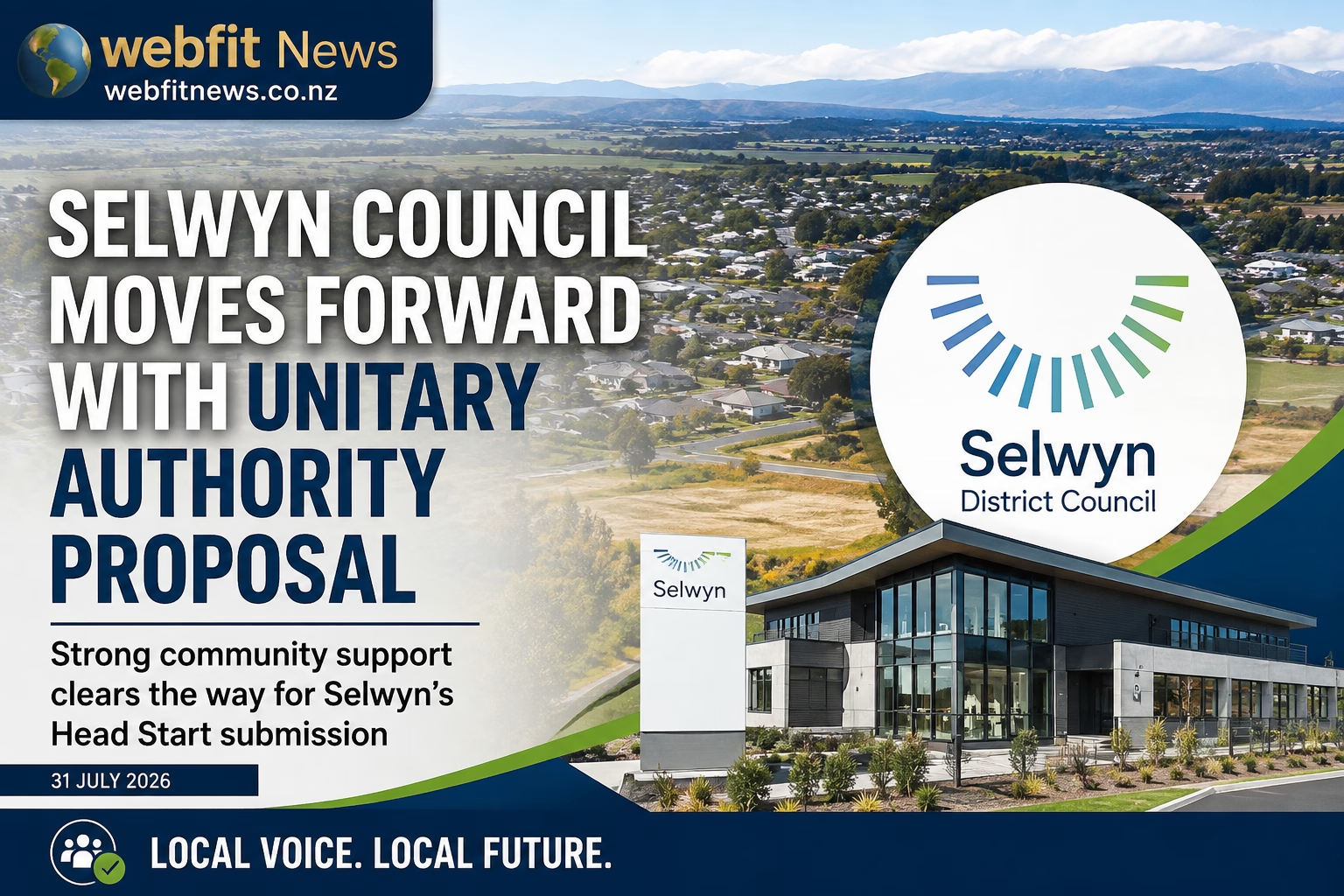
Selwyn District Council will formally progress a proposal to become a unitary authority after thousands of residents backed keeping local government decision-making within the district.
Councillors agreed at an extraordinary meeting on Thursday, 30 July to finalise and submit a Head Start proposal to the Government for consideration.
Under the proposal, Selwyn District Council would assume both district and regional council responsibilities within its existing boundaries. It would continue working with neighbouring councils on issues that cross district borders, but decisions affecting Selwyn would remain centred within the district.
The proposal does not represent a final decision on local government reform. It begins a longer process of assessment and design that could eventually lead to structural changes from the 2028 local government elections.
Community surveys shape council decision
The council’s decision followed two major rounds of community engagement that attracted nearly 11,000 responses.
The latest consultation, called What’s next, Selwyn?, received 4,035 responses between 16 and 26 July.
That followed the earlier 60 Seconds for Selwyn survey, which attracted close to 7,000 responses in June.
Selwyn Mayor Lydia Gliddon said the response demonstrated the level of public interest in the future of local government across the district.
“Nearly 11,000 responses across our two surveys shows just how much our community cares about the future of Selwyn,” Mayor Gliddon said.
“People have taken the time to share their views, and that feedback has played an important role in helping councillors make this decision.”
The consultation gave residents several possible models to consider, including a standalone Selwyn Unitary Authority and options involving neighbouring councils.
Selwyn-only model receives clear majority
The results showed 58 percent of respondents supported establishing a Selwyn Unitary Authority.
A Mid Canterbury model combining Selwyn and Ashburton councils received 24 percent support.
A larger northern Canterbury unitary authority involving Selwyn, Christchurch, Waimakariri and Hurunui councils received 18 percent.
| Proposed model | Public support |
|---|---|
| Selwyn Unitary Authority | 58% |
| Mid Canterbury Unitary Authority | 24% |
| Northern four-council authority | 18% |
The Selwyn-only option attracted more than twice the support of the Mid Canterbury proposal and more than three times the backing of the northern option.
Council analysis found that the preference for a Selwyn Unitary Authority was consistent across rural and urban communities, age groups and other demographic categories.
That broad support was important because the district includes established rural communities, fast-growing townships and areas increasingly connected to greater Christchurch.
Residents want decisions kept close to home
Independent analysis of more than 3,200 written comments identified several recurring themes among supporters of the Selwyn model.
Residents frequently referred to the importance of local decision-making, protecting Selwyn’s identity and ensuring the district’s growth was managed by people familiar with local conditions.
Other common themes included confidence in the council’s existing capability, maintaining direct local accountability and keeping Selwyn priorities at the centre of future investment decisions.
Mayor Gliddon said the feedback provided a clear direction.
“The message we’ve heard is clear. Our community wants strong local representation, local decision-making, and a future that builds on Selwyn’s strengths while ensuring we’re well placed to manage continued growth and deliver the services our communities rely on,” she said.
“People told us they value local accountability, a strong local voice and confidence in Selwyn’s ability to manage its own future.”
What would a unitary authority do?
New Zealand’s local government system generally separates responsibilities between territorial authorities and regional councils.
District councils manage services such as local roads, rubbish collection, community facilities, building control, land-use planning and local infrastructure.
Regional councils are responsible for wider environmental and resource management functions, including freshwater, air quality, regional transport planning, flood management and public transport coordination.
A unitary authority combines both sets of responsibilities within one organisation.
If Selwyn’s proposal eventually proceeds, the council would take responsibility for regional functions within its existing district boundaries as well as continuing its present district-level work.
The proposal would require detailed planning around governance, funding, staffing, environmental management, infrastructure and relationships with surrounding councils.
Growth sits at the centre of the debate
Selwyn has experienced rapid population and housing growth over recent years, particularly in Rolleston, Lincoln, Prebbleton and surrounding communities.
The district’s changing character has placed pressure on roads, water systems, schools, public transport and other services.
Mayor Gliddon said Selwyn could no longer be viewed simply as a small rural district outside Christchurch.
“Selwyn is no longer a small rural district on the edge of Christchurch. We are one of New Zealand’s fastest-growing regions,” she said.
“Our communities have told us they want decisions about that growth to remain close to home, and this proposal reflects that aspiration.”
Supporters of the unitary model believe combining district and regional responsibilities could reduce overlapping processes and allow planning decisions to better reflect local growth pressures.
However, detailed work would still be required to determine whether the model would improve services and remain financially sustainable.
Council considered taking no action
Councillors also considered the option of not submitting a Head Start proposal.
The earlier 60 Seconds for Selwyn survey found only seven percent support for the council declining to participate in the process.
Mayor Gliddon has consistently argued that Selwyn should actively shape its future rather than wait for decisions to be made elsewhere.
She said she wanted the district to be “the shaper and maker of our own destiny”.
The Head Start process allows councils to put forward local government reorganisation proposals before the Government moves further with its wider reform programme.
By submitting a proposal now, Selwyn aims to ensure its preferred model is part of those discussions.
No immediate change to council services
The council has stressed that the decision does not immediately alter governance arrangements or services.
If the Government accepts the proposal for further consideration, it would move into a detailed design process.
That stage would examine how the authority could operate, what responsibilities would transfer and how costs and services would be managed.
Further decisions and consultation would be required before any final structure was confirmed.
Changes would not be expected to take effect before the 2028 local government elections.
“This isn’t a final decision on local government reform, it’s the start of the next stage,” Mayor Gliddon said.
Relationships with neighbouring councils remain important
Although Selwyn is pursuing a standalone model, the council says it will continue collaborating with other Canterbury councils.
Regional transport, river management, civil defence, economic development and environmental issues often extend beyond council boundaries.
Mayor Gliddon said the proposal was not intended to isolate Selwyn from the rest of Canterbury.
“We’ll now work with our neighbouring councils to ensure Selwyn’s proposal can be considered as part of the Government’s Head Start process, while continuing the collaborative relationships that are so important to Canterbury,” she said.
The submission will now be finalised and sent to the Government.
For Selwyn, the next phase will determine whether strong community support for local control can be translated into a workable unitary authority model cap