AUCKLAND, 11 August 2026
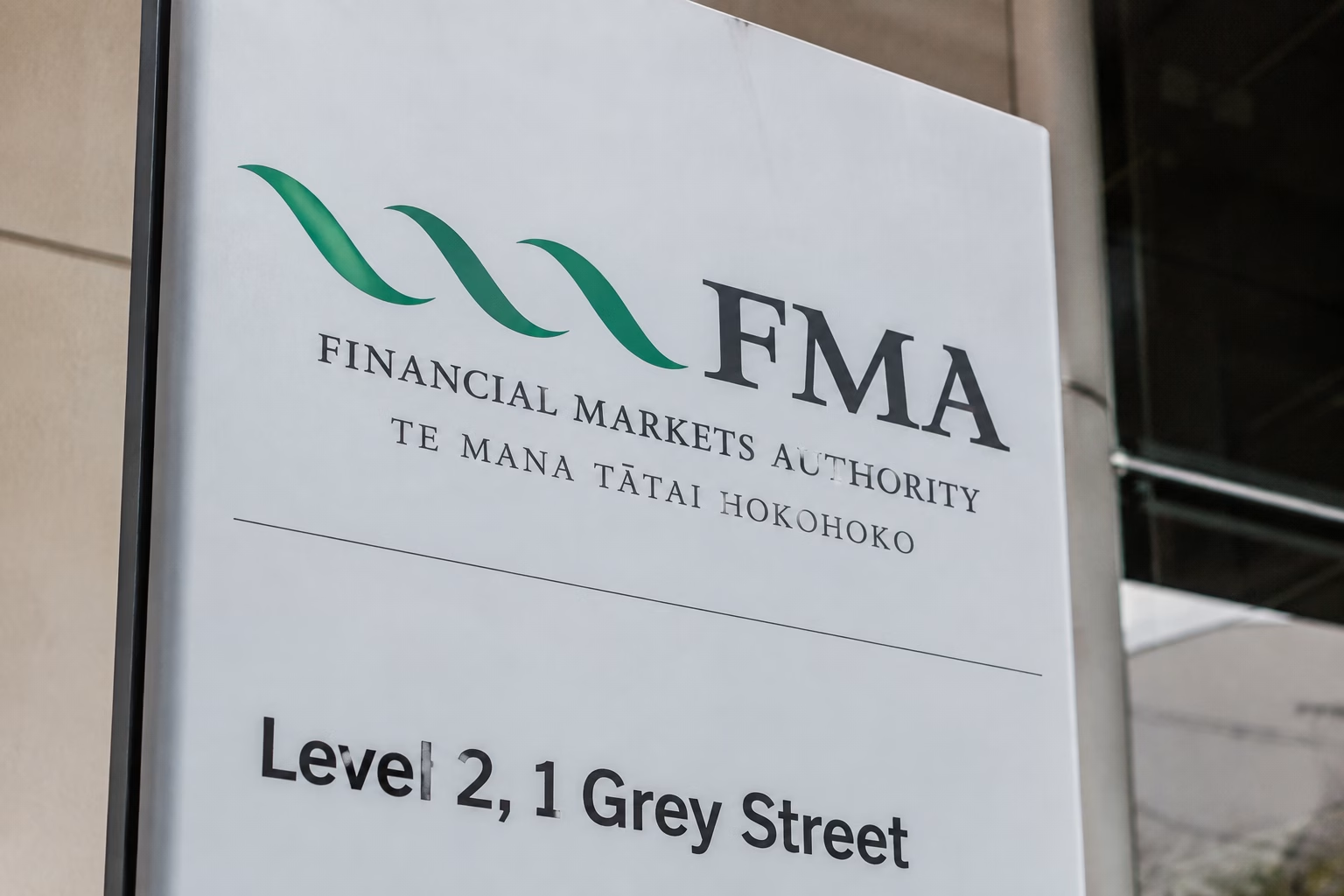
The Financial Markets Authority has secured a seven-year banning order against Peter Huljich over insider conduct connected to trading in former NZX-listed technology company Pushpay Holdings, bringing a long-running enforcement case to a close.
The High Court in Auckland made the order following Huljich’s criminal conviction for insider conduct in November 2023 and the subsequent exhaustion of his appeal process.
In a related development, the FMA has accepted an enforceable undertaking from Sarah Huljich, formerly Sarah Elder, who was Pushpay’s Head of Investor Relations at the time of the events.
She has paid $50,000 in lieu of a pecuniary penalty after admitting she ought to have known information she held was material and that she helped facilitate, and therefore encouraged, trading in Pushpay shares while possessing that information.
The FMA has now discontinued its civil proceedings against her.
Together, the two outcomes conclude the regulator’s proceedings arising from the Pushpay share sale.
What Peter Huljich is now prohibited from doing
The seven-year order is substantial, but it is important to be precise about what it means.
Huljich has been prohibited from being a director or promoter of a financial markets participant, or from being directly or indirectly concerned or involved in the management of one.
The prohibition also applies to a company that has resolved to become a financial markets participant.
The order runs for seven years from the date of his conviction, 3 November 2023, unless he obtains leave from the High Court.
That means the restriction effectively extends until November 2030.
Huljich did not oppose the FMA’s application for the banning order.
What happened in the Pushpay case?
The case goes back to events in June 2018.
According to the FMA, former Pushpay co-founder and director Eliot Crowther told individuals within the company that he was considering resigning and selling his shareholding.
The regulator considered that information to be material and not generally available to the market at the time.
That distinction sits at the heart of New Zealand’s insider trading rules.
People with access to material information that has not been made generally available cannot use their privileged position to gain an unfair trading advantage or improperly encourage others to trade.
The FMA says Huljich possessed such information and encouraged others to trade while it was unavailable to the wider market.
Importantly, Pushpay itself was not the subject of the FMA’s investigation and was not a party to the proceedings.
The FMA also confirmed that Crowther’s own share sale was lawful.
Conviction followed by appeals
Huljich was found guilty at trial in August 2023, with his conviction formally entered on 3 November 2023.
The conviction was subsequently upheld by the Court of Appeal.
An attempt to take the matter further ended when the Supreme Court declined leave to appeal in 2025.
With the criminal proceedings finally determined, the FMA returned to the High Court seeking the banning order.
The High Court judgment, delivered on 10 August 2026, accepted the seven-year prohibition sought by the regulator.
Court describes insider conduct as serious
The High Court judgment provides important context beyond the FMA’s media release.
In submissions accepted by the Court, the FMA argued that criminal insider trading is inherently serious because it undermines the integrity of New Zealand’s financial markets.
The Court noted Huljich had been convicted for advising or encouraging, in one instance, trustees of a trust to trade.
The judgment also recorded that Huljich did not disclose the material information itself.
It was also not proven beyond reasonable doubt that he advised or encouraged the trustees to trade because he was motivated by possession of that inside information.
Those qualifications matter when accurately describing the offending.
However, the jury’s verdict necessarily meant Huljich knew the information was material and knew it was not generally available to the market.
The Court referred to the Court of Appeal’s recognition that insider conduct is a form of fraud capable of undermining public confidence in the integrity of the stock market.
Previous financial markets conviction considered
The High Court also considered Huljich’s previous history involving financial markets legislation.
He was convicted in 2011 over breaches of the Securities Act 1978 relating to a family business operating a KiwiSaver scheme.
According to the latest High Court judgment, Huljich was a director of the business and promoter of eight offer documents issued by the company.
The company had entered into undisclosed transactions at undervalue, resulting in the offer documents misrepresenting the scheme’s performance.
The FMA relied on that previous conviction, along with the seriousness of the Pushpay insider conduct and other factors, when arguing that the seven-year ban was appropriate.
The Court accepted the regulator’s position.
Sarah Huljich agrees to $50,000 payment
The FMA’s action involving Sarah Huljich has ended differently.
At the time of the Pushpay events, she was Head of Investor Relations.
According to the FMA, she admitted that she ought to have known the information in question was material and that she helped facilitate, and therefore encouraged, trading in Pushpay shares while holding that information.
Under the enforceable undertaking accepted by the regulator, she has paid $50,000 in lieu of a pecuniary penalty.
The civil proceedings against her have subsequently been discontinued.
The distinction between the outcomes for Peter and Sarah Huljich is important.
Peter Huljich was criminally convicted of insider conduct and is now subject to the seven-year High Court banning order.
Sarah Huljich’s matter has been resolved through an enforceable undertaking and payment, rather than the same criminal outcome.
FMA says equal access to information is fundamental
FMA Head of Enforcement Margot Gatland said market participants must be able to trade knowing others are operating under the same rules.
“Everyone trading in our markets is entitled to do so on the same footing, without others acting while holding information the market doesn’t have,” Gatland said.
She said Huljich possessed information that was not generally available and encouraged others to trade while holding it.
“The seven-year ban that now concludes the FMA’s proceedings over the Pushpay share sale is a significant consequence,” Gatland said.
“With Ms Huljich’s enforceable undertaking, this matter is at an end.”
Why insider conduct matters to ordinary investors
Insider trading can sound like a highly technical area of financial law, but the principle behind it is straightforward.
A functioning sharemarket depends on investors believing they are participating in a reasonably fair marketplace.
Company directors, executives, employees, advisers and others can sometimes obtain significant information before ordinary shareholders know about it.
That could include information about a takeover, major contract, financial result, executive departure, capital raising or another development capable of influencing a company’s share price.
Possessing confidential information is not itself necessarily wrongdoing.
The problem arises when material, non-public information is improperly used for trading or to encourage someone else to trade.
If investors believe people with privileged access can exploit information before everyone else receives it, confidence in the market suffers.
That is why insider conduct attracts serious regulatory and potentially criminal consequences.
Pushpay itself has since left the NZX
The company at the centre of the historical events is no longer publicly traded.
Pushpay, a New Zealand-founded technology business providing software, payments and digital services primarily to churches and faith-based organisations, was acquired in 2023 through a scheme involving BGH Capital and Sixth Street.
After an initial takeover proposal failed to secure sufficient shareholder support, an improved offer of $1.42 per share was subsequently approved.
The transaction was implemented in May 2023, after which Pushpay ceased trading and was delisted from the NZX and ASX.
The insider conduct case concerned events from 2018 and was separate from that later acquisition.
Webfit News perspective: market confidence depends on equal rules
This case is significant beyond the individuals involved.
New Zealand’s capital markets depend heavily on trust.
Retail investors cannot sit inside boardrooms, attend executive meetings or see confidential company correspondence. They depend on continuous disclosure rules and market regulation to ensure price-sensitive information reaches the market appropriately.
That creates an unavoidable information imbalance between insiders and ordinary investors.
Financial markets law exists to prevent that legitimate access to confidential information becoming an illegitimate trading advantage.
At the same time, enforcement reporting needs precision.
A banning order is not evidence that every allegation made during a case was proven. Nor should related individuals or the company itself be treated as responsible simply through association.
In this matter, the FMA expressly states that Pushpay was not the subject of its investigation and was not a party to the proceedings, while Crowther’s own share sale was lawful.
Those distinctions are important.
So is the final outcome.
Peter Huljich has exhausted the appeal process against his insider conduct conviction and is now prohibited from participating in the management of financial markets participants for seven years from his conviction date.
Sarah Huljich has resolved the civil action against her through an enforceable undertaking and $50,000 payment.
For the FMA, the Pushpay proceedings are now finished.
For New Zealand investors, the broader message remains relevant long after the case closes: access to privileged information carries responsibility, and confidence in financial markets depends on everyone being expected to play by the same rules.