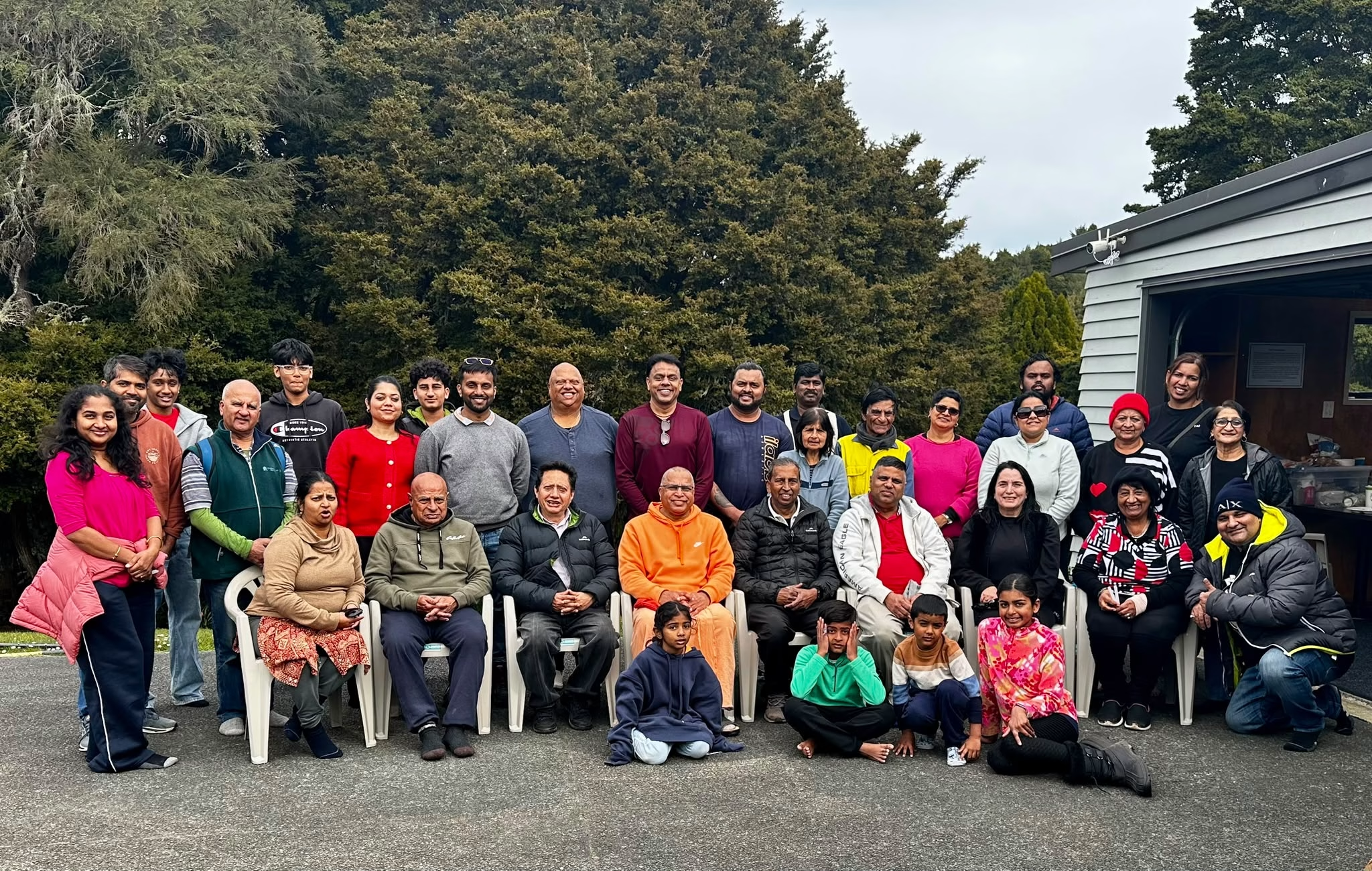

By Om Jha
Business Coach and International Motivational Speaker
Published by Webfit News as a contributed community perspective
For generations, migration has shaped the lives of millions of Bihari families.
People have left villages, towns and cities across Bihar in search of education, employment, security and a better future. Many have built successful careers across India and overseas, but that success has often carried an emotional cost.
Business coach and international motivational speaker Om Jha believes it is time for the global Bihari community to turn that shared experience into practical action.
In his reflections, Jha describes the pain of leaving home not simply as an economic issue, but as a deeply personal reality affecting parents, children and entire families.
“No one willingly leaves their home, parents, friends and childhood memories,” he writes. “People leave because they have no choice.”
His message is direct: Bihar does not lack talent. It lacks enough local opportunities to allow that talent to grow without being forced to migrate.
A Personal Story Rooted in Bihar
Jha traces his connection to Mithila Dham in Bihar, a region widely known for its history, farming traditions, scholarship, language and cultural heritage.
Although he was born and raised in Delhi, Bihar remained central to his identity.
His father, like countless other Biharis, left his village because there were not enough opportunities to earn a dignified livelihood. Despite building a life in the city, Jha says his father continued to carry a deep longing for his village, childhood friends and the fields where he had grown up.
To ensure his children remained connected with their roots, his father took Jha and his two elder sisters back to the village every year.
Those visits became more than family holidays.
They connected the children with their identity, family history and cultural foundations.
After travelling across different countries and experiencing different cultures, Jha says he still carries the pain of the child whose family had to leave its homeland because opportunity was missing.
That experience has shaped his long-term vision for Bihar.
Why Migration Hurts Beyond Economics
Migration is often explained through employment figures, income levels and urbanisation data.
For families, however, its impact is far more personal.
It can mean missing a parent’s ageing years, watching a village change through photographs, celebrating Chhath Puja through video calls and being absent when younger siblings or relatives need support.
A migrant may become financially successful while still feeling emotionally distant from home.
According to Jha, migration has created opportunities for millions of Biharis, but it has also demanded sacrifices that cannot be measured in money.
His goal is not to stop migration entirely.
Migration is a natural part of a connected world. People should be free to travel, study, work and explore opportunities anywhere.
The real objective, he argues, should be to make migration a choice rather than a necessity.
A young person should leave Bihar because they want to explore the world, not because survival demands it.
Development Must Reach Rural Bihar
Jha questions how development should be measured.
Roads, bridges, airports, buildings and government schemes are important, but they do not automatically create meaningful change in people’s daily lives.
For him, real development is visible when villages generate sustainable employment, farmers earn with dignity, young people find opportunities locally and families are not separated by economic compulsion.
He is particularly focused on rural Bihar.
His vision is not limited to development in major cities or through headline infrastructure projects. He wants villages to become places where people can build successful lives without being forced to leave their homes.
Jha raises a difficult but necessary question: have development schemes and programmes genuinely created lasting opportunities on the ground, or have they sometimes produced prominent individuals and public recognition without resolving deeper structural problems?
He stresses that this question is not intended as an attack on any person, government or organisation.
Instead, he wants an honest conversation that leads to practical solutions.
Employment as the Greatest Social Reform
One of the strongest arguments in Jha’s message is that employment is the most powerful form of social development.
Employment creates dignity.
It strengthens families, improves access to education and healthcare, reduces distress migration and gives young people hope.
A single entrepreneur may employ ten people. Ten entrepreneurs may support one hundred families. Thousands of entrepreneurs, working across districts, can reshape an entire regional economy.
This is why Jha believes entrepreneurship should sit at the centre of Bihar’s development strategy.
Agriculture, food processing, tourism, healthcare, education, manufacturing, renewable energy, technology and digital services all offer potential areas for investment and job creation.
Remote employment also presents a major opportunity.
Companies based in India or overseas can employ skilled professionals living in Bihar, allowing people to earn globally competitive incomes while remaining close to their families.
The Strength of the Global Bihari Community
Biharis living outside the state have accumulated experience, capital, skills and professional networks across the world.
They work as doctors, engineers, teachers, bankers, lawyers, researchers, IT professionals, hospitality leaders, business owners and entrepreneurs.
Jha believes even a small portion of this collective strength could have a significant impact if directed towards Bihar in a coordinated way.
He proposes several practical areas for action:
- Building a structured global network of Bihari professionals, investors and entrepreneurs
- Mentoring students and young professionals
- Supporting startups through guidance, seed funding and partnerships
- Creating remote employment opportunities
- Helping educational institutions align courses with industry needs
- Supporting women-led enterprises
- Connecting Bihar’s products and services with international markets
- Encouraging investment in scalable local businesses
- Establishing an annual Global Bihar Development Summit
- Creating a non-political Bihar Employment Mission
The emphasis is not only on large donations or major investments.
A professional who gives a few hours each month to mentor students can make a difference. A business owner who hires one remote worker in Bihar can support an entire family. An investor who helps a small enterprise scale can create jobs for dozens of people.
Collective impact often begins with small, consistent actions.
A Role for Biharis in New Zealand
Jha also sees significant potential within the Bihari community in New Zealand.
New Zealand has experience in agriculture, dairy technology, education, sustainability, innovation and entrepreneurship. These are areas where cooperation and knowledge exchange could support Bihar’s development.
Possible initiatives could include business delegations, educational partnerships, agricultural innovation programmes, startup exchanges and professional mentoring.
The Bihari community in New Zealand may be smaller than diaspora communities in some other countries, but its skills, networks and willingness to contribute could make it influential.
The challenge is not a lack of ideas.
It is the need for coordination, commitment and measurable goals.
Moving Beyond Nostalgia and Debate
Biharis around the world often remain emotionally connected to their home state.
They celebrate festivals, preserve languages, share memories and support relatives. But Jha argues that emotional attachment must now evolve into structured participation.
Nostalgia alone will not create employment.
Political arguments alone will not strengthen rural economies.
Social media debates alone will not build institutions.
His call is for the community to create businesses, support skills, develop networks and invest in people.
Success abroad should not only be measured by personal income, professional titles or social status. It should also be measured by what individuals help create for the communities from which they came.
A Call for Action
Jha’s message is ultimately one of responsibility and hope.
The question is no longer whether Bihar has potential. Its people have demonstrated their ability across India and around the world.
The question is whether global Biharis are ready to become active partners in Bihar’s transformation.
He wants future generations to inherit a Bihar where staying close to family does not mean giving up professional ambition.
That dream requires more than slogans.
It requires investment, mentorship, employment, entrepreneurship and long-term institution building.
As Jha writes, history remembers communities that build.
His appeal is for this generation of global Biharis to be remembered not simply for succeeding away from home, but for helping create opportunity back home.
Because no Bihari should have to leave simply to survive.
About the Author
Om Jha is a business coach and international motivational speaker whose work focuses on leadership, entrepreneurship, rural development and community empowerment. Drawing from his family’s migration journey and his connection with Mithila and Bihar, he advocates practical, employment-led development and stronger participation from the global Bihari diaspora.
Webfit News Community Partnership
As an official media partner of Bihar Jharkhand Sabha Australia and New Zealand, Webfit News is pleased to provide a platform for thoughtful community voices. Publishing perspectives such as this helps encourage constructive discussion about identity, migration, development and the role of the global Bihari community.
Editorial note: This article is based on contributed writings by Om Jha and represents the author’s personal views and development proposals.