By WebFit News Desk
Auckland, New Zealand
Published: 29 December 2025
As New Zealand edges toward 2026, the country continues to describe itself with familiar words. Safe. Sensible. Low-risk. High-trust.
Those labels have served us well. But they may also be blinding us.
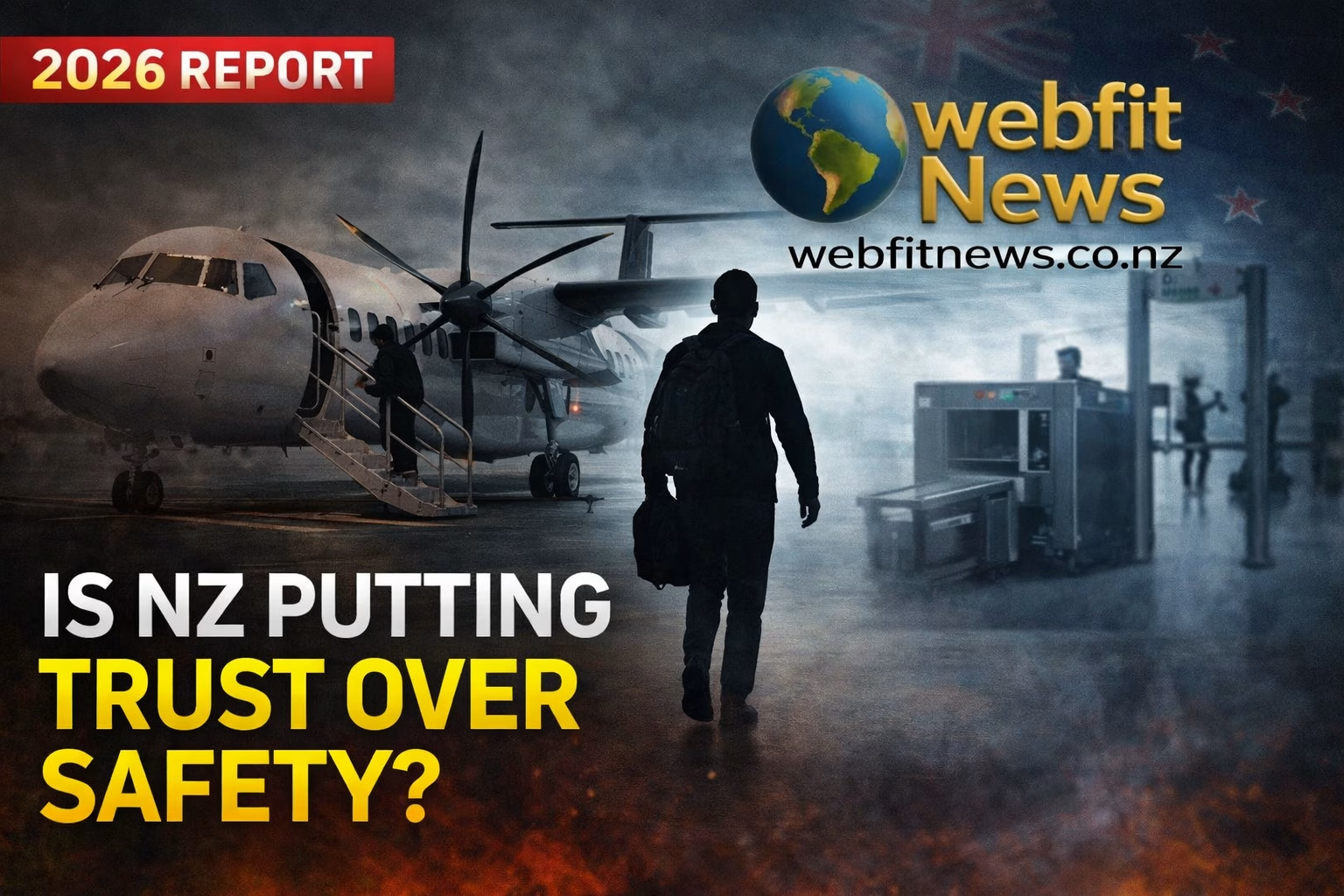
Nowhere is this more evident than in domestic aviation, where New Zealand operates one of the least screened commercial flight systems in the developed world. For years, the absence of routine security checks has been framed as efficiency, culture, or even quiet confidence.
The harder truth is this.
It is also a gamble.
The Comfort of Familiar Systems
Most Kiwis have never questioned domestic air travel. You walk into a regional airport, board a plane, and take off without passing through metal detectors or bag scanners.
It feels normal because it has always been normal.
However, systems that feel normal are often the hardest to examine. Especially when they are built on trust rather than verification.
New Zealand’s aviation security model was shaped by a different era. A time when threat assessments focused on aircraft size, physical infrastructure damage, and cost containment. A time when risk was measured statistically rather than socially.
That logic still underpins today’s regulations.
Flights operated by aircraft with fewer than 90 seats remain largely exempt from security screening. This threshold has not meaningfully changed in almost two decades, despite explicit government reviews acknowledging the risks.
The Warning That Did Not Lead to Change
In 2008, New Zealand experienced what should have been a turning point.
A regional Air New Zealand flight from Blenheim to Christchurch was attacked from inside the cabin. A passenger stabbed the pilots in an attempted hijacking. The aircraft landed safely, but only because of quick thinking and luck.
A subsequent government review in 2009 identified unscreened regional flights as a high-risk environment.
The finding was clear.
The response was not.
Despite the acknowledgement, the regulatory framework remained largely untouched. The risk was documented, then quietly absorbed back into the system.
The question is not why nothing happened next year, or the year after that.
The question is why nothing happened at all.
Risk Has Shifted, But Policy Has Not
New Zealand’s aviation security rules were never designed around lone-actor violence, mental health crises, or spontaneous acts of harm.
Yet those are precisely the risks dominating global aviation incidents today.
Modern threats do not require explosives, complex planning, or international coordination. They require access, proximity, and opportunity. Domestic flights offer all three.
Security experts increasingly warn that relying on a low historical incident rate is not risk management. It is probability blindness.
The absence of incidents does not mean a system is safe. It often means it has not yet been tested.
The Cost Argument Is No Longer Simple
For years, cost has been the quiet veto.
Regional airports operate on tight margins. Communities rely on affordable air links. Adding security infrastructure has been framed as an unacceptable financial burden.
But that calculation is changing.
Domestic aviation security levies are already projected to nearly double by mid-2025, rising from around six dollars per passenger to close to eleven dollars. The cost is increasing regardless.
At the same time, new “frictionless” screening technologies are reshaping what security looks like. Walk-through sensors. AI-assisted detection. Systems that allow laptops and liquids to remain in bags.
Security no longer automatically means queues, delays, or airport theatre.
The real cost question has shifted from “Can we afford security?” to “What are we paying for by avoiding it?”
A Public More Comfortable Than the Evidence
Surveys consistently show high passenger satisfaction with New Zealand’s current aviation security approach. Most travellers feel safe.
That comfort is genuine. But it may also be misleading.
People tend to assess safety emotionally, not structurally. We trust what feels familiar. We underestimate risks that do not interrupt our routines.
Meanwhile, political pressure is moving in the opposite direction. Officials and aviation bodies increasingly view the current system as outdated, inefficient, and misaligned with modern threat assessments.
This disconnect between public perception and institutional concern is widening.
Are We an Outlier, or Just Late?
New Zealand often frames itself as unique. Sometimes rightly.
But when compared with similar island nations and regional aviation systems overseas, the picture becomes uncomfortable. Many countries with comparable rural routes and small aircraft have already introduced scaled or selective screening models.
They did not do so because they were attacked.
They did so because they asked what would happen if they were.
New Zealand has not yet asked that question seriously enough.
Trust Is Not a Security Strategy
This debate is often framed as freedom versus fear. That framing is too simple.
The real tension is between trust and responsibility.
Trust is a strength. But trust without safeguards is not confidence. It is exposure.
A system that relies on hope, goodwill, and luck may function smoothly for years. But when it fails, it fails catastrophically.
And aviation is unforgiving of first mistakes.
The Choice Ahead
As 2026 approaches, New Zealand faces a decision it can no longer postpone.
Does it continue to treat domestic aviation as an exception to modern security thinking?
Or does it design a uniquely Kiwi upgrade that respects trust while acknowledging reality?
This is not about importing overseas paranoia.
It is about recognising that the world has changed, even if we would prefer it had not.
The most dangerous assumption New Zealand can make is that the future will resemble the past.
The WebFit News View
New Zealand’s domestic aviation system is not broken.
But it is ageing.
It was built for a high-trust world that no longer exists in the same form. Maintaining it unchanged is not an act of confidence. It is an act of deferral.
The debate is no longer whether security should increase.
It is whether New Zealand chooses to modernise thoughtfully or waits until an incident forces its hand.
In aviation, prevention is invisible. Failure is not.
And in 2026, invisibility is no longer a defence.
A practical note for readers
As New Zealand heads into 2026, many households are also reassessing something far more personal than aviation policy. Their finances.
If you are trying to understand your mortgage repayments without the noise of talking to multiple brokers or being pushed into sales conversations, KiwiHelp offers a simple, free mortgage calculator designed for everyday Kiwis. It lets you explore repayments, interest impacts, and scenarios at your own pace, with no pressure and no jargon.
You can access the tool here:
https://www.kiwihelp.co.nz/renting-housing/mortgage-calculator