
Introduction
On the evening of Sunday, 14 December 2025, Bondi Beach ceased to be just a postcard symbol of Australian life. During the “Chanukah by the Sea” celebration at Archer Park, a father and son opened fire on families gathered to mark the Jewish festival of Hanukkah. Within minutes, 15 people were dead, and dozens were injured. The massacre became the deadliest mass shooting in Australia since Port Arthur in 1996, abruptly ending nearly three decades of confidence in the nation’s gun control framework.
Beyond the immediate horror, the Bondi Beach attack has triggered a profound national reckoning. It has reshaped Australia’s political agenda, exposed intelligence and licensing failures, reignited debates over gun ownership, and strained the already fragile bonds of multicultural cohesion.
What Happened and Where
The attack occurred at Archer Park, a grassy area adjacent to Bondi Beach that regularly hosts community events. Hundreds of people, including elderly Holocaust survivors, young families, and tourists, had gathered for an open, family-friendly Hanukkah celebration organised by Chabad of Bondi.
At approximately 6:43 pm, gunfire erupted from a pedestrian footbridge overlooking the park. One attacker fired from an elevated position into the crowd, while the second moved along Campbell Parade toward fleeing civilians. Panic spread rapidly as people ran for cover or toward the shoreline.
Police responded within minutes. One attacker was fatally shot at the scene. The second was critically wounded and taken into custody. By 6:50 pm, the immediate threat had ended, but the damage was irreversible.
Who Was Involved
Authorities later identified the attackers as a father and son, Sajid Akram, 50, and Naveed Akram, 24, residents of Sydney’s southwest. Investigators confirmed that several firearms used in the attack were legally owned under a New South Wales firearms licence.
The case raised urgent questions about how an individual with lawful access to multiple firearms could share a household with a previously flagged extremist without triggering safeguards. While intelligence agencies had previously assessed the younger attacker as low-risk, the absence of real-time coordination between federal intelligence and state licensing systems proved critical.
The Human Cost
Among the victims were children, elderly community volunteers, and survivors of historical atrocities who had sought safety in Australia decades earlier. For the Jewish community, the attack carried deep symbolic trauma, transforming a celebration of faith into a site of mass death.
Dozens of survivors now face long-term physical recovery and psychological trauma. Mental health services across New South Wales were expanded within days, particularly for children who witnessed the violence.
A Moment of Courage
Amid the chaos, one act of extraordinary bravery altered the trajectory of the attack. Ahmed al-Ahmed, a Syrian-born Australian refugee, intervened after seeing one gunman advancing toward the crowd. Using parked vehicles for cover, he tackled and disarmed the attacker at close range.
Al-Ahmed was shot during the intervention but survived. His actions are widely credited with saving lives and preventing further casualties. His story became a powerful counter-narrative to the hatred that drove the attack, highlighting the complexity of identity and courage within Australia’s multicultural society.
Political and Legal Fallout
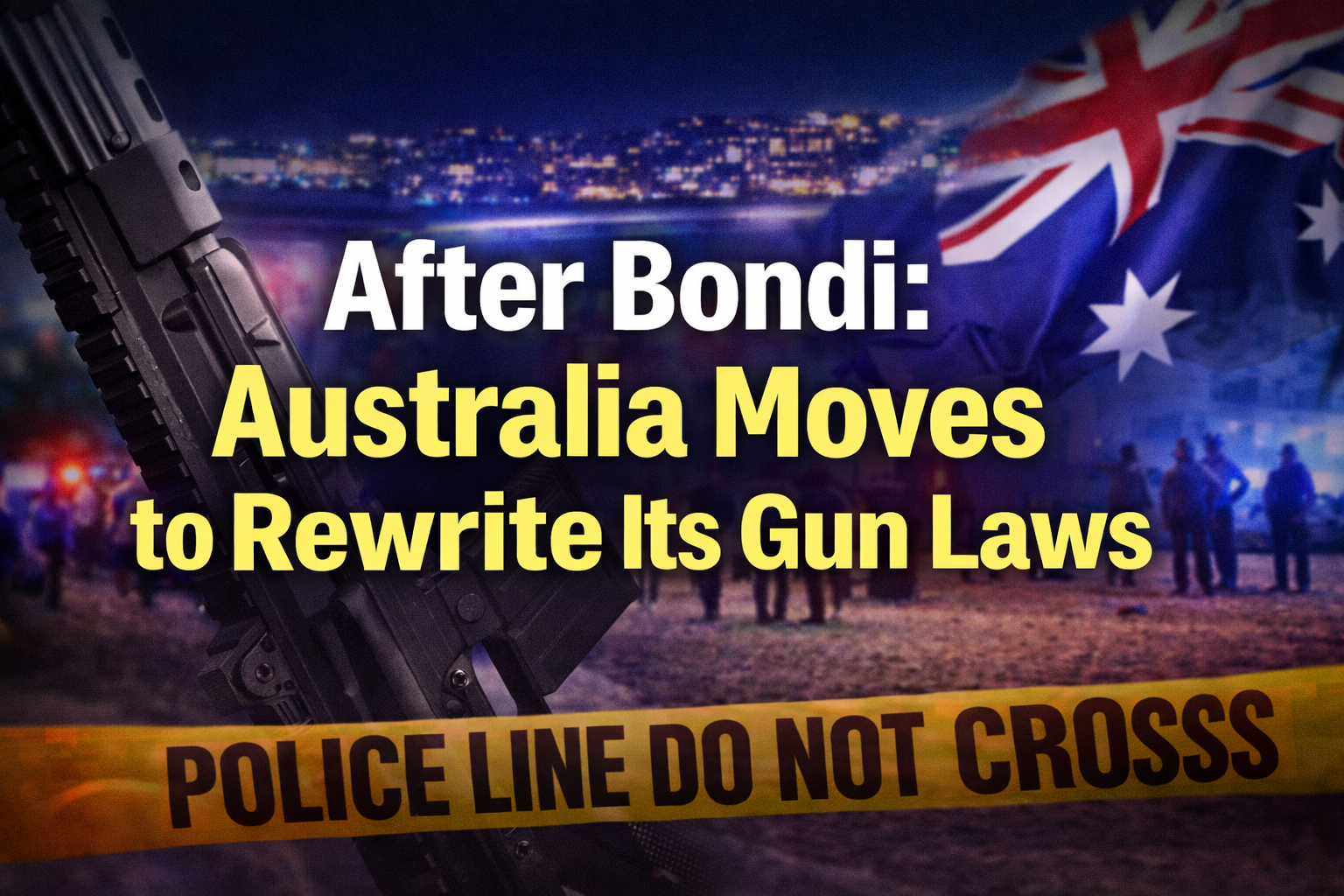
Within days, Prime Minister Anthony Albanese announced the most significant overhaul of Australia’s firearm regulations in a generation. Central to the response was a new National Gun Buyback Scheme, designed to remove hundreds of thousands of firearms from civilian circulation.
Key reforms under consideration include:
- Limits on the number of firearms an individual may own
- Expanded bans on high-powered and rapid-fire weapons
- Accelerated creation of a national firearms register
- Tighter eligibility and review standards for licensing
The government argues that gun ownership has become increasingly concentrated, with fewer people holding more weapons, often in urban settings. According to international estimates, Australia currently has roughly 14 to 15 civilian firearms per 100 people, compared with New Zealand’s estimated 26 per 100.
Opposition has been fierce. Rural MPs, shooting groups, and right-wing populists argue the reforms punish law-abiding owners rather than addressing extremist ideology. Internal dissent has also emerged within the governing party, underscoring how politically volatile gun reform remains.
Public Sentiment and Social Strain
Public reaction has been complex. Vigils and memorials across Sydney and beyond reflected deep solidarity, with thousands gathering at Bondi Beach in silence. Donations for victims and first responders surged, as did public expressions of unity across religious lines.
At the same time, the attack intensified polarisation. Small but vocal nationalist rallies framed the tragedy through immigration and identity politics, prompting condemnation from political leaders and community organisations. Authorities warned against exploiting grief to inflame division.
The New Zealand Perspective
Across the Tasman, the attack resonated strongly. New Zealand leaders referenced their own experience with mass violence, particularly the 2019 Christchurch mosque attacks. Security was visibly increased around Jewish sites, and political leaders reaffirmed their commitment to strict firearm controls.
The comparison reinforced a shared regional reality: geographic isolation no longer guarantees immunity from global ideological violence.
Conclusion
The Bondi Beach attack marked a turning point for Australia. It shattered assumptions about safety, exposed systemic weaknesses, and forced a reassessment of how guns, intelligence, and social cohesion intersect in a modern democracy.
Whether the policy response ultimately prevents future tragedies remains uncertain. What is clear is that Australia has entered a new era, one in which vigilance, accountability, and social responsibility will be tested repeatedly.
Bondi Beach remains beautiful. But the sense of effortless security it once symbolised has been permanently altered.