Auckland, 13 August 2026
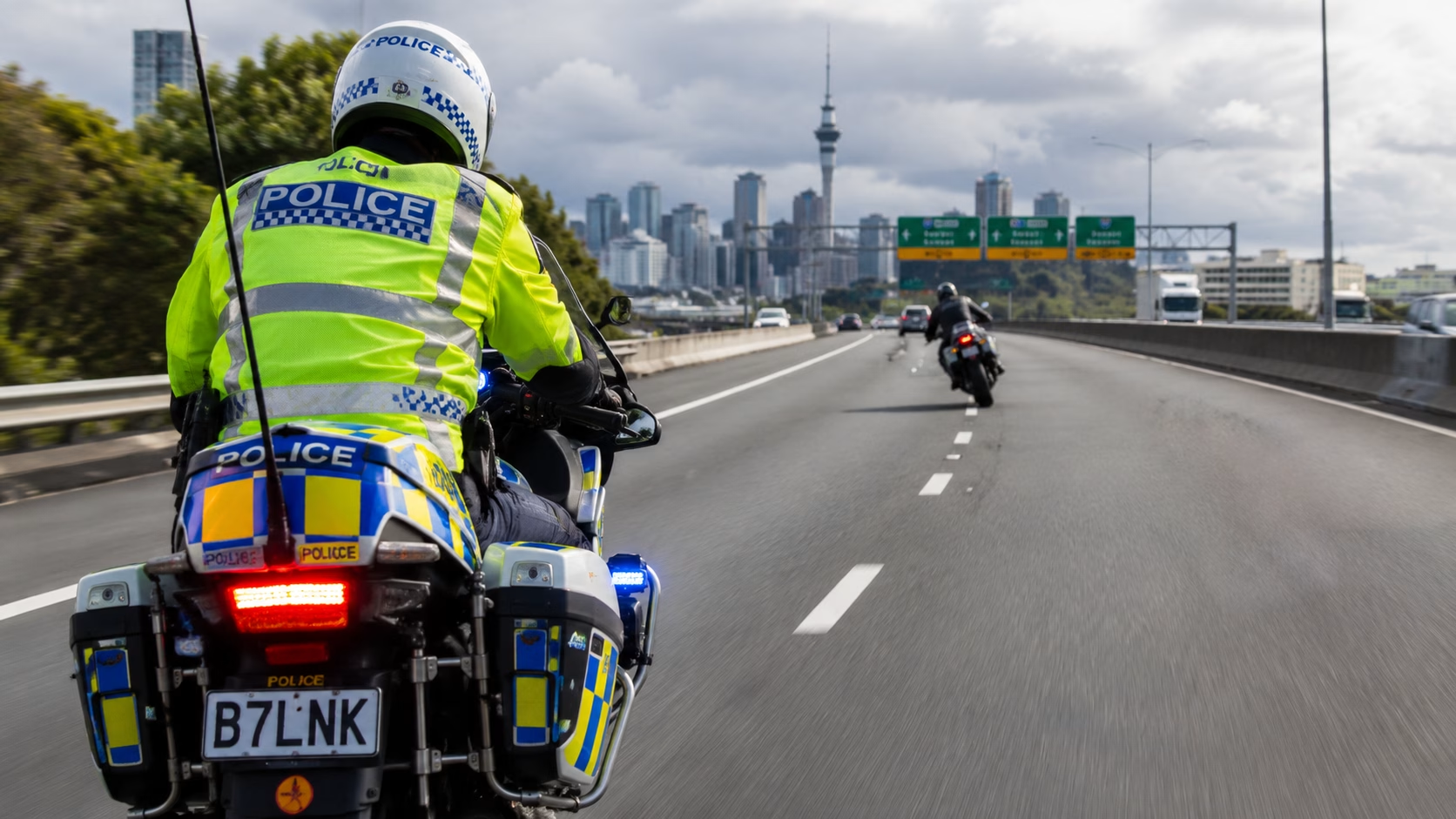
An Auckland Police motorcycle officer pursued a Ducati rider at speeds reaching about 192km/h despite having no working radio communication with Police command, in a pursuit the Independent Police Conduct Authority says was unjustified from the beginning and should have been abandoned soon after entering the motorway.
The motorcyclist died after crashing into a lamppost near Tauhinu Road in Greenhithe following an almost 11km pursuit through State Highways 16 and 18 on the morning of 13 July 2023.
Three years later, the IPCA has released its detailed findings after court proceedings and an internal Police employment process were completed.
Its conclusion is severe.
The Authority found the officer was not justified in initiating the pursuit, failed to comply with Police fleeing-driver policy, seriously misjudged the risks involved and continued following the rider at extremely high speeds despite having no communication with the Police Communications Centre.
The IPCA also found the officer’s actions were a “material contributing factor” to the fatal crash.
New Zealand Police have accepted the findings.
What began at a Henderson checkpoint
At approximately 10.10am on 13 July 2023, the Police motorcycle officer, identified in the IPCA report as Officer A, was helping at a road policing checkpoint near Lincoln Road and Universal Drive in Henderson.
Traffic was heavy and slow-moving.
Officer A noticed a red Ducati motorcycle moving between vehicles.
He told investigators that he recognised the motorcycle from previous occasions and believed he had previously seen it being ridden quickly, passing between vehicles and using motorway ramps to get around traffic.
However, there was a significant problem with that assumption.
The IPCA later established that the rider who died, referred to as Mr Z, had owned the Ducati for only five months.
Officer A had been associating the motorcycle with behaviour he believed he had witnessed over roughly three years.
Two other officers at the checkpoint also saw the Ducati moving through traffic. They estimated its speed at only about 15 to 30km/h and did not consider what they observed to constitute an offence.
Available CCTV footage, according to the IPCA, showed the Ducati travelling at a similar speed to the vehicle ahead of it.
The Authority concluded that the rider’s behaviour at the checkpoint was not posing the kind of immediate threat that justified a pursuit.
The officer was legally entitled to ask the rider to stop
The IPCA made an important distinction.
Officer A was legally entitled to signal the motorcyclist to stop.
Police have powers under the Land Transport Act to require drivers to stop and provide identification.
The problem was what happened after that.
Officer A followed the Ducati with his Police motorcycle’s lights and siren activated.
At one stage, Mr Z stopped behind another vehicle near the Lincoln Road motorway interchange.
Officer A pulled in behind him.
According to the officer, there was eye contact between the two men and he attempted through gestures to indicate that Mr Z should pull over.
The rider then moved around the vehicle ahead and entered the State Highway 16 on-ramp.
Officer A followed.
That decision became the critical turning point.
IPCA says it became a pursuit
Officer A maintained that he did not consider himself to be pursuing a fleeing driver.
The IPCA rejected that interpretation.
The Authority said the circumstances clearly amounted to a pursuit.
The Police motorcycle followed the Ducati for almost 11 kilometres, sometimes at close range, at very high speeds, with emergency lights and siren operating for much of the journey.
Police policy required the officer to consider whether the immediate safety risk created by the fleeing driver was serious enough to justify continuing.
The IPCA concluded that it was not.
According to the Authority, the alleged offending was not serious enough to outweigh the danger created by the pursuit itself.
Within metres of each other entering SH16
CCTV footage provided investigators with a picture very different from parts of the officer’s recollection.
As the motorcycles travelled down the Lincoln Road motorway on-ramp, Mr Z was estimated to be averaging around 131 to 134km/h.
Officer A was travelling at approximately 141 to 144km/h.
At one point the officer closed the distance until his Police motorcycle was about two metres from the Ducati.
Officer A later told investigators he was surprised when confronted with the footage because he had not realised he had been so close.
The Authority said this demonstrated a significant disconnect between what was actually happening and the officer’s perception of the pursuit.
Speeds approach 200km/h
The speeds increased dramatically as the motorcycles continued across Auckland’s motorway network.
The IPCA reviewed footage from 12 traffic cameras.
Mr Z completed the 10.8km distance between the Lincoln Road on-ramp and Tauhinu Road exit in approximately 3 minutes and 58 seconds.
His approximate average speed was 162km/h.
At several points, speeds were much higher.
Near Trig Road, the Ducati was calculated at approximately 180 to 187km/h.
Officer A was travelling at approximately 186 to 192km/h.
Near Waiarohia Creek, the Ducati was travelling around 180 to 185km/h while the Police motorcycle was again estimated at up to 192km/h.
Near Squadron Drive, Mr Z was travelling at approximately 180km/h while Officer A was calculated at about 191km/h.
The speed limit on the motorways was 100km/h.
Other motorists near the motorcycles were generally travelling at roughly 87 to 103km/h.
Footage showed both motorcycles changing lanes and travelling close to other vehicles while moving dramatically faster than surrounding traffic.
The officer had no working radio communication
One of the most serious aspects of the IPCA findings concerned communication.
Police policy requires an officer initiating a pursuit to notify the Emergency Communications Centre.
Comms then assumes command and control of the pursuit and receives continuing information about speed, traffic conditions, risks and other relevant circumstances.
That did not happen.
Officer A’s motorcycle radio was not working because the microphone cord had become disconnected from his helmet.
He therefore had no effective communication with Comms throughout the pursuit.
The officer said he repeatedly attempted to make contact, initially hoping camera operators could help identify the Ducati’s registration.
But Police command did not know that the high-speed pursuit was occurring.
That meant there was nobody outside the pursuit independently assessing whether it should continue.
The IPCA described this as leaving the officer’s actions unchecked by those responsible for command and control.
According to Police policy, sustained loss of communication is itself a reason a pursuit must be abandoned.
The Authority concluded Officer A should have stopped following Mr Z soon after entering State Highway 16.
Officer said he did not know how fast they were travelling
Officer A told investigators he did not know the speeds at which he and the Ducati were travelling.
He said he did not normally use the motorcycle’s standard speedometer, while the calibrated speedometer he normally relied on had been turned off because it had not recently been calibrated.
The IPCA was not persuaded.
Given the officer’s extensive motorcycle experience, the Authority described his claim that he could not judge their speed as implausible.
It also concluded that he had overestimated his ability to process the multiple risks involved while riding at extreme speed.
The report states that his recollection of the pursuit was “fundamentally inconsistent” with the CCTV footage.
The final moments before the crash
Near Squadron Drive, the pursuit approached the Upper Harbour Bridge.
Mr Z made a dangerous manoeuvre around a large truck and trailer travelling at about 90km/h, eventually crossing in front of it.
Officer A followed.
The officer later told investigators that he had decided around this point to abandon the pursuit because he could not communicate with Police and believed the rider’s driving was deteriorating.
However, the IPCA found no independent evidence showing that the pursuit had actually been abandoned.
CCTV showed the officer continuing at speed behind the Ducati across the bridge, changing lanes and keeping his emergency lights activated.
Mr Z then took the Tauhinu Road off-ramp.
He was travelling at an estimated average speed of between 130 and 144km/h approaching Tauhinu Road.
He braked before the curve, struck a raised traffic island and collided with a lamppost.
Officer A was approximately 96 to 98 metres behind when the crash happened.
Mr Z died.
Court case followed
Officer A was subsequently charged with Dangerous Driving Causing Death.
He was acquitted of that charge.
However, he was convicted of Driving a Motor Vehicle in a Dangerous Manner and disqualified from driving for six months.
An internal Police employment process also commenced.
In April 2026, near the conclusion of that process, the officer resigned from New Zealand Police.
The IPCA said it agreed with the Police decision to prosecute him.
Crucially, the Authority’s finding that his actions materially contributed to the crash is an independent conduct finding and should not be confused with the criminal charge of causing death, of which the officer was acquitted.
Police accept the findings
New Zealand Police publicly accepted the IPCA findings on Thursday.
Acting Superintendent Simon Walker, Relieving Waitematā District Commander, acknowledged the death and expressed condolences to the man’s family.
Police said members of the public were entitled to expect officers to exercise sound judgement and maintain high standards while carrying out their duties.
The Police statement also acknowledged the importance of effective risk assessment when officers are making decisions in rapidly developing situations.
The bigger question: when does catching someone become more dangerous than letting them go?
This case goes to the heart of why Police pursuit policies exist.
A fleeing driver may already be creating danger.
But a pursuit can dramatically increase that danger.
The decision Police officers must make is therefore not simply whether someone has broken the law.
It is whether immediately catching that person is important enough to justify the additional risk created by pursuing them.
In this case, the IPCA found that threshold was never reached.
The motorcyclist had not allegedly committed an offence serious enough to justify what followed.
Once the pursuit reached motorway speeds, the risk changed dramatically.
Once communication with Police command was unavailable, another important safety mechanism disappeared.
And once the motorcycles were travelling close to 200km/h through ordinary motorway traffic, the consequences of even a small mistake became potentially catastrophic.
That is exactly what Police fleeing-driver policy is designed to prevent.
The IPCA’s conclusion is therefore broader than criticism of one officer’s riding.
It is about judgement.
The Authority found that the officer had the legal power to stop the rider, but not sufficient justification to pursue him in the manner that followed.
Those are two very different things.
Nearly three years after a man lost his life on a Greenhithe off-ramp, that distinction is now at the centre of the official findings.
References
Independent Police Conduct Authority, Police motorcycle officer unjustified in pursuing motorcyclist, Public Report IPCA 23-18803, 13 August 2026.
Independent Police Conduct Authority, media release, 13 August 2026.
New Zealand Police, Police acknowledge IPCA findings in unjustified pursuit, 13 August 2026.
Land Transport Act 1998.
New Zealand Police fleeing-driver policy.