Introduction
India in 2025 is rewriting the story of modern development.
It is no longer waiting for a seat at the global table. It is building its own table and inviting the world to join.
From space exploration to digital inclusion, from climate action to cultural confidence, the nation is turning potential into purpose.
The City of Contrasts, The Country of Balance
India’s transformation is not about choosing between heritage and modernity. It is about blending them.
Classical art and cutting-edge science thrive together. Bharatnatyam and biosciences. Filter coffee and fintech.
India is not a pot where everything melts into one taste. It is a thali – a plate where each dish keeps its flavor yet completes the meal.
That thali now serves both the local and the global palate.
Five Driving Forces Behind the Change
1. Demography:
Half of India’s 1.4 billion people are under 30. They are the most connected, confident, and creative generation in the country’s history. They scroll Instagram, launch startups, and challenge old limits.
2. Democracy:
In a world where authoritarianism is growing, India’s democracy stands firm. It is noisy, emotional, and sometimes slow, but it is also what saves and defines the nation. Every election and peaceful transition of power adds strength to the system.
3. Diversity:
With 22 official languages, hundreds of dialects, and every major faith on earth, India is a living example of unity through variety. Diversity is not a weakness. It is the country’s identity and power.
4. Digital Power:
Technology has become the equalizer. From Aadhaar to UPI to Digital Locker, India has built the world’s largest public digital infrastructure.
UPI alone processed more than 20 billion transactions in one month, valued at over 24 lakh crore rupees, setting a new global record.
It is not just digital progress. It is digital inclusion.
5. Diaspora:
More than 35 million Indians abroad form one of the most influential global communities. From the CEOs of global companies to doctors, engineers, and entrepreneurs, they are India’s finest ambassadors, showing what confidence and hard work can achieve.
The Numbers Behind the Story
- India’s GDP grew 7.8 percent in the last quarter, when many major economies slowed.
- It is now the fourth-largest economy in the world and expected to become the third by 2027, behind only the United States and China.
- The country has created over 100 unicorn startups worth billions of dollars.
- Remittances from overseas Indians reached US$135 billion, the highest in the world.
- India is leading in clean energy growth, with renewable capacity expanding faster than any other large economy in Asia.
- It is the youngest major nation on the planet, with an average age of 28.
A Nation Learning to Shape the World
India’s foreign policy is no longer about choosing sides. It is about choosing a strategy.
The idea of non-alignment has evolved into multi-alignment.
India trades with Moscow, talks with Washington, builds with Tokyo, and still sends mangoes to West Asia.
It engages with everyone but depends on no one.
Through the G20 Presidency, BRICS, and the Quad, India has placed the Global South at the heart of global discussions. It gave the African Union a permanent seat at the G20 table, redefining inclusiveness in diplomacy.
Technology, Trust, and Transformation
The new world is being shaped not only by armies and money but also by algorithms and data.
India’s rise in areas like artificial intelligence, biotechnology, and quantum computing shows how power maps are being redrawn.
The country is building its own technological sovereignty – creating systems designed at home and shared with the world.
Its Chandrayaan-3 landing near the Moon’s south pole marked a milestone for space exploration and inspired millions to dream higher.
The World Around Us: A VUCA Era
India’s rise comes in a VUCA world – one filled with vulnerability, uncertainty, complexity, and ambiguity.
American dominance is fading. China faces economic headwinds. Europe struggles to find direction. Russia gambles with aggression.
Amid this shifting landscape, India is emerging as a steady voice of balance. It talks to all sides and reminds the world that stability in Asia depends on inclusion, not isolation.
Homegrown Challenges, Honest Reflection
India’s leaders and thinkers openly admit that growth alone is not enough.
- Employment: Millions of young people enter the workforce every year. The challenge is to create meaningful, skilled jobs that match their energy.
- Human Capital: The country has produced world leaders in technology, but must improve basic education, healthcare, and skills for all.
- Institutions: The justice system faces over 50 million pending cases. Bureaucratic reforms must speed up decision-making.
- Social Cohesion: Diversity must be protected from division. Inequality and polarization weaken progress.
- Environment: Air pollution, floods, and droughts remain serious national challenges that demand collective action.
Recognizing these issues is a sign of confidence, not weakness. It shows a nation unafraid to look at itself honestly.
Energy, Environment, and Responsibility
India’s transition to cleaner energy is accelerating. Solar parks in Rajasthan and Tamil Nadu are becoming global examples.
The country’s green hydrogen mission aims to make India a leading supplier of sustainable fuel.
In global forums, India reminds the world that climate justice must include fairness – the nations that polluted the most must do the most.
Soft Power and Cultural Confidence
The deeper transformation of New India is cultural.
For decades, others defined how the world saw India. Today, India defines itself.
It is no longer trapped by old stereotypes of poverty or mysticism. It shows competence, creativity, and care.
Self-doubt has been replaced by self-belief.
Noise is not mistaken for relevance.
Tradition is not rejected; it is reinterpreted.
Ambition is no longer arrogance. It is an aspiration with purpose.
The Path Ahead
India’s rise is not guaranteed. It is being built, step by step, by millions of people who dream big and work hard.
The nation must keep balancing ambition with patience, and strength with compassion.
It must continue to reform, to educate, and to innovate.
But one thing is clear. The world’s fastest-growing democracy is not a story of chance. It is a story of choice.
Conclusion
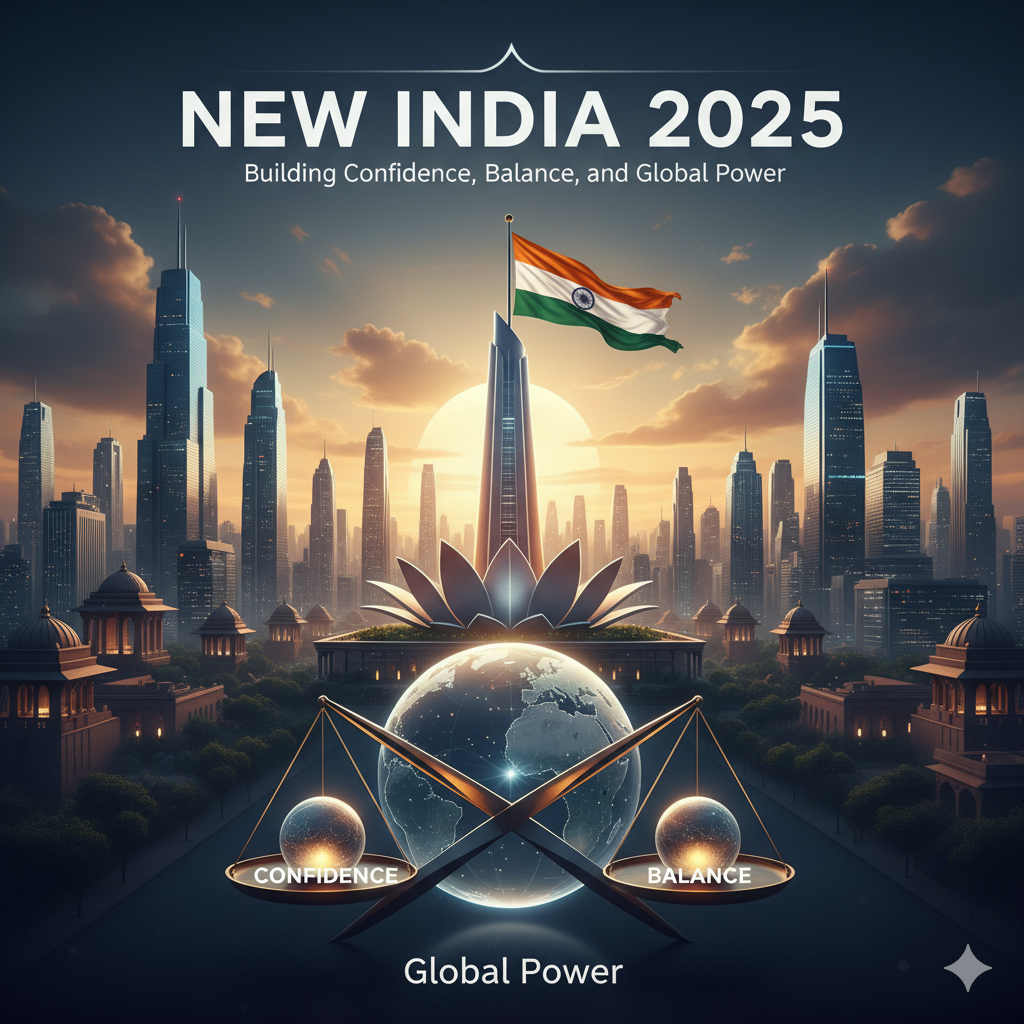
New India 2025 stands as a global force shaped by its people, guided by its values, and powered by its ideas.
It is not perfect. It is still learning, still improving, still rising.
But it is unstoppable.
The world is watching, and India is ready to lead – not by demanding space, but by creating it.