14 August 2026
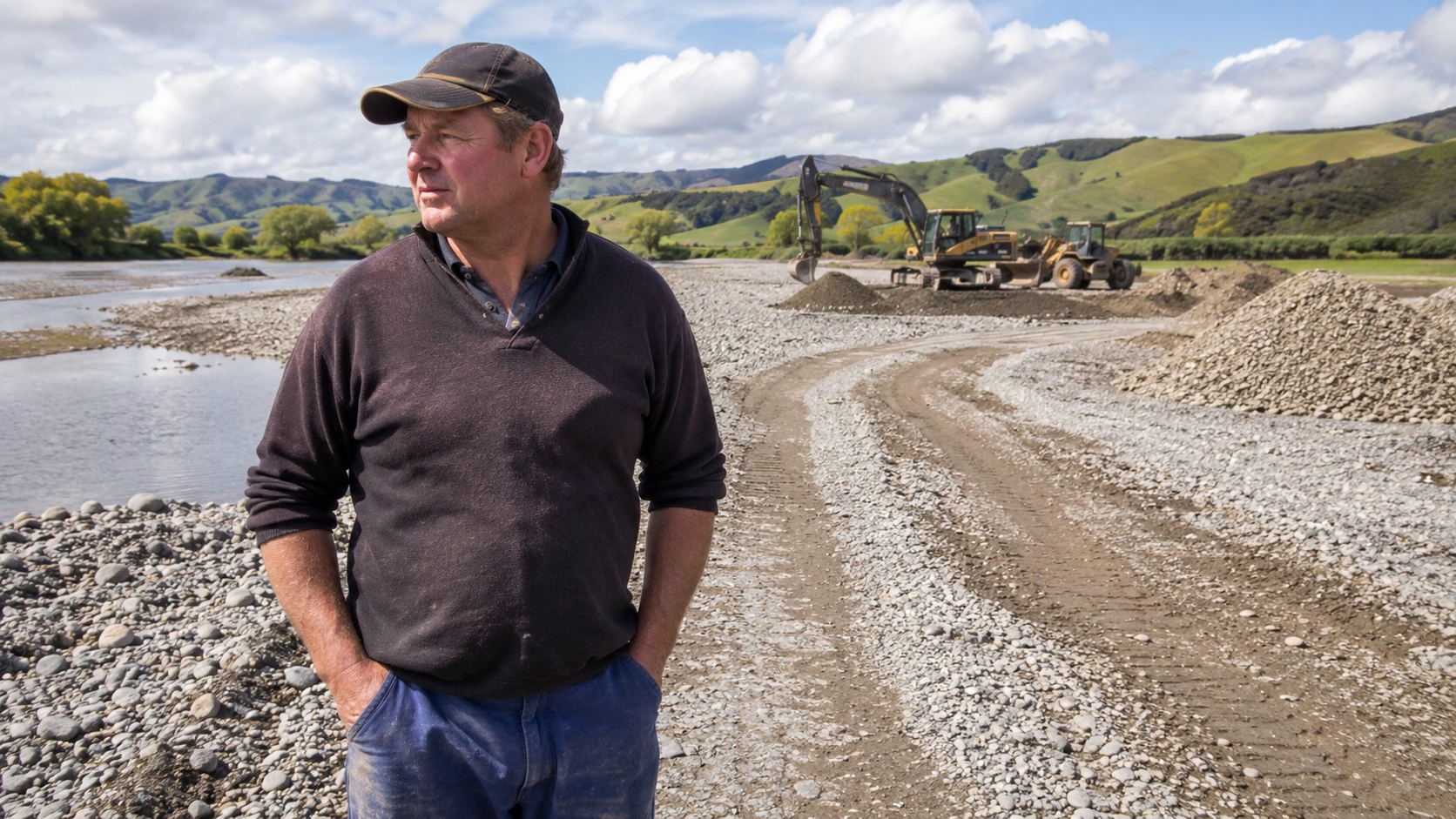
National has promised to make it easier for farmers to remove river gravel and operate small-scale quarries on their own properties, arguing that routine rural work should not automatically require expensive and lengthy resource consent processes.
The policy, announced at the South Island Election Conference in Christchurch, would introduce national standards covering river gravel extraction and on-farm quarrying if National is re-elected in November.
Federated Farmers has strongly welcomed the proposal, saying it addresses two practical problems that have frustrated rural landowners for years.
The organisation says the current system can leave farmers facing different rules depending on which council boundary they happen to operate within.
Federated Farmers president Colin Hurst said national permitted-activity standards could provide much-needed certainty while still allowing environmental restrictions in sensitive locations.
“We asked for a set of nationwide rules for everyday farming activities to get rid of needless red tape and cost, and today’s announcement is a significant step in the right direction,” Hurst said.
But the proposal is about more than paperwork.
River gravel extraction sits at the intersection of flood management, freshwater protection, infrastructure and commercial aggregate supply.
On-farm quarrying similarly raises questions about how far regulation can be simplified before environmental effects become significant.
What National is proposing
Under the river gravel proposal, removing gravel could become a permitted activity where farmers or contractors meet a defined set of national conditions.
That would mean qualifying work could proceed without requiring an individual resource consent.
The proposed system would not necessarily make gravel extraction unrestricted.
Federated Farmers says national rules could still distinguish between different rivers and catchments, impose conditions and prohibit extraction in environmentally sensitive areas.
The central principle is that if an activity falls within clearly defined limits, farmers would know in advance that they can proceed.
That would replace some of the uncertainty that currently comes with applying for council consent.
The second proposal would apply a similar model to small-scale quarries located on farms.
Farmers could extract limited quantities of gravel, stone or sand from their own properties where they comply with national standards governing matters such as extraction area and volume.
Sensitive locations could still be excluded.
Why river gravel matters
River gravel does not stay in one place.
Material is continually transported downstream through catchments during ordinary river flows and particularly during floods.
Over time, gravel can accumulate in parts of a riverbed.
Federated Farmers argues that where significant build-up occurs, riverbeds can rise and reduce the amount of water a channel can safely carry.
That can become particularly important during major rainfall events.
Hurst said recent flooding in North Canterbury and Wairarapa had reinforced rural concerns about how rivers are managed.
“New Zealand has always had to manage its rivers. Gravel is constantly being washed down our catchments, and if it builds up unchecked, riverbeds rise and the risk of flooding increases,” he said.
Gravel removed from rivers can also become a useful source of aggregate for roads, tracks and construction.
That gives extraction two potential benefits: river management and access to material.
However, it also explains why environmental controls matter.
Removing too much gravel, or taking it from the wrong location, can alter river channels and potentially affect aquatic habitat, bank stability and downstream behaviour.
A national standard would therefore have to balance both sides.
Why farmers are frustrated with the existing approach
Resource consenting can become disproportionately expensive when the activity being proposed is small.
A farmer may need several truckloads of aggregate to repair a damaged track, strengthen a gateway or improve access to stock yards.
If suitable material already exists on the property, buying and transporting aggregate from a commercial quarry may seem wasteful.
But if extracting the material on-farm triggers a resource consent, professional reports, council fees and delays can make using the local material uneconomic.
Hurst said that is exactly the problem Federated Farmers wants addressed.
“Many farmers have perfectly good sources of aggregate on their own farms, but the cost and uncertainty of getting a resource consent can mean they’re forced to buy material from somewhere else, which makes absolutely no sense.”
Farm tracks are not a minor part of farming infrastructure.
They are used by stock, farm vehicles, milk tankers, contractors and emergency services.
Poor surfaces can also create animal welfare, erosion and workplace safety problems.
The industry argument is that allowing farmers to source small amounts of material locally can be both cheaper and more practical.
National rules instead of council-by-council variation
The larger political argument behind the proposal is about consistency.
Resource management in New Zealand has traditionally involved substantial regional and district council discretion.
That recognises that landscapes, waterways and environmental pressures vary around the country.
But it also means the same activity can be permitted in one region and require consent in another.
Federated Farmers says routine farming practices should increasingly be governed by national permitted-activity standards rather than a patchwork of local rules.
Hurst said farmers want “certainty and sensible rules, not a different consenting regime depending on which side of a council boundary they happen to be operating on.”
National has already been pursuing a broader resource-management reform agenda, including changes intended to make freshwater farm plans more practical and reduce duplication for farmers. Government reforms passed in 2025 increased the minimum farm size triggering freshwater farm-plan requirements in several sectors and allowed recognised industry assurance programmes to play a greater role in certification and auditing.
The new election proposal appears to push further in the same direction.
Federated Farmers wanted 10 national standards
The two proposals are part of a broader Federated Farmers election agenda.
The organisation has called for national permitted-activity standards across 10 common rural activities.
River gravel extraction and farm quarries make up two.
The other areas are:
- farm plans
- vegetable growing
- on-farm water storage
- drain maintenance
- effluent management
- fertiliser application
- wetland restoration
- small and medium-scale solar projects
Federated Farmers says National has also committed to making small-scale solar developments permitted activities if returned to government.
That means three elements of the farming organisation’s requested approach have now received political backing from National.
Hurst wants the same philosophy extended to the remaining areas.
The environmental question
Any reform of river or quarry rules will inevitably attract scrutiny over environmental safeguards.
The argument for national rules is strongest where an activity has predictable and manageable effects.
But rivers are not identical.
A gravel build-up that creates a flood-management concern in one catchment may provide important habitat or channel stability somewhere else.
The same applies to quarrying.
A small extraction site on stable farmland may pose limited effects.
A similar activity close to a wetland, stream, culturally significant area or unstable slope could create very different risks.
Federated Farmers itself acknowledges this.
Hurst said national standards should not amount to identical rules being imposed on every river.
“There should absolutely be strong environmental safeguards, and the rules need to recognise that rivers and catchments are different.”
He said a national standard could include different conditions for different river types and preserve areas where extraction is prohibited.
That detail will be critical.
A national permitted-activity standard is only as credible as the conditions attached to it.
The flood-management argument is not automatically simple
There is a temptation to frame river gravel extraction as a straightforward equation: remove gravel, lower the riverbed, reduce flooding.
In reality, river systems are more complicated.
Flood risk can be influenced by riverbed levels, stopbanks, channel width, vegetation, bridges, sediment flows, land use and the scale of rainfall arriving across the catchment.
Gravel extraction may be useful in certain places, but it is not a universal substitute for catchment-wide flood management.
That is why detailed technical criteria will matter if National turns the election promise into regulation.
The policy will need to identify where extraction genuinely assists river management, what quantities are appropriate and what ecological effects must be avoided.
Without those details, “cutting red tape” is a political message rather than a complete regulatory system.
Why aggregate matters beyond farming
New Zealand has large infrastructure demands and aggregate is one of the most basic materials required to meet them.
Road construction, concrete, flood protection, farm tracks and subdivision development all depend on stone, sand and gravel.
Aggregate is heavy and relatively expensive to transport long distances.
That means local sources can have significant economic value.
National’s wider resource-management direction has already placed considerable emphasis on reducing barriers to infrastructure, renewable energy and development, including through fast-track approval mechanisms for large projects. Ministry for the Environment records show a range of quarry, mining and aggregate projects have featured in recent development proposals.
The farm-quarry proposal works at the opposite end of the scale.
Instead of accelerating large commercial projects, it would reduce regulation around limited extraction undertaken primarily for use on the farm itself.
Election-year politics behind the announcement
The timing matters.
National made the announcement on 14 August at the South Island Election Conference at Te Pae Christchurch Convention Centre.
The event brings together political leaders and business representatives to debate economic, workforce and infrastructure policy ahead of the 2026 general election. Christopher Luxon, Chris Hipkins and representatives from National, Labour, ACT, NZ First and the Greens are among those featured in the programme.
Rural regulation is likely to remain an important election issue.
National has historically competed strongly for farming votes, but ACT and New Zealand First are also actively targeting rural communities.
That gives National an incentive to demonstrate that its resource-management reforms will produce practical changes farmers can see on the ground.
River gravel and farm quarries fit that strategy well.
They are relatively technical issues nationally, but intensely practical for farmers who deal with them.
The real test will be in the conditions
The political headline is easy.
National wants fewer resource consents.
Federated Farmers wants lower costs.
But the success of the policy will depend on the less glamorous part: drafting the national standards.
Maximum extraction volumes will matter.
Setbacks from waterways will matter.
Sediment controls will matter.
Ecological exclusions will matter.
Rehabilitation requirements for farm quarry sites will matter.
So will monitoring and enforcement when operators move beyond permitted limits.
Rules that are too restrictive would recreate much of the complexity the policy is intended to remove.
Rules that are too loose could create environmental problems and shift costs onto communities later.
Getting that balance right will determine whether this becomes genuine regulatory reform or simply another election promise to “cut red tape”.
A bigger debate about how New Zealand regulates farming
The announcement reflects a broader argument that has been building for years.
Farmers frequently say regulation has become too fragmented, expensive and difficult to navigate.
Environmental groups and councils often respond that local rules exist because environmental conditions are different across regions and cumulative effects can be significant.
Both points can be true.
New Zealand does need strong environmental protections.
It also needs regulations that ordinary businesses can realistically understand and comply with.
National’s proposal attempts to bridge that divide by setting national boundaries within which routine activities can proceed without consent.
Federated Farmers believes that approach should become much more widespread.
Whether voters agree will depend partly on how much confidence they have that “permitted” can still mean properly controlled.
For farmers dealing with washed-out tracks, rising riverbeds or a useful gravel source sitting on their own property, the attraction is obvious.
They want to get the job done without first turning a small piece of farm maintenance into a legal and planning exercise.
The harder job for National will be proving that it can make that process simpler without making environmental oversight weaker.
That is where the real policy debate begins.
References
Federated Farmers, National’s plan tackles two big headaches for farmers, 14 August 2026.
Business Canterbury, South Island Election Conference 2026.
South Canterbury Chamber of Commerce, South Island Election Conference, 14 August 2026.
New Zealand Government, Farming to get easier with improved freshwater farm plans, 20 August 2025.
Ministry for the Environment, resource-management and fast-track project documentation.