Diplomatic appointments are usually announced, noted, and forgotten.
This one should not be.
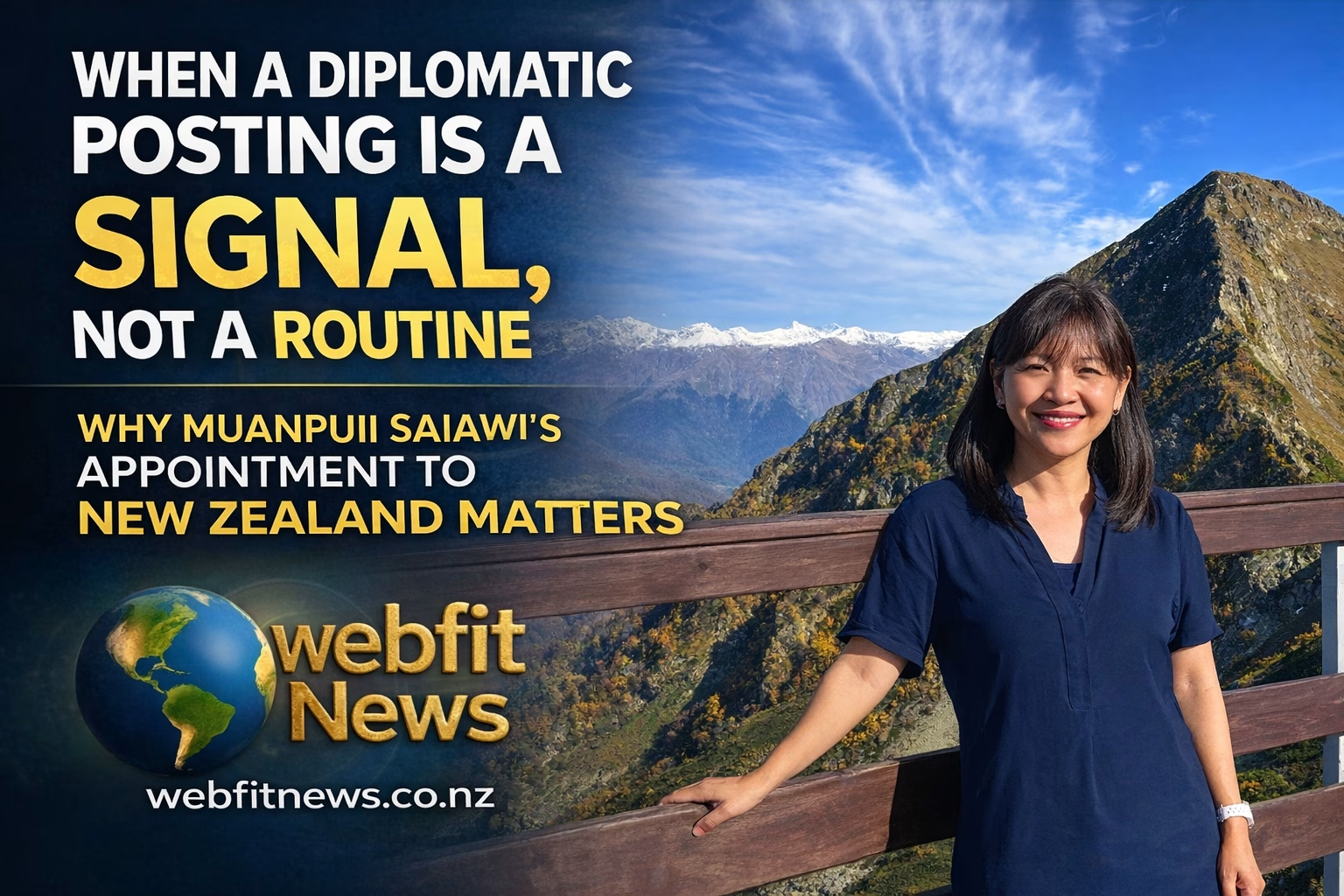
When India named Muanpuii Saiawi as its next High Commissioner to New Zealand on January 19, 2026, the decision looked procedural on the surface. In reality, it was a signal. A quiet one, but unmistakable for those watching how India is reshaping its presence in the Indo-Pacific.
This was not about rotation. It was about intent.
A Post That Has Changed Its Meaning
Until recently, the role of India’s High Commissioner to New Zealand sat comfortably in the category of friendly diplomacy. Trade talks moved slowly. Strategic cooperation was polite but limited. Cultural ties carried the relationship more than hard policy.
That era has ended.
The recently concluded India–New Zealand Free Trade Agreement has fundamentally altered the job description. The High Commissioner in Wellington is no longer just a bridge builder. The role now demands a negotiator, a technology strategist, a security interlocutor, and a manager of political sensitivities in a region under growing geopolitical pressure.
Saiawi steps into this moment by design.
From Mizoram to the Centre of Global Power
Saiawi’s rise is not simply impressive. It is instructive.
Born in Mizoram and educated in Mumbai at St Anne’s High School and St Xavier’s College, she represents a generation of Indian diplomats shaped by mobility rather than metropolitan entitlement. Her career reflects the widening pipeline of talent entering India’s foreign policy establishment.
Her journey through the UPSC examinations remains widely cited for good reason.
Her civil service progression:
- 2003: Selected for the Indian Audit and Accounts Service
- 2004: Selected for the Indian Revenue Service
- 2005: Selected for the Indian Foreign Service
Few officers demonstrate such breadth before committing to diplomacy. Fewer still carry that analytical range into senior leadership roles.
At the Foreign Service Institute, Saiawi further distinguished herself by winning both the Gold Medal for Best Officer Trainee and the Silver Medal for Best Thesis. This was not ceremonial recognition. It marked her as a thinker as well as an operator.
A Career Built Where Power Is Contested
Saiawi’s overseas postings were not accidental assignments. They were strategic classrooms.
In South Korea, she worked on political and security affairs during a period of heightened regional tension. The experience exposed her early to deterrence, alliance management, and great power rivalry.
In Japan, she handled public diplomacy at a time when India-Japan relations were being elevated into a strategic partnership. As Director of the Vivekananda Cultural Centre in Tokyo, she learned how soft power sustains hard alliances.
In Israel, she served during the high-water mark of India-Israel cooperation. Defence, agriculture, cyber security, and innovation diplomacy were not abstract concepts there. They were daily work.
Each posting added a layer. Together, they produced a diplomat unusually comfortable at the intersection of culture, technology, and security.
Cyber Diplomacy Comes to Wellington
Before her appointment to New Zealand, Saiawi held one of the most sensitive portfolios in New Delhi.
As Joint Secretary overseeing Cyber Diplomacy and Disarmament and International Security Affairs, she represented India in high-level dialogues with the European Union, Japan, Australia, and the United Kingdom. These discussions shaped global norms on cyber security, data governance, and emerging technologies.
This background is not incidental to her Wellington posting.
New Zealand is increasingly focused on:
- Cyber resilience and democratic safeguards
- Digital infrastructure protection
- Artificial intelligence governance
- Foreign interference in online spaces
India’s decision to send a cyber specialist rather than a conventional trade diplomat reflects a clear reading of where future risks lie.
The Free Trade Agreement as a Stress Test
The India–New Zealand FTA is ambitious on paper. Its real test lies in execution.
Key pillars of the agreement include:
- Full duty-free access for Indian exports across thousands of tariff lines
- Expanded access for New Zealand agricultural products
- Streamlined pharmaceutical approvals
- Structured mobility pathways for skilled professionals and students
The most politically sensitive element remains mobility. The agreement formalises pathways for Indian professionals while attempting to balance domestic labour concerns in New Zealand.
Saiawi’s challenge will be to translate legal text into trust on the ground.
A Diplomat Who Carries a Symbol
Beyond policy, Saiawi’s appointment carries symbolic weight.
In Mizoram and across Northeast India, her rise is viewed as evidence that geography no longer limits representation at the highest levels of the Indian state. In strategic terms, it aligns with India’s effort to integrate its Northeast into Indo-Pacific thinking.
This is not optics. It is a structural change.
Indigenous Knowledge and Quiet Innovation
One of the most underreported aspects of the India–New Zealand relationship is its emerging focus on indigenous knowledge systems.
The FTA includes recognition of India’s AYUSH traditions alongside engagement with Māori health practices. This creates space for cooperation that respects culture rather than commodifying it.
Saiawi’s past work in cultural diplomacy positions her well to manage this with sensitivity rather than symbolism.
Why This Appointment Will Be Remembered
Diplomatic history is rarely made by speeches. It is made by alignment.
Saiawi brings security credibility, technological fluency, cultural intelligence, and administrative depth to a posting that now demands all four. Her appointment reflects how India sees New Zealand not as a distant partner, but as a strategic node in the Pacific.
If executed well, this posting will not just strengthen bilateral ties. It will redefine them.
Some diplomatic appointments fill a seat.
Others mark a moment.
This one does the latter.