
WELLINGTON, 10 August 2026
As artificial intelligence becomes increasingly embedded in workplaces, public services, education, business and everyday decision-making, the Human Rights Commission is urging New Zealand to adopt a human rights and Te Tiriti o Waitangi-based approach to the way AI and digital technologies are developed, governed and used.
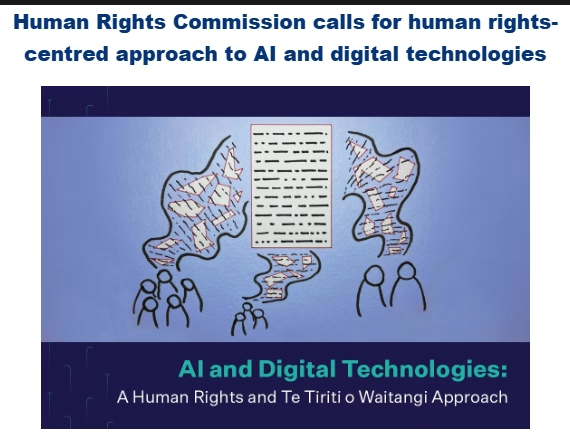
Te Kāhui Tika Tangata Human Rights Commission has released a new report, AI and Digital Technologies: A Human Rights and Te Tiriti o Waitangi Approach, setting out principles it believes should guide New Zealand’s digital future.
The Commission says the country has an opportunity to benefit from emerging technology while ensuring that dignity, equality, privacy, accountability and participation remain at the centre of decision-making.
The question is not whether New Zealand uses AI
Chief Human Rights Commissioner Dr Stephen Rainbow said AI is already becoming part of modern life, meaning the debate needs to move beyond whether the technology should be used at all.
“The question is not whether we use AI, but how we use it,” Dr Rainbow said.
“We have an opportunity now to build systems that respect human rights and ensure the widest possible access to the benefits of AI.”
He said getting the foundations right could help New Zealand capture the benefits of technology while also building the public confidence required for wider adoption.
That distinction is important.
Public trust in AI will depend not simply on whether systems are efficient or innovative, but on whether people understand how decisions are made, whether those systems are fair, and whether people have meaningful ways to challenge decisions that affect them.
Existing rights frameworks already provide a starting point
The Commission argues New Zealand does not need to create an entirely new ethical system for AI.
Instead, the report says existing human rights protections, domestic law, international standards and Te Tiriti o Waitangi already provide a strong basis for governing emerging technology.
The challenge is making sure those principles are actually applied as AI becomes more deeply integrated into both public and private sector systems.
The report is intended to provide a foundation for future policy development, practical guidance and public discussion.
Its central message is that technological innovation should not sit outside established human rights protections simply because the technology is new.
Te Tiriti must be part of AI governance
A major focus of the report is the role of Māori rights, Māori participation and data sovereignty.
The Commission says decisions about AI cannot be separated from questions about who controls data, how information about communities is used, and whether Māori have meaningful authority over data connected to their identities, language, knowledge and interests.
Rongomau Taketake Indigenous Rights Governance Partner Dayle Takitimu said Te Tiriti o Waitangi provides essential guidance.
“Māori, like all peoples, have the right to determine how data relating to their communities, interests and identities is collected, used, governed and protected,” Takitimu said.
“As AI systems increasingly draw on language, knowledge and data, it is critical that Māori rights, interests and authority are respected.”
The issue goes beyond consultation.
Takitimu said a Te Tiriti-based approach should recognise tino rangatiratanga, protect taonga and ensure Māori are active partners in shaping the country’s digital future.
“A Te Tiriti-based approach is not simply about managing risk,” she said.
“It is about recognising tino rangatiratanga, protecting taonga, and ensuring Māori are active partners in shaping Aotearoa’s digital future.”
AI brings major opportunities, but also serious risks
The Commission acknowledges that artificial intelligence and digital technologies can deliver major benefits.
These can include faster services, improved accessibility, better analysis of large datasets, support for medical research, productivity gains and new educational tools.
But the same systems can also amplify existing inequalities if they are poorly designed or trained on biased data.
The Commission highlights several key risks:
| Area of concern | Potential impact |
|---|---|
| Discrimination | AI systems may reproduce or amplify existing bias |
| Privacy | Personal information may be collected or used without sufficient safeguards |
| Transparency | People may not understand how automated decisions are made |
| Accountability | It may be unclear who is responsible when AI causes harm |
| Access to redress | People may struggle to challenge automated decisions |
| Māori data rights | Māori knowledge, language or community data may be used without appropriate authority |
| Unequal access | Benefits of AI may not be shared evenly across society |
These risks become particularly important when AI is used in areas such as employment, welfare, policing, healthcare, credit decisions, education or government services.
People should know when AI is making decisions about them
Dr Rainbow said transparency must be a basic requirement.
“People have a right to know when technology is being used to make decisions about them, what information is being used, and how they can challenge those decisions,” he said.
That principle could become increasingly important as automated decision-making systems become less visible.
A person may not always know whether a job application has been screened by AI, whether an insurance assessment has involved an automated model, or whether a public service decision has been influenced by algorithmic analysis.
The Commission’s position is that people should not be left in the dark when technology materially affects their rights or opportunities.
Human rights should not be treated as an obstacle to innovation
A common tension in debates about AI regulation is the fear that safeguards could slow innovation.
The Commission rejects that framing.
“Human rights are not a barrier to innovation. They are the foundation for innovation that people can trust,” Dr Rainbow said.
That is likely to become one of the central policy questions facing governments internationally.
Fast-moving AI development creates pressure to adopt new systems quickly, particularly where organisations expect gains in efficiency or productivity.
But rapid adoption without strong governance can also create legal, ethical and reputational risks.
The Commission argues that rights-based safeguards can actually support long-term adoption because systems are more likely to be trusted when people believe they are fair, transparent and accountable.
Public trust will determine how far AI can go
The report places public confidence at the centre of New Zealand’s AI future.
That matters because adoption is not simply a technical question.
If people believe AI systems are opaque, discriminatory or impossible to challenge, resistance to those technologies is likely to grow.
Conversely, clear rules around transparency, privacy, accountability and participation could make people more willing to accept AI in areas where it provides genuine benefits.
The Commission therefore sees human rights protections as part of the infrastructure required for successful digital innovation.
A national conversation is only beginning
The release of the report comes as governments, businesses and public agencies around the world grapple with how to regulate rapidly developing AI technologies.
New Zealand faces the same fundamental challenge.
How can the country capture the advantages of AI without allowing efficiency or technological excitement to override privacy, equality, indigenous rights and accountability?
The Human Rights Commission’s answer is that the country already has much of the framework it needs.
Human rights law, Te Tiriti o Waitangi, domestic legislation and international standards provide the foundation.
The harder task is ensuring those principles are applied consistently as technology develops.
For the Commission, the goal is not to slow the digital future.
It is to make sure that future works for everyone.