
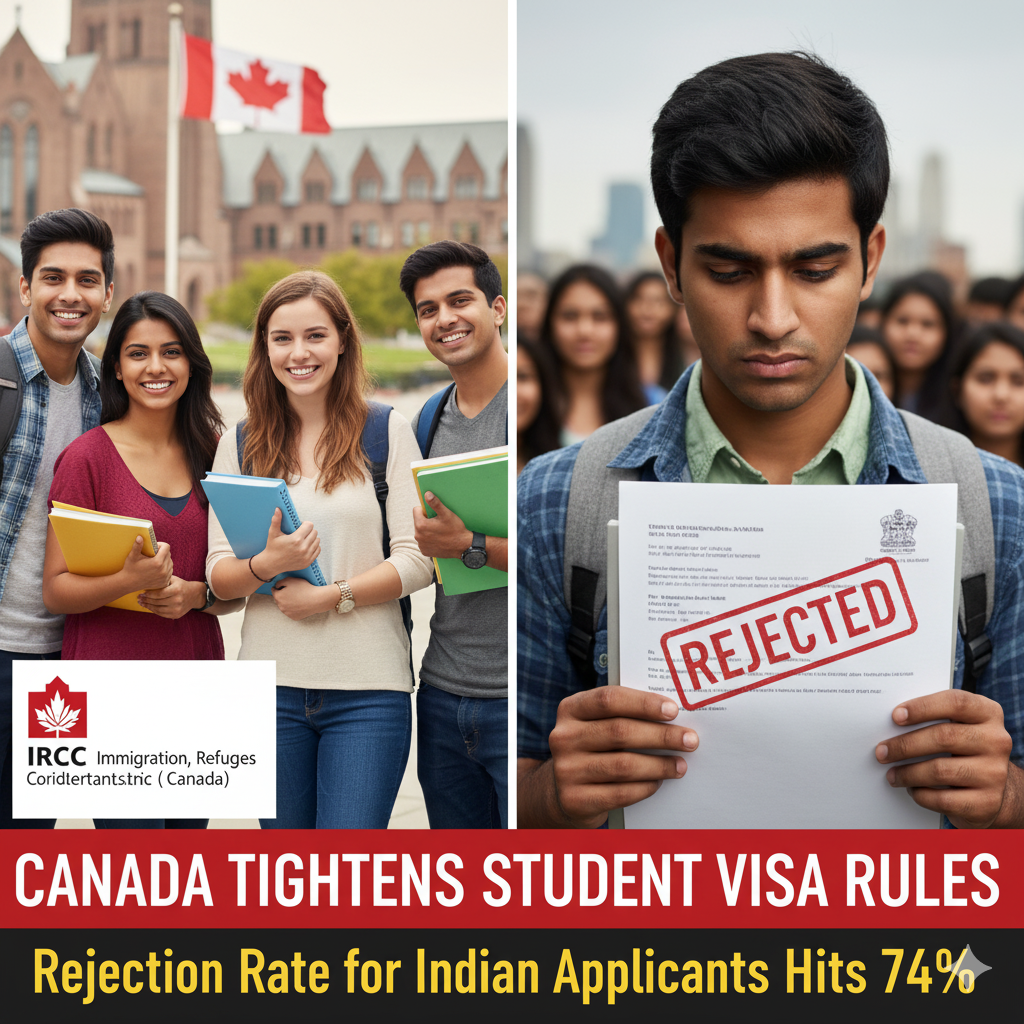
As part of sweeping changes to international student policy, Canada has sharply increased scrutiny of study permits. Applicants from India are facing the highest rejection rates, now around 74 percent for August 2025, showing major shifts and new risks.
Toronto | November 2025
Canada’s once-favoured destination for Indian students is now undergoing a major policy reset. New data from Immigration, Refugees and Citizenship Canada (IRCC) show that in August 2025 about 74 percent of Indian student visa applications were refused.
This sharp increase comes alongside wider reforms that aim to manage growing student numbers, housing pressure, and fraud concerns.
What’s Changed – Key Highlights
- The total number of study permits Canada plans to issue in 2025 is capped at 437,000, which is lower than in previous years.
- From 1 September 2025, applicants must now show at least CAD 22,895 (≈ INR 14 lakh) for living expenses alone, not including tuition.
- Indian students saw a 31 percent drop in new permits, falling from 44,295 in Q1 2024 to 30,640 in Q1 2025.
- Rejection rates for Indian applicants have overtaken those from all other major source countries.
Why These Changes Matter
These updates affect students and families in several ways.
Firstly, the route to Canada is becoming more selective and more expensive.
Secondly, stronger documentation and clear intent are essential to stand out.
Additionally, universities that depend on Indian enrolments may see reduced numbers, which could impact budgets.
Finally, anyone planning to use a study permit as a quick path to work or residency must now adjust expectations, since Canada is tightening all temporary-resident pathways.
What Not to Do – Common Mistakes Leading to Rejection
| Mistake | Why It Hurts Your Application |
|---|---|
| Submitting weak or inconsistent proof of funds | Large, unexplained deposits raise red flags. Officers now verify financial history to ensure transparency. |
| Applying without a Designated Learning Institution (DLI) offer or missing PAL/TAL letter | Only students enrolled in approved DLIs with a valid attestation letter are considered for approval. |
| Using vague study plans or unrealistic post-study goals | Weak or generic statements make an application look insincere. Explain how the course connects to your career. |
| Sending incomplete or late documents | Missing transcripts or unclear scans delay processing and often trigger automatic refusals. |
| Assuming old approval patterns still apply | Evaluation standards have changed since 2024. Each case is reviewed under stricter criteria. |
What This Means for Students and Institutions
Indian students should plan early, budget carefully, and verify every document before applying.
Meanwhile, Canadian colleges and consultancies must adapt recruitment strategies as approval rates drop.
At a broader level, this shift shows that Canada wants to balance growth with credibility in its international-education system.
Key Takeaways
- Canada’s student-visa policy now focuses on quality rather than quantity.
- Applicants who prepare detailed financial proofs and well-defined study goals have a much higher chance of success.
- The opportunity to study in Canada still exists, but it rewards strong preparation and transparency.