

By Webfit News Desk
A quiet but serious issue is unfolding across New Zealand’s universities, one that rarely makes headlines but is now too large to ignore.
New research from the University of Auckland has revealed that almost half of university students are facing food insecurity, raising concerns about how deeply the cost-of-living crisis is affecting young people.
For many students, this is not about skipping the occasional meal. It is about uncertainty, compromise, and survival.
What the Study Found
Fuel Crisis Fears Rise in New Zealand as Questions Grow Over Government Response – WebfitNews
The research, published in the Journal of the Royal Society of New Zealand, surveyed 347 students and delivered a clear and concerning result:
- 45 percent of students were food insecure
- Many lacked reliable access to affordable, nutritious food
- Financial pressure and living arrangements played a major role
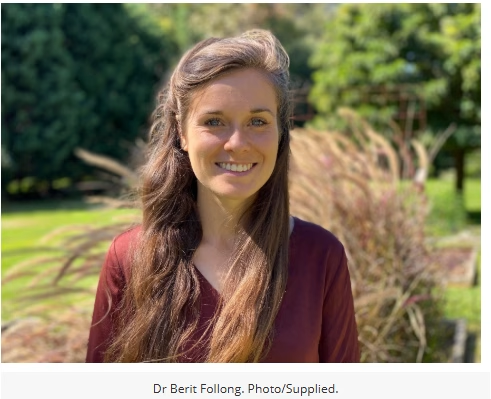
According to lead researcher Dr Berit Follong, the findings reflect what is already being seen across the country.
Students are struggling to balance rent, bills, study, and basic nutrition.
Living Away From Home Is the Biggest Risk
One of the strongest patterns in the study is simple and hard to ignore.
Students who live away from their families are far more vulnerable.
- They were around three times more likely to experience food insecurity
- Those living at home had a clear advantage
- 76 percent of students eating well were living with a family
This points to a basic reality. Family homes act as a safety net, both financially and practically.
Once that safety net is removed, the pressure increases sharply.
Cost and Time Are the Main Barriers
The study highlights two key issues driving the problem:
1. Cost of Food
- 80 percent of affected students said food prices are a major barrier
- Many are forced to prioritise rent and bills over nutrition
2. Lack of Time
- Busy study schedules leave little time to cook
- Convenience often replaces nutrition
To cope, students reported:
- Buying the cheapest food available
- Reducing portion sizes
- Skipping meals or saving food for later
Food banks exist, but surprisingly, usage remains low.
That raises another issue. Access is not just about availability. It is also about awareness and stigma.
Hidden Impact on Education and Mental Health
This is not just a food issue. It is an education and well-being issue.
International research shows that food insecurity is linked to:
- Lower academic performance
- Increased stress and anxiety
- Poor mental and physical health
When students are worrying about their next meal, focusing on lectures becomes secondary.
And that has long-term consequences.
Support Exists, But Many Students Do Not Know About It
One of the more surprising findings is how few students are using available support.
- Only one in four students knew about food-related support services
- Of those, only half actually used them
According to co-researcher Professor Cliona Ni Mhurchu, this highlights a major gap.
Support systems exist, but they are not reaching the people who need them.
That is not a resource problem. That is a communication problem.
Calls for Practical and Non-Judgmental Solutions
Researchers are not just highlighting the issue. They are calling for action.
Key recommendations include:
- Better communication of available support
- Practical education on budgeting and low-cost healthy meals
- Financial policies that reflect real student living costs
- Solutions that remove stigma around seeking help
The message is clear. This problem cannot be solved by one initiative alone.
It needs a multi-level approach.
A Wider National Concern
Although the study focused on Auckland, the implications are national.
The researchers themselves have acknowledged that more work is needed across other universities to understand the full picture.
But let’s be honest. This is unlikely to be an isolated issue.
If anything, Auckland is probably reflecting a wider trend across New Zealand.
Webfit News Perspective
This is where things get uncomfortable.
We often talk about students as future leaders, innovators, and professionals. But right now, many of them are struggling to afford basic food.
That is not a student problem. That is a system problem.
If nearly half of students are food insecure, then something is clearly broken in how we support education and living costs.
Here is the hard truth:
You cannot build a strong future workforce on empty stomachs.
And if students are forced to choose between rent, study, and food, then we are setting them up to fail before they even begin.
This is not about sympathy. It is about priorities.
Conclusion
The findings from this study are a wake-up call.
Food insecurity among university students is real, widespread, and growing.
The question now is not whether action is needed. It is how quickly it will happen.
Because for many students, this is not a future issue.
It is happening right now.
Credit
Source: University of Auckland via Scoop Media