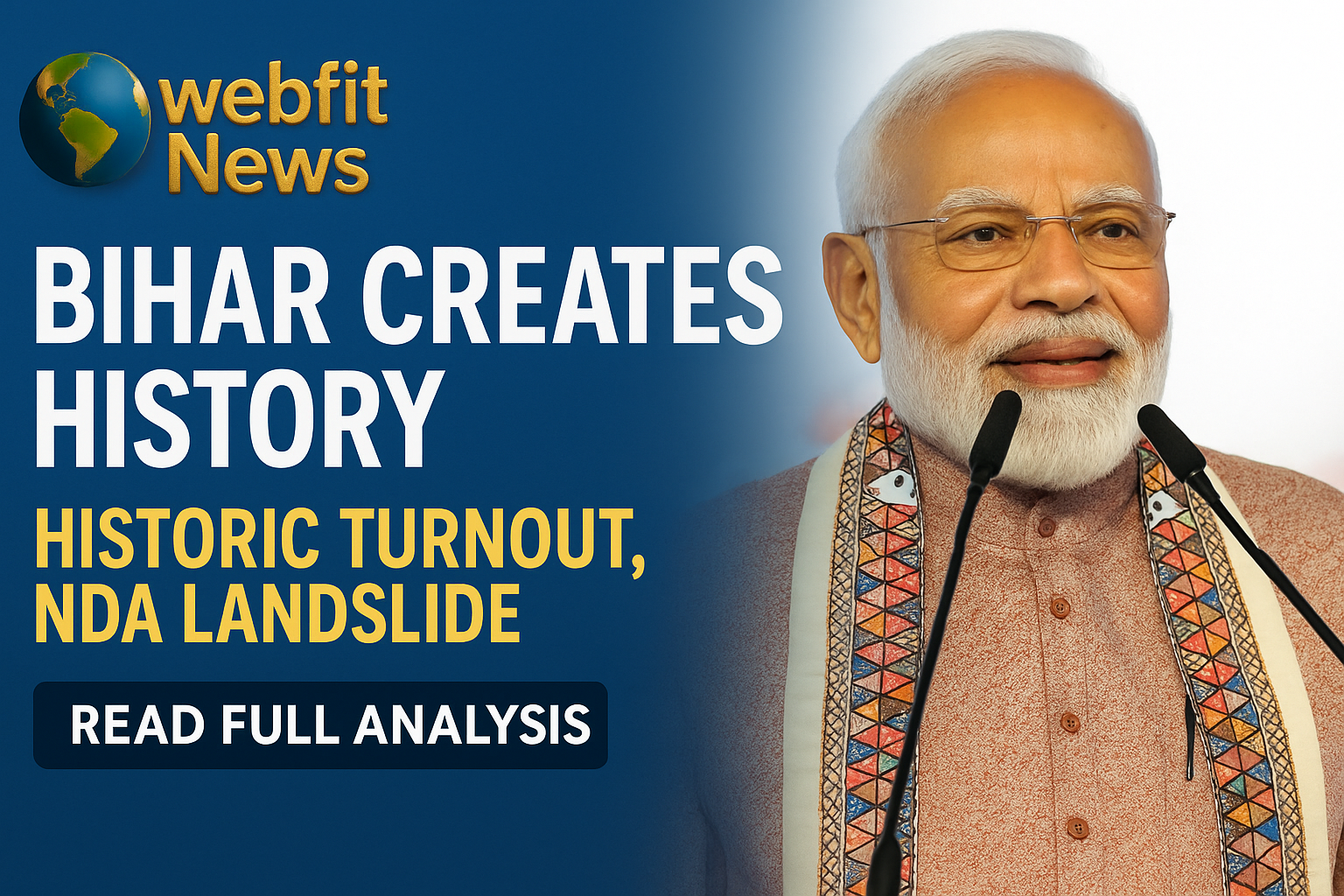
Bihar made history in the 2025 Assembly election with its highest turnout in 74 years, led by women voters. The NDA won a sweeping 202-seat majority, while the opposition collapsed. Full turnout data, key seat results, and detailed political analysis inside.
Introduction: A Historic Day For Bihar’s Democracy
The 2025 Bihar Assembly election will be remembered as a turning point in the state’s political story.
Voters came out in record numbers, women led from the front, and the National Democratic Alliance (NDA) returned to power with a huge majority.
It was Bihar’s highest voter turnout since the first election in 1951. Women not only outvoted men, they also broke records and became the decisive force in many seats. Their vote helped deliver a strong mandate for Chief Minister Nitish Kumar and the NDA, while the opposition Mahagathbandhan (INDIA bloc) suffered one of its worst defeats in recent history.
Background: How Big Was The Turnout And Why It Matters
Bihar recorded an overall turnout of 66.91 percent, the highest in 74 years. More than the headline number, it is the gender gap that stands out.
- Overall male turnout: 62.8 percent
- Overall female turnout: 71.6 percent
Women voted 8.8 percentage points more than men, the widest gap ever seen in the state. For the first time, women also outnumbered men in absolute votes, with roughly 5 lakh more women voting than men.
This did not happen overnight. Since 2010, women in Bihar have been voting in higher numbers than men in almost every Assembly election, helped by:
- Reservation for women in local bodies
- Welfare schemes targeting women
- Better law and order compared to the 1990s
- Improved mobility and political awareness
At the same time, many men migrate out of the state for work and often miss polling day, which adds to the turnout gap.
In 2025, this long-term trend reached its peak. The queues of women outside polling booths in village after village became one of the most powerful images of the election.
Record Turnout, Phase By Phase
The election took place in two phases, and women outvoted men in both.
Phase-wise turnout by gender
| Phase | Total Turnout (%) | Male Turnout (%) | Female Turnout (%) |
|---|---|---|---|
| Phase I | 65.08 | 61.56 | 69.04 |
| Phase II | 68.76 | 64.10 | 74.03 |
| Overall | 66.91 | 62.80 | 71.60 |
Source: Election Commission of India (provisional figures), Press Information Bureau
This data makes two things very clear:
- Women are now the most reliable and enthusiastic voting bloc in Bihar.
- Any party that understands their priorities and earns their trust will have a serious advantage.
Analysts point out that women’s support for Nitish Kumar is closely linked to:
- Focus on law and order
- Schemes like bicycles for schoolgirls, housing help, LPG connections, and women’s self-help groups
- Reservation for women at the panchayat level
The 2025 election shows that this political investment in “Mahila shakti” has fully matured into real electoral power.
Key Constituency Results: Big Margins, Big Upsets, And Nail-biters
As counting progressed on 14 November, the NDA pulled ahead early and never really lost control. Below is a compact snapshot of 50 high-impact constituencies that tell the story of this election: huge victory margins, upsets, and razor-thin finishes.
Table 1: Notable constituency results and victory margins
| Constituency | Winner (Party) | Victory Margin (votes) | Key note |
|---|---|---|---|
| Rupauli | Kaladhar Prasad Mandal (JD(U)) | 73,572 | Largest margin in the state |
| Digha | Sanjiv Chaurasia (BJP) | 59,079 | Part of big urban sweep |
| Hasanpur | Rajesh Kumar (LJP(RV)) | 58,191 | Strong LJP(RV) showing |
| Gopalpur | Shailesh “Bulo” Mandal (JD(U)) | 58,135 | Comfortable JD(U) win |
| Aurai | Rama Nishad (BJP) | 57,206 | NDA wave seat |
| Rajgir | Kaushal Kishore (JD(U)) | 55,428 | JD(U) stronghold |
| Jhanjharpur | Nitish Mishra (BJP) | 54,849 | High-profile BJP win |
| Jamui | Shreyasi Singh (BJP) | 54,498 | Sportsperson turned MLA consolidates |
| Pirpainti | Murari Paswan (BJP) | 53,107 | Big NDA margin |
| Bankipur | Nitin Nabin (BJP) | 51,936 | Urban Patna stronghold |
| Kahalgaon | Shubhanand Mukesh (JD(U)) | 50,112 | JD(U) dominance continues |
| Tarapur | Samrat Choudhary (BJP) | 45,843 | Deputy CM and BJP state chief wins |
| Alamnagar | Narendra Narayan Yadav (JD(U)) | ~45,000 | Deputy Speaker’s sweeping win |
| Banmankhi | Krishna Kumar Rishi (BJP) | ~45,000 | Solid BJP margin |
| Mahua | Sanjay Kumar Singh (LJP(RV)) | ~44,000 | Defeats Tej Pratap Yadav |
| Nalanda | Shravan Kumar (JD(U)) | 33,000+ | JD(U) bastion holds |
| Mahnar | Umesh Kushwaha (JD(U)) | 30,000+ | JD(U) state chief wins easily |
| Mokama | Anant Singh (JD(U)) | 28,000+ | Wins despite jail term |
| Sandesh | Radha Charan Sah (JD(U)) | 27 | Smallest margin in the state |
| Lakhisarai | Vijay Kumar Sinha (BJP) | 24,940 | Deputy CM retained |
| Bettiah | Renu Devi (BJP) | 22,373 | Former Deputy CM wins again |
| Jale | Jibesh Kumar (BJP) | 21,862 | Comfortable BJP win |
| Kutumba (SC) | Lalan Ram (HAM(S)) | 21,525 | BJP holds in key urban seat |
| Danapur | Ram Kripal Yadav (BJP) | 20,000+ | Senior BJP leader holds seat |
| Raghopur | Tejashwi Prasad Yadav (RJD) | 14,532 | RJD leader retains family bastion |
| Darbhanga | Sanjay Saraogi (BJP) | ~15,000 | RJD gain with a young face |
| Siwan | Mangal Pandey (BJP) | 9,370 | Defeats Assembly Speaker (RJD) |
| Gaya Town | Prem Kumar (BJP) | 5,601 | Narrow win after tough fight |
| Chapra | Chhoti Devi (BJP) | ~6,000 | Beats star candidate Khesari Lal |
| Alinagar | Maithili Thakur (BJP) | 11,730 | Singer-turned-politician wins debut |
| Raghunathpur | Osama Shahab (RJD) | ~10,000 | AIMIM holds in Seemanchal |
| Paliganj | Sandeep Saurav (CPI(ML) Liberation) | Won | Left retains foothold |
| Bakhri | Suryakant Paswan (CPI(ML) Liberation) | Won | Left gains another seat |
| Chanpatia | Abhishek Ranjan (INC) | Won | Congress flips seat from BJP |
| Govindganj | Raju Tiwari (LJP(RV)) | Won | LJP(RV) flips seat from BJP |
| Katihar | Tarkishore Prasad (BJP) | Won | Former Deputy CM retains |
| Jokihat | Shahnawaz Alam (AIMIM) | Won | AIMIM hold in Seemanchal |
| Bahadurganj | Mohammad Aneesur Rahman (AIMIM) | Won | AIMIM hold |
| Kochadhaman | Md. Sarwar Alam (AIMIM) | Won | AIMIM hold |
| Amour | Akhtarul Iman (AIMIM) | Won | AIMIM hold |
(Margins marked with ~ are approximate, based on provisional and media tallies.)
Two seats stand out as symbols of the scale and sensitivity of this election:
- Rupauli: JD(U)’s Kaladhar Mandal won by more than 73,000 votes, a margin bigger than the entire vote tally of some smaller constituencies.
- Sandesh: JD(U)’s Radha Charan Sah won by just 27 votes against the RJD, a true photo finish that shows how every single vote counts.
In the high-profile Yadav belt, results were mixed:
- Tejashwi Yadav held on to Raghopur with a margin of 14,532 votes.
- Tej Pratap Yadav suffered a shock defeat in Mahua, where he even slipped to third, as LJP(RV)’s Sanjay Kumar Singh won by more than 44,000 votes.
AIMIM retained its pocket of influence in Seemanchal with five seats, acting as a spoiler for both NDA and Mahagathbandhan in some Muslim dominated areas. The Left, especially CPI(ML) Liberation, held on in a few strongholds like Paliganj and Bakhri.
Overall Result: NDA Sweep, Opposition In Retreat
Once all 243 results were declared, the picture was one sided.
Table 2: Seat tally by alliance and major parties
| Bloc / Party | Seats Won |
|---|---|
| NDA total | 202 |
| – Bharatiya Janata Party (BJP) | 89 |
| – Janata Dal (United) JD(U) | 85 |
| – Lok Janshakti Party (Ram Vilas) | 19 |
| – Hindustani Awam Morcha (Secular) | 5 |
| – Rashtriya Lok Morcha (RLJD) | 4 |
| Mahagathbandhan (INDIA bloc) total | 34 |
| – Rashtriya Janata Dal (RJD) | 25 |
| – Indian National Congress | 6 |
| – CPI(ML) Liberation | 2 |
| – CPI(M) | 1 |
| Others | 7 |
| – AIMIM | 5 |
| – Independents / Other small parties | 2 |
Key takeaways from the numbers:
- NDA’s 202 seats sit far above the majority mark of 122.
- BJP is the single largest party with 89 seats, its best Bihar result since 2010.
- JD(U) has bounced back strongly to 85 seats, putting Nitish Kumar back in the centre of power.
- LJP(RV) has emerged as an important junior partner with 19 seats, much more than last time.
- The Mahagathbandhan has been reduced to just 34 seats, with the RJD dropping from 75 seats in 2020 to only 25 now.
- Congress performed very poorly, winning only 6 out of 61 seats it contested.
- The Left presence has shrunk.
- AIMIM has held on to 5 seats, matching its earlier performance.
Interestingly, despite the seat crash, the RJD’s vote share is still around 23 percent, slightly above JD(U). That means the party still has a sizeable core base, but the alliance arithmetic and the spread of votes worked completely against it in 2025.
Nitish Kumar is set to continue as Chief Minister with a comfortable two-thirds majority, supported by BJP, LJP(RV), HAM(S), and RLJD. BJP is expected to retain the Deputy Chief Minister posts, reflecting a renewed partnership where both BJP and JD(U) are strong and almost equal in strength.
Public Reaction: Pride, Shock, And A Clear Message
On the ground, reactions from ordinary people in Bihar fall into three broad emotions:
- Pride in record participation
- Many citizens, especially women, speak of feeling proud that Bihar has delivered its highest turnout in decades.
- Images of women queuing at dawn, often with children in tow, became a source of pride shared widely on social media.
- Satisfaction among NDA supporters
- NDA voters see this as an endorsement of stability, development work, and welfare schemes.
- Many women voters directly credit Nitish Kumar’s focus on safety, roads, electricity, education, and support for women’s self-help groups.
- Shock and disappointment among opposition supporters
- The scale of the defeat has surprised even senior leaders.
- Some Congress and RJD leaders initially talked about “tilted playing fields” and alleged problems with voter lists, but many later admitted the result was far beyond what they had expected.
Despite political differences, there is a shared sense that the election was largely peaceful, that people voted in huge numbers, and that the result clearly reflects the popular mood.
Key Details: Why Bihar Voted For Continuity
1. Women Voters And Welfare Politics
Women were the story of this election. Their turnout touched nearly 72 percent overall and crossed 74 percent in the second phase.
Reasons women leaned strongly towards the NDA, according to ground reports and analysts:
- Law and order improved compared to the 1990s period often called “Jungle Raj”.
- Policies such as:
- Free or subsidised bicycles for schoolgirls
- Reservation for women in panchayats
- Access to LPG cylinders
- Housing support and toilets
- Focus on prohibition, which many women see as reducing domestic violence and household tension.
- A recent seed capital transfer of ₹10,000 into the accounts of millions of women was widely discussed in the campaign and appears to have had a positive impact for the NDA.
Women voters cut across caste lines more than men, softening some of the traditional caste blocks and helping NDA candidates in both rural and urban seats.
2. Nitish Kumar’s Social Coalition And Alliance Crafting
Nitish Kumar’s repeated alliance flips have often attracted criticism, but 2025 proves again that he understands Bihar’s social map better than most.
This time, by rejoining the BJP, he restored the old “double engine” narrative – a friendly government in Patna and Delhi working together.
Key points in his coalition-building:
- Retained support from Kurmi voters and a wide range of Extremely Backward Classes (EBCs) through welfare schemes and representation.
- Relied on BJP for upper caste consolidation.
- Pulled in Paswan and Dalit votes through LJP(RV) and HAM(S).
- Offered women a stable, familiar face in a turbulent political environment.
The NDA campaign also constantly contrasted its governance with the RJD period in the 1990s, when crime and kidnapping were common. References to “Jungle Raj” and a few recent incidents were used to remind voters what they did not want to return to.
Seat sharing between the BJP and JD(U) was done smoothly, with both parties avoiding messy clashes in most places, which helped present a united front.
3. BJP’s Rise And JD(U)’s Comeback
The 2025 election was also a test for the BJP in Bihar. For the first time in years, it fought as an equal partner, not a clear junior.
- BJP emerged as the largest party with 89 seats.
- It won big margins in many constituencies, including urban areas and some new regions.
- Fresh faces like Maithili Thakur and Shreyasi Singh won comfortably, showing that celebrity and performance-based candidates can convert popularity into votes when backed by a strong party organisation.
JD(U) surprised many by almost matching the BJP tally:
- From a poor third place in 2020, it climbed back to 85 seats.
- This comeback is linked to Nitish Kumar’s personal image as “Sushasan Babu” and his long work with rural voters, women, and EBCs.
Together, the BJP’s organisational strength and Nitish’s social engineering created a powerhouse combination. The outcome has put Nitish in a strong bargaining position inside the alliance, despite BJP’s national dominance.
4. Mahagathbandhan’s Collapse And Vote-Split Troubles
The opposition INDIA bloc, mainly the RJD and Congress with Left parties, failed to turn anger over unemployment and price rise into electoral gains.
Some key reasons:
- The RJD’s message focused on jobs and youth frustration, but could not expand much beyond its core Muslim-Yadav base.
- In Seemanchal and some other areas, AIMIM split the Muslim vote, weakening the RJD and Congress.
- Congress lacked a clear state face, and its organisational network was weak in many seats. Winning only 6 out of 61 seats underlines this.
- The “vote theft” narrative and claims about voter list errors did not find wide acceptance. Voters saw high turnout and peaceful polling, which undercut these complaints.
- The promise of 10 lakh government jobs, which had higher traction in 2020, did not cut through as strongly when faced with the NDA’s mix of welfare benefits, infrastructure claims, and stability pitch.
Yet, the RJD’s vote share remaining slightly above JD(U)’s shows that the party’s base is still alive. With a different alliance map or a smaller NDA sweep, the same vote share could have translated into more seats. For now, the opposition has been pushed to the margins of the Assembly and will struggle to be heard inside a House dominated by NDA benches.
5. New And Smaller Players: Winners And Losers
- LJP(RV): Chirag Paswan’s party is the biggest success story among junior allies with 19 seats and a vote share of around 5 to 6 percent. He is now a central figure in Bihar politics and a possible Deputy CM candidate in future equations.
- HAM(S): Jitan Ram Manjhi’s party has held its relevance with 5 seats, highlighted by the big win in Kutumba where Congress state president Rajesh Ram was defeated.
- RLJD: Upendra Kushwaha’s formation with 4 seats adds another piece to the NDA’s EBC and OBC puzzle.
- AIMIM: Retaining 5 seats in Seemanchal shows that Owaisi’s party has carved out a niche Muslim base in certain pockets.
- Jan Suraaj Party (JSP): Despite Prashant Kishor’s long padyatra, awareness campaigns, and huge personal profile, JSP failed to win a single seat or lead anywhere seriously. This suggests that most voters in 2025 preferred to choose between the two big alliances and were not ready to experiment with a new outsider party.
- NOTA: The “None of the Above” option got around 1 percent of the vote statewide, showing that most people chose to pick a side rather than abstain.
Expert View: What This Mandate Means For Bihar’s Future
Political observers point to several long-term signals from this result:
- Women are now the pivot of Bihar’s politics.
Any future alliance that hopes to win the state will have to build a clear, credible message for women, across caste and region. - Nitish Kumar remains the king of Bihar’s coalition politics.
Even after several alliance flips, he has once again shown that he can read the state’s mood and craft a winning social coalition. - BJP is now deeply rooted in Bihar.
With 89 seats, a wide geographic spread, and new local faces, the party is not just a junior national partner but a solid state-level force. - The RJD is wounded but not finished.
Its high vote share means it is still the principal opposition force, but it needs a fresh strategy, new messaging, and stronger alliances if it wants to challenge the NDA again. - New players will matter, but only with big alliances.
LJP(RV), HAM(S), RLJD, and AIMIM show that small parties can punch above their weight if they are tied to bigger coalition structures. - Bihar has chosen continuity, not chaos.
After years of political churn, voters seem to have preferred a known model of governance, with the comfort of a strong link to the central government.
Conclusion: A Proud Moment For Bihari Democracy
The 2025 Bihar Assembly election will be studied for years as a milestone in India’s state politics.
- It delivered the highest turnout in generations.
- It showed how women voters can rewrite political equations when they participate in large numbers.
- It produced one of the most one-sided verdicts in Bihar since 2010, giving the NDA a two-thirds majority.
For Biharis, there is real pride in what this election symbolises:
- Ordinary people, especially women, are taking charge of their future.
- Largely peaceful voting in a state once infamous for booth capturing and muscle power.
- A clear, strong mandate that leaves little ambiguity about what voters want.
The message from Bihar in 2025 is simple but powerful:
People want stability with change, development with inclusion, and respect for their vote.
By turning out in such large numbers and by voting so decisively, the people of Bihar have reminded the country how strong and vibrant democracy can be when citizens, especially women, step forward and claim their place at the centre of the story.
References
- Election Commission of India: Bihar Assembly Election 2025 provisional turnout and results data.
- Press Information Bureau (PIB): Turnout figures and gender wise voting statistics for Bihar 2025.
- The Indian Express: Reports on women’s turnout, NDA seat tally, and overall Bihar verdict.
- NDTV: Analysis of women’s voting patterns in Bihar and historical trends since 2010.
- The Economic Times: Constituency-wise margins including Rupauli, Digha, Gopalpur, Aurai, Kahalgaon, Pirpainti, and Hasanpur.
- The Tribune: Detailed results for seats like Jhanjharpur, Jamui, Lakhisarai, Bettiah, Jale, Darbhanga, Siwan, Prem Kumar’s win in Gaya Town, and Maithili Thakur’s victory in Alinagar.
- All India Radio News / Newsonair: Coverage of high-profile contests in Mahua, Nalanda, Danapur, Mahnar, Raghunathpur, and other key seats.
- Financial Express: Reports on a tight finish in Sandesh and Anant Singh’s win in Mokama.
- India Today: Coverage of the Kutumba result and HAM(S)’s win over the Congress state chief.
- Hindustan Times: Analysis of Congress performance, Mahagathbandhan’s collapse, and AIMIM’s role in Seemanchal.
- Al Jazeera: Reports on vote share patterns, AIMIM performance, welfare schemes, and women-focused cash transfers before the polls.
- The Times of India, JagranJosh, and other national outlets: Commentary on Nitish Kumar’s alliance strategy, “Jungle Raj” narrative, and caste and class voting trends in Bihar 2025.