
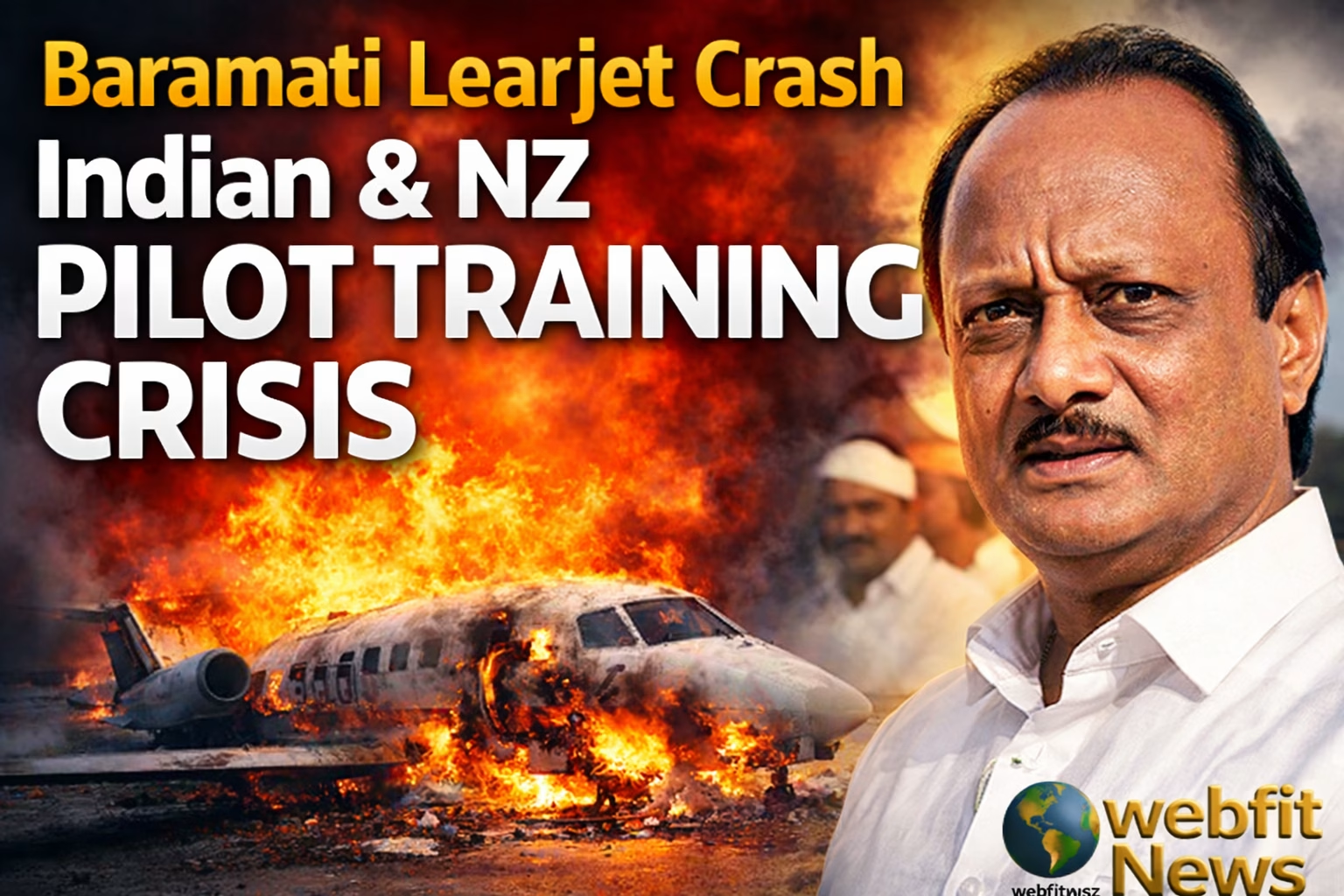
A tragedy that crossed borders and exposed uncomfortable gaps in pilot training oversight
The Learjet 45 crash at Baramati Airport on January 28, 2026, was not just another aviation accident. It became a moment of reckoning for two countries connected by a quiet but powerful link: pilot training.
The crash killed five people, including Maharashtra Deputy Chief Minister Ajit Pawar, sending shockwaves across India’s political and aviation circles. As investigators began reconstructing the final minutes of the flight, attention moved far beyond the runway at Baramati, reaching flight schools, regulators, and training standards as far away as New Zealand.
What initially appeared to be a tragic landing accident is now forcing a deeper conversation about how pilots are trained, certified, and monitored across borders.
What Happened at Baramati
The aircraft, a Bombardier Learjet 45XR operated by VSR Ventures Pvt Ltd, departed Mumbai on a short executive charter flight to Baramati. The destination airport is an uncontrolled airfield with no dedicated air traffic control tower and limited navigation aids.
Weather conditions were technically within visual limits, but haze reduced clarity during the approach. The crew attempted a first landing but executed a go-around after failing to visually acquire the runway. During the second approach, the aircraft touched down off the runway threshold, veered out of control, and was engulfed in fire following a violent impact.
The aircraft was destroyed. There were no survivors.
India’s Aircraft Accident Investigation Bureau has confirmed a full technical and human factors investigation is underway.
A Pattern That Cannot Be Ignored
This was not the first serious accident involving a Learjet operated by the same company. In 2023, another VSR Ventures Learjet 45 suffered a runway excursion in Mumbai during poor weather. That incident did not result in fatalities, but it raised concerns about approach stability, crew response, and operator safety culture.
Two similar accidents involving the same aircraft type, the same operator, and landing phase difficulties have intensified scrutiny of training practices and operational oversight.
The Learjet 45 is known for high approach speeds and narrow margins during landing. Errors during final approach leave little room for recovery, especially at airfields without precision guidance.
Who Was in the Cockpit
The aircraft was commanded by Captain Sumit Kapoor, a highly experienced pilot with more than 16,000 flight hours. By all accounts, he met licensing and medical requirements.
The First Officer was Shambhavi Pathak, a 25-year-old pilot representing a new generation of Indian aviators. She held a frozen ATPL, had instructional experience, and came from a strong academic background.
Her flight training history, however, has drawn attention because it included overseas training in New Zealand.
New Zealand’s Role Enters the Spotlight
Pathak completed her initial commercial pilot training at the New Zealand International Commercial Pilot Academy in Whanganui between 2018 and 2019. She was issued a New Zealand commercial pilot licence before converting it for use in India under DGCA rules.
In 2025, less than a year before the Baramati crash, the New Zealand Civil Aviation Authority took the rare step of grounding NZICPA’s fleet following whistleblower complaints. Investigations identified serious issues in maintenance records, training continuity, instructor workload, and governance.
The Civil Aviation Authority of New Zealand and the New Zealand Qualifications Authority both confirmed shortcomings in oversight and quality systems at the academy.
While Pathak trained years before the grounding, aviation experts note that institutional weaknesses often develop over long periods rather than appearing overnight.
Regulatory Pressure on New Zealand Aviation Oversight
New Zealand has long enjoyed a strong international reputation for flight training. That reputation has come under strain.
A 2025 audit by the International Civil Aviation Organization recorded an Effective Implementation score of just over 70 percent for New Zealand’s aviation oversight. While technically acceptable, it marked a decline from earlier years and highlighted gaps in surveillance, inspector training, and enforcement consistency.
Critics argue that New Zealand’s growing reliance on international pilot training as an export industry has created commercial pressure to accelerate training timelines. Faster pathways, higher student volumes, and airline-aligned cadet programs may improve throughput, but they risk reducing exposure to complex manual flying scenarios.
The Broader Question Facing India
India’s aviation growth depends heavily on foreign training pipelines. Hundreds of Indian pilots obtain licences overseas each year before converting them domestically under the Directorate General of Civil Aviation.
The Baramati crash raises an uncomfortable but necessary question: should India rely solely on foreign regulators to assure training quality, or should it conduct direct audits of overseas flight schools supplying Indian airlines and operators?
Some experts argue that mutual recognition without active verification creates blind spots that only become visible after tragedy.
What Investigators Will Likely Examine Next
Authorities are expected to focus on several key areas:
- Whether the approach into Baramati met the stabilized approach criteria
- Crew resource management and decision making after the first go-around
- Operator training practices following the 2023 Mumbai incident
- Quality and depth of foundational pilot training
- Oversight effectiveness by both Indian and New Zealand regulators
No conclusions have been reached. Any attempt to assign individual blame would be premature and unfair.
A Shared Responsibility Across Borders
Aviation safety does not stop at national boundaries. Training decisions made in one country can have consequences thousands of kilometres away.
For India, the lesson may be about strengthening oversight of imported licences.
For New Zealand, it may be about restoring confidence in a system once seen as a global benchmark.
For families affected by the Baramati tragedy, accountability matters more than reputation.
Conclusion
The Baramati Learjet crash was not simply a runway accident on a hazy morning. It exposed cracks in how modern aviation balances speed, scale, and safety.
Until training quality, regulatory vigilance, and operational discipline are treated as non-negotiable, similar questions will continue to surface after every major accident.
Lives depend on the answers.
References
- Aircraft Accident Investigation Bureau, India
- Civil Aviation Authority of New Zealand official notices
- New Zealand Qualifications Authority regulatory findings
- ICAO Universal Safety Oversight Audit Programme
- Directorate General of Civil Aviation, India publications
Legal clarity
The causes of the Baramati crash have not been determined. All references to training institutions, operators, and regulators are based on publicly available records, audit findings, and official statements. Responsibility for the accident will be established only through the Aircraft Accident Investigation Bureau’s final report.