
AUCKLAND, 10 August 2026
An Auckland builder has been fined $8,000 after carrying out restricted building work without the required licence or supervision and using another Licensed Building Practitioner’s licence without that person’s knowledge or consent.
The sentence was handed down in the Manukau District Court following a prosecution by the Ministry of Business, Innovation and Employment.
Angelo Madut was found guilty of carrying out restricted building work while unlicensed and unsupervised, as well as knowingly making a false or misleading statement under the Building Act 2004.
Judge Forrest imposed a total fine of $8,000 plus court costs.
Foundation work carried out before licence obtained
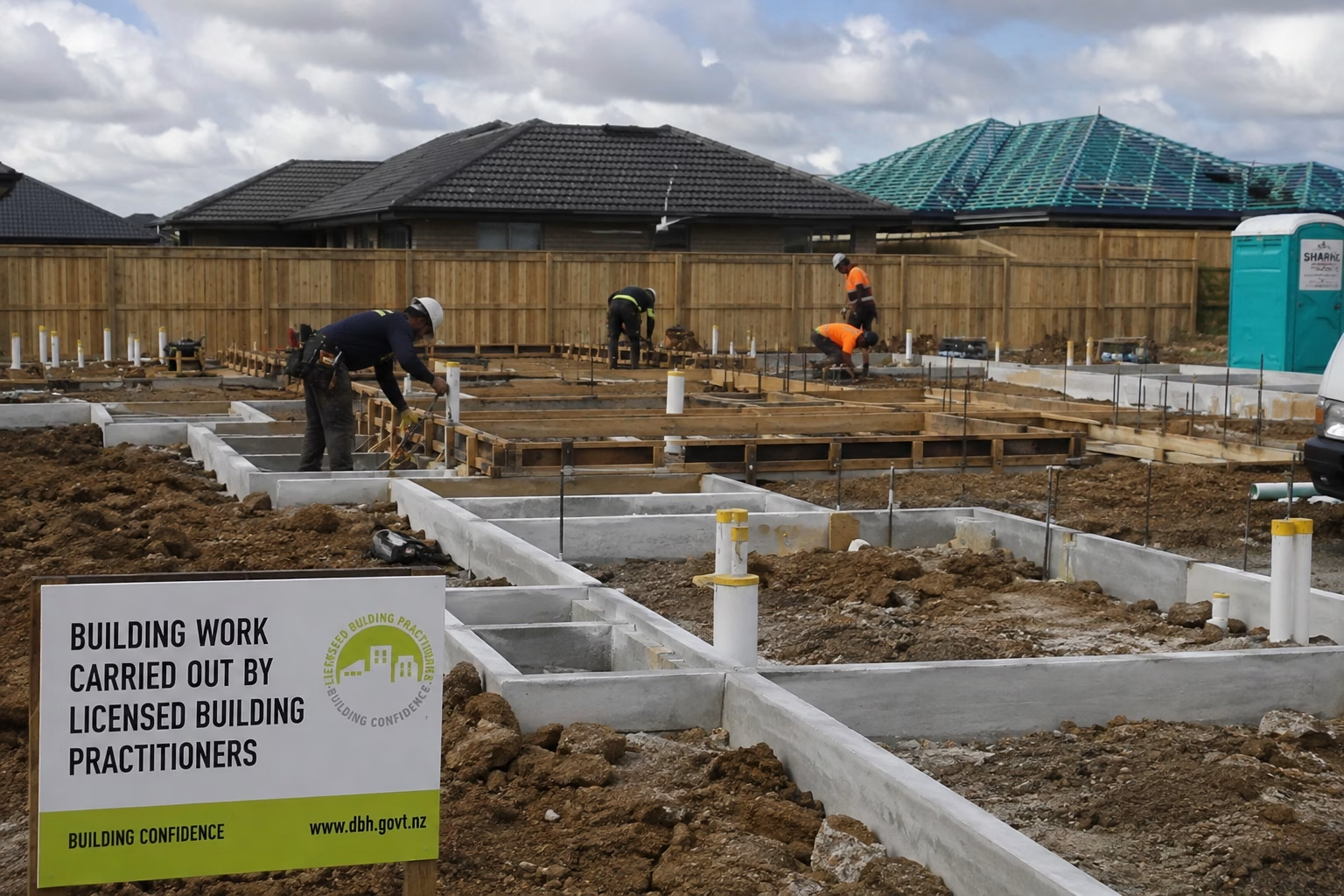
The case related to foundation construction work at an Auckland residential development.
Foundation work is classed as restricted building work because it involves critical structural elements of residential construction.
Under the Licensed Building Practitioner scheme, this type of work must be carried out or supervised by an appropriately licensed practitioner.
MBIE said Madut undertook the work before he had obtained an LBP licence.
That meant he was not legally entitled to carry out the restricted work on his own and was required to be properly supervised by a licensed practitioner.
Another builder’s licence used during inspection
The case became more serious during a building inspection.
According to MBIE, Madut told an inspector that another licensed practitioner had supervised the work.
He also provided a copy of that person’s licence.
However, MBIE’s investigation found that the licensed practitioner had not been involved in the project and had not authorised Madut to use their licence.
That resulted in an additional finding that Madut had knowingly made a false or misleading statement under the Building Act.
MBIE warns licence misuse is an offence
Bevan Yee, Acting National Manager Occupational Regulation at MBIE, said the case highlighted the importance of proper licensing and supervision.
“Restricted building work must be carried out or supervised by appropriately licensed practitioners. It is an offence to use another practitioner’s licence without their consent,” Yee said.
He said the Licensed Building Practitioner scheme plays a key role in maintaining confidence in residential construction.
“Licensed Building Practitioners and the LBP scheme play an important role in giving homeowners and councils confidence that restricted building work is being carried out by appropriately qualified people.”
Why restricted building work is treated differently
Restricted building work covers parts of residential construction that are considered especially important to a building’s structural integrity and ability to remain weatherproof.
This can include foundation work and other critical structural or weathertightness elements.
Because mistakes in these areas can have serious consequences, the law requires appropriately qualified practitioners to either carry out the work themselves or directly supervise it.
The system is designed to create accountability and give councils and homeowners confidence that important construction work is being completed to the required standard.
Licensed Building Practitioner scheme
The Licensed Building Practitioner scheme was established under the Building Act 2004.
Its purpose is to improve building quality and accountability across New Zealand.
Practitioners who hold an LBP licence can carry out or supervise restricted building work within the scope of their licence.
The scheme also gives homeowners and councils a way to check whether someone is properly licensed before work begins.
MBIE’s Occupational Regulation team administers the scheme and provides support to the Building Practitioners Board and associated licensing and disciplinary processes.
Unlicensed work can attract much larger penalties
The $8,000 fine in this case sits below the maximum penalty available under the Building Act.
Carrying out restricted building work without the appropriate licence or supervision can result in fines of up to $50,000.
That makes the legal obligations clear for builders working on residential projects.
Being experienced in construction is not enough if the work legally requires an LBP licence.
The practitioner must hold the appropriate licence or be properly supervised by someone who does.
Homeowners urged to check licences before work begins
MBIE is encouraging homeowners and others involved in building projects to verify a practitioner’s licence before engaging them for restricted building work.
Licence status can be checked through the LBP Public Register.
That allows homeowners to confirm whether a practitioner currently holds the required licence and whether they are authorised to carry out the type of work being proposed.
For homeowners, this check can reduce the risk of later discovering that restricted work was completed by someone who was not properly authorised.
It can also help avoid complications during council inspections, compliance checks or future property transactions.
Practitioners should act if their licence is misused
MBIE is also urging licensed practitioners to contact the Ministry if they believe their licence has been used without their knowledge or consent.
The use of another person’s licence is not a minor administrative issue.
A licence is effectively a professional credential that confirms the holder has met requirements under the LBP system.
Using that credential without permission can mislead councils, clients and inspectors about who actually carried out or supervised the work.
Accountability remains central to building regulation
The prosecution sends a clear message to the building industry.
Restricted building work must be completed within the rules, and licensed practitioners’ credentials cannot be borrowed, shared or used without authorisation.
For homeowners, the case is also a reminder to check licensing before work starts rather than after something goes wrong.
With residential building work involving major financial commitments and long-term safety implications, the LBP system exists to make responsibility clear.
In this case, the court found those obligations were not met, and the result was an $8,000 fine plus court costs.