Introduction
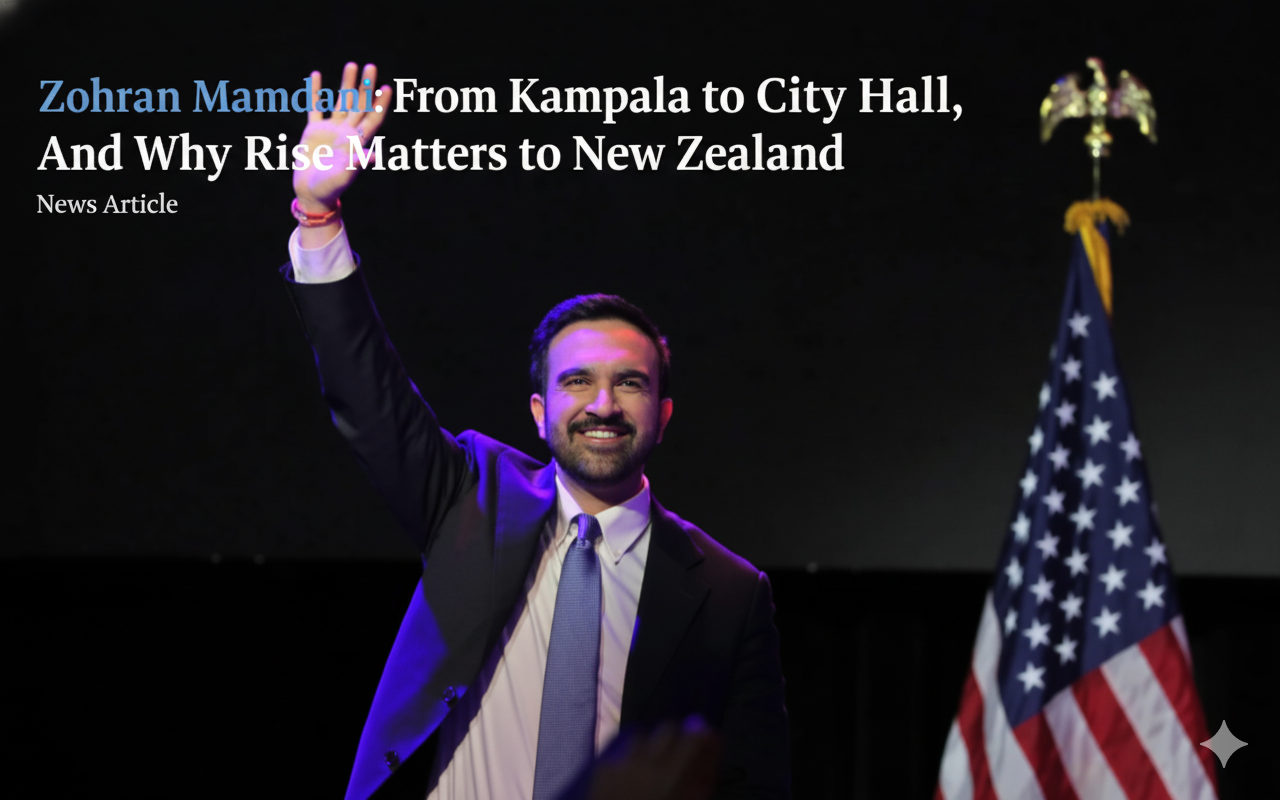
A new political era has begun in New York City.
Zohran Mamdani, once a housing counsellor and grassroots activist, has become the city’s first Muslim, first Asian American, and first immigrant mayor in eight decades.
His victory signals a shift in global urban politics and stands in sharp contrast to the centralised, corporate-style governance taking shape under New Zealand’s Prime Minister Christopher Luxon.
Who Is Zohran Mamdani?
Zohran Mamdani is a Ugandan-born politician of Indian descent.
He rose from community activism to lead one of the world’s most influential cities.
At only 34, he has turned a small socialist movement into a city-wide mandate focused on affordability, inclusion, and public welfare.
He represents a new generation of leaders who combine social justice ideals with practical governance.
Early Life and Family Roots
Mamdani was born in Kampala, Uganda, to Indian parents.
His father, scholar Mahmood Mamdani, and his mother, filmmaker Mira Nair, built their careers around ideas of identity and justice.
The family moved from India to East Africa, then to the United States when Zohran was seven.
His upbringing shaped his politics.
With one parent Hindu and the other Muslim, and later marrying a Syrian-American, Mamdani reflects the layered diversity of New York.
His Indian and African heritage, along with his immigrant experience, helped him connect with working-class and minority communities who often feel unseen in politics.
Education and Formative Years
Mamdani studied economics and political science at Bowdoin College in Maine.
After graduation, he worked as a foreclosure-prevention housing counsellor during the 2008 financial crisis.
Helping families save their homes gave him a direct view of inequality and shaped his belief that housing is a human right.
In 2020, he entered public life as a member of the New York State Assembly for Astoria, Queens.
He championed affordable housing, rent relief, and public transport.
His blend of academic insight and street-level empathy made him a fresh, relatable voice in progressive politics.
The Mayoral Campaign
Mamdani’s campaign began with a simple line: “New York is too expensive.”
He promised practical change—free buses, rent freezes, and universal childcare—rather than abstract slogans.
Backed by the Democratic Socialists of America, he built a diverse coalition of young voters, working families, and immigrants.
Against former Governor Andrew Cuomo, who ran as an independent, Mamdani won with 50.4 percent of the vote.
Record early turnout and smart social-media outreach helped him mobilise new voters.
His direct, people-focused style turned frustration over high costs into a unifying call for fairness.
Election Aftermath and the Trump Clash
Mamdani’s win shook American politics.
Former President Donald Trump attacked him as a “communist candidate” and endorsed Cuomo to block his rise.
In his victory speech, Mamdani replied, “Turn the volume up, because this is what democracy sounds like.”
This face-off highlights two opposite visions: Trump’s law-and-order nationalism versus Mamdani’s people-first socialism.
It mirrors a wider global divide between progressive local reform and conservative centralisation—seen in places like New Zealand.
Governance and Working Style
Since taking office, Mamdani has focused on delivering results over rhetoric.
His team blends moral conviction with technical know-how.
His key priorities include:
- A four-year rent freeze for two million regulated tenants.
- Construction of 200,000 affordable homes funded by higher corporate taxes.
- City-owned grocery stores to reduce food insecurity.
- Shifting homelessness and mental-health response from policing to community care.
Critics question whether the city can afford such a program.
Supporters say his pragmatic socialism proves bold ideas can still balance the books.
His cabinet combines policy experts, organisers, and analysts, signalling a move toward participatory government.
Mamdani and Luxon: A Tale of Two States
Mamdani’s leadership in New York contrasts sharply with Christopher Luxon’s rule in New Zealand.
Mamdani spreads power through social programs and public involvement.
Luxon’s administration is doing the opposite—centralising control through the Fast-Track Approvals Bill and limiting local input on environmental decisions.
Mamdani’s vision asks the state to protect the vulnerable through redistribution.
Luxon’s strategy relies on efficiency and discipline by strengthening executive power.
One builds equity from the bottom up; the other enforces order from the top down.
Why It Matters for New Zealand
Zohran Mamdani’s story goes beyond New York.
It shows how local leadership can challenge global inequality and revive trust in government.
For New Zealand, where leaders debate how to balance social fairness with economic growth, his rise poses a question: Can empathy and bold policy work together?
As Auckland faces housing shortages and rising living costs, Mamdani’s example reminds us that courage in leadership still resonates.
His model of compassionate, practical politics may soon shape how people everywhere, including in Wellington, measure effective governance.