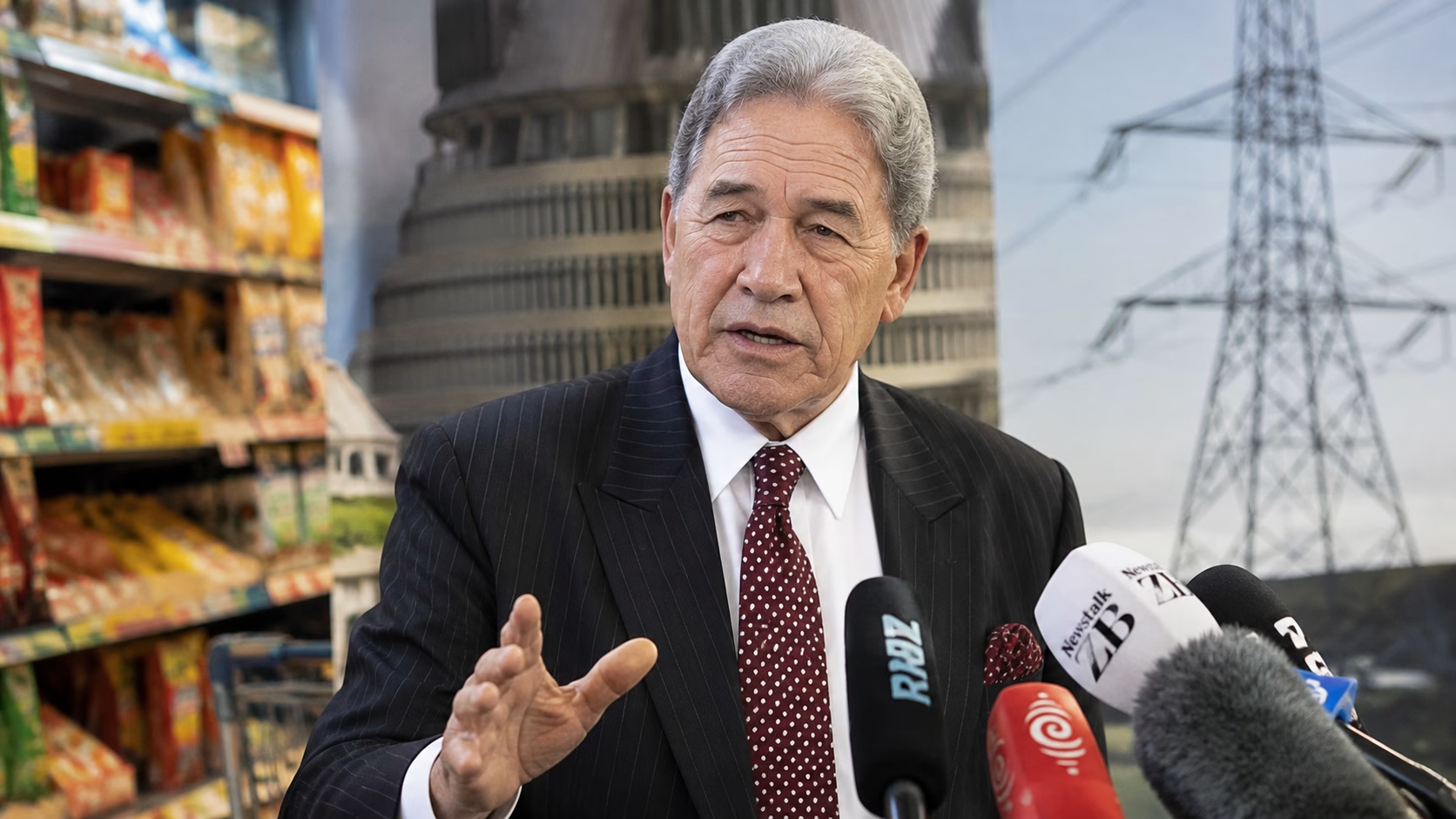
Winston Peters has laid out one of the most aggressive policy agendas of New Zealand’s 2026 election campaign, promising changes to electricity companies, supermarkets, banking, KiwiSaver, infrastructure, mining, energy exploration, climate policy and even who should be allowed to vote.
Coming from the leader of New Zealand First, Foreign Minister and one of the most experienced political operators in the country, the message deserves more than a quick reaction.
It also carries an unusual political tension.
Peters is campaigning as a member of the current National-led coalition Government while simultaneously proposing major changes that could reshape parts of the economic and regulatory system overseen by that same Government.
With the general election scheduled for 7 November and the political contest tightening, Peters appears to be positioning NZ First not simply as a coalition partner seeking another term, but as the party that wants to force the next government further towards economic nationalism.
His central argument is straightforward: New Zealand should own more of its strategic assets, develop more of its natural resources, reduce dependence on overseas institutions and intervene much more aggressively where markets are not delivering acceptable outcomes for households.
Whether all of those promises are financially or politically achievable is another question.
Here is what he is actually proposing.
Luxon Survives Again, But National Has Now Made the 2026 Election His Test – WebfitNews
1. Breaking up the power companies
Peters says New Zealand First wants to break up the large electricity companies that combine power generation with electricity retailing.
These businesses are commonly known as gentailers.
The argument from NZ First is that having major companies controlling both generation and retail weakens genuine competition and contributes to high electricity costs.
This is not a small regulatory adjustment. Structurally separating generation businesses from retail operations could fundamentally reshape New Zealand’s electricity market.
Supporters of such a move argue that separating the two functions could reduce conflicts within vertically integrated companies and create stronger competition.
Critics question whether restructuring the companies would actually reduce household power bills.
The New Zealand Initiative, for example, has argued that simply splitting generators from retailers would not necessarily produce cheaper electricity because New Zealand’s underlying problems also involve generation capacity, dry-year risk, transmission investment and future energy supply.
That distinction matters.
High power prices are politically potent, but restructuring ownership does not automatically create more electricity.
The real test for NZ First would therefore be whether its proposal could generate meaningful consumer savings after transition costs and market disruption are included.
2. Splitting the supermarket duopoly
This may be one of Peters’ most politically attractive proposals.
New Zealand’s grocery sector is dominated by Woolworths New Zealand and the Foodstuffs cooperatives.
The Commerce Commission has previously concluded that competition in the grocery market is not working as well as it should and that stronger competition could produce better prices, choice and service for consumers.
NZ First wants to go significantly further than existing reforms.
Its proposal is to restructure Foodstuffs into two nationwide competitors based around separate brands.
Under the proposal, Pak’nSave would operate as one national cooperative while New World and Four Square would form another, placing both in direct competition with Woolworths.
The political logic is obvious.
Few issues connect more directly with voters than the price of groceries.
But the economics are more complicated.
Large supermarket networks gain purchasing, logistics and distribution efficiencies from scale. A forced restructuring could increase competition, but if badly designed it could also increase operating costs.
The question is therefore not whether New Zealand needs stronger supermarket competition. Even the Commerce Commission has identified that problem.
The real question is whether compulsory structural separation is the best way to achieve it.
3. Bringing a major bank back into New Zealand ownership
Peters also wants New Zealand to buy back the Bank of New Zealand from its Australian owner, National Australia Bank.
NZ First argues that the purchase could restore greater national control over banking and create a powerful locally owned competitor.
The party has suggested the acquisition could be financed through mechanisms including sovereign banking bonds, long-term Crown borrowing and investment connected with public funds.
Peters argues that BNZ’s profitability means the acquisition could ultimately service its own financing.
This proposal will attract attention because banking profitability has become a politically sensitive subject in New Zealand.
But buying BNZ would involve an enormous capital commitment.
Even if the bank continued producing substantial profits, taxpayers would still ultimately carry acquisition and financing risk.
Supporters would call it strategic ownership.
Critics would call it an expensive use of government borrowing when New Zealand already owns Kiwibank.
That debate is likely to become one of the sharper economic arguments of the campaign.
4. Returning mining royalties to the regions
NZ First wants 50 percent of Crown mineral royalties generated from mining to be returned directly to the region where the mining activity occurs.
Peters argues communities hosting extraction projects should receive a tangible share of the financial benefit.
The money could be directed towards regional infrastructure, flood protection, transport, housing-enabling works, energy projects and local development.
Politically, the proposal could resonate strongly in mining regions.
For decades regional communities have argued that Wellington collects revenue from productive industries while local councils carry infrastructure and environmental pressures.
Critics will focus on environmental consequences and whether sharing royalties could create incentives for councils to support extraction projects primarily for financial reasons.
That debate reflects a larger philosophical divide in the election.
NZ First increasingly sees natural resources as an economic opportunity that New Zealand has been too reluctant to exploit.
Environmental parties are likely to see the same expansion as increasing long-term ecological and climate risk.
5. A new inquiry into Covid vaccine injuries
Peters has also called for a parliamentary select committee inquiry focused specifically on people who say they suffered injuries after Covid-19 vaccination and on questions surrounding compensation.
This is politically sensitive territory.
Any credible inquiry would need to distinguish carefully between medically verified vaccine injuries, suspected adverse events and conditions that occurred after vaccination without proven causation.
New Zealand already has systems for reporting suspected adverse reactions and ACC can provide cover for qualifying treatment injuries.
NZ First, however, argues that some affected people have not been adequately heard and wants further parliamentary scrutiny.
The challenge for any investigation would be maintaining scientific rigour while allowing people claiming injury to have their evidence examined fairly.
Turning the issue into a partisan argument would help nobody.
A properly constituted inquiry would need medical evidence, pharmacovigilance data, ACC information and independent expert testimony.
6. Compulsory KiwiSaver from birth, with $1,000 for eligible children
One of NZ First’s more unusual proposals is automatic KiwiSaver enrolment from birth.
The party says New Zealand citizen children would receive an immediate Crown contribution of $1,000 into their KiwiSaver account.
Peters presents this as the beginning of what he calls a KiwiSaver generation.
There is a powerful mathematical argument behind early investment.
Money invested at birth has decades to compound before retirement.
But making KiwiSaver compulsory raises questions around parental choice, contribution rules, administrative costs and how the policy would apply as children grow older.
The policy also reveals an important theme running through Peters’ economic platform.
He is not arguing for a smaller state across the board.
On several issues he is proposing much more active government intervention, provided that intervention is directed towards national ownership, savings, infrastructure and productive investment.
7. A $100 billion Future Fund
Perhaps the biggest number in Peters’ programme is his proposed $100 billion Future Fund.
NZ First says the fund would support a 30-year infrastructure programme.
New Zealand undeniably faces major infrastructure pressures.
Transport, water systems, hospitals, electricity networks and housing infrastructure require long-term investment extending far beyond the three-year political cycle.
A 30-year planning framework therefore has obvious appeal.
The critical unanswered questions are how quickly the fund would reach $100 billion, where the capital would come from, how much would represent new borrowing, what assets would be held, and which institution would determine investment priorities.
The difference between a sovereign investment fund and a government spending account is enormous.
If NZ First wants the proposal taken seriously as fiscal policy, considerably more detail will be required before polling day.
8. Leaving the Paris Agreement
This may be the most internationally consequential proposal in the entire package.
NZ First says New Zealand should withdraw from the Paris climate agreement.
Peters argues New Zealand produces only a tiny share of global emissions and should not impose large costs on its economy while major economies generate vastly more greenhouse gases.
New Zealand ratified the Paris Agreement in 2016 and has subsequently submitted national emissions reduction commitments under the framework.
Leaving the agreement would therefore represent a substantial shift in New Zealand foreign and climate policy.
Supporters of Peters’ position argue New Zealand should prioritise domestic environmental investment rather than incur potentially large costs meeting international emissions targets.
Opponents would argue that smaller countries cannot logically demand action from large emitters while abandoning their own commitments.
Withdrawal could also become a trade and diplomatic issue rather than remaining purely an environmental debate, particularly as climate obligations increasingly appear in trade agreements and international investment decisions.
9. Citizens only voting
NZ First wants general election voting rights restricted to New Zealand citizens.
Currently eligible permanent residents can vote in New Zealand elections if they satisfy the residence requirements.
Peters argues voting should belong to people who have taken the final legal step of becoming New Zealand citizens.
Supporters will see that as strengthening the value of citizenship.
Opponents are likely to argue that permanent residents who live, work, pay taxes and raise families in New Zealand have a legitimate stake in how the country is governed.
There is another practical consequence.
New Zealand has historically had unusually inclusive voting rules for permanent residents compared with many other democracies.
Changing that would significantly reshape the country’s approach to political participation.
For migrant communities, including Auckland’s large Asian and Pacific populations, this could become one of the most personally consequential election policies.
10. Spending $1 billion to map New Zealand’s underground energy potential
Peters’ Facebook summary refers heavily to oil and gas exploration, but the full NZ First policy is broader.
The party proposes an initial $1 billion investment over a term of government into what it calls a National Subsurface Development Survey.
The programme would map potential energy resources, geothermal resources and carbon storage sites and build a national geological dataset.
NZ First argues New Zealand may possess major untapped offshore and deep-basin resources capable of improving domestic energy security and potentially supporting exports.
Peters has compared the potential economic opportunity with resource-rich countries that transformed their economies through energy discoveries.
That is the upside case.
The downside is obvious.
Exploration does not guarantee commercially recoverable reserves.
A billion-dollar government investment could produce valuable geological information without producing a commercially viable oil or gas discovery.
There is also a direct clash between expanded fossil-fuel development and international climate commitments, which helps explain why NZ First is simultaneously campaigning to leave the Paris Agreement.
These policies are not isolated.
They form one connected economic strategy.
11. The Kiwi Kids Grant
NZ First also wants a new Kiwi Kids Grant targeted at New Zealand citizens raising their first three children during the first three years of each child’s life.
The party says falling birth rates and the cost of raising children are becoming national economic and demographic problems.
That puts NZ First into a growing international debate.
Countries across Europe and Asia are spending increasing amounts trying to encourage families to have children as fertility rates fall.
Cash support can certainly ease household pressure.
Whether it substantially changes birth rates is much less certain.
Housing affordability, childcare costs, job insecurity, working hours and delayed family formation also influence fertility decisions.
The effectiveness of the Kiwi Kids Grant would therefore depend heavily on its size, eligibility rules and relationship with existing family support.
Peters is campaigning against parts of the system while sitting inside it
This is what makes his 2026 campaign particularly interesting.
Winston Peters is not campaigning as an outsider.
He is Foreign Minister and leader of a party participating in the National-led coalition Government.
Yet his campaign increasingly argues that important parts of New Zealand’s existing economic model need fundamental reconstruction.
Banking needs more New Zealand ownership.
Supermarkets need structural intervention.
Electricity companies need breaking apart.
Natural resources need greater development.
Infrastructure requires generational investment.
Climate obligations should be reconsidered.
Citizenship should carry greater political privilege.
That is more than a collection of policies.
It amounts to an economic nationalist programme.
Coalition politics could make Peters even more important
There is another reason voters should pay attention.
New Zealand’s election remains highly competitive.
Recent polling has produced a fluid picture, with the governing National, ACT and NZ First bloc facing a tight contest and new political forces gaining support.
A 1News Verian poll released on 12 August showed the Opportunity Party reaching 8 percent while NZ First fell three points in that survey.
Other polling has shown the existing governing bloc capable of retaining only a narrow parliamentary majority.
Under MMP, the precise percentage won by NZ First could therefore determine not only whether Peters returns to Parliament, but how much leverage he carries during coalition negotiations.
Peters understands coalition leverage better than almost anyone in New Zealand politics.
That makes every policy announcement relevant even if NZ First never wins enough votes to implement its programme alone.
The real question after the election may not be whether Winston Peters becomes prime minister.
It may be how much of Winston Peters’ agenda another prime minister has to accept to form a government.
The bigger political bet
Peters appears to be betting that a substantial group of New Zealand voters believe the country’s economic system no longer works sufficiently in their interests.
Electricity bills are high.
Groceries remain expensive.
Australian-owned banks generate large profits.
Infrastructure feels permanently behind demand.
Regional communities want a larger share of resource wealth.
Families worry about their children’s economic future.
On those frustrations, Peters has identified genuine political pressure points.
But identifying the pressure points is easier than implementing the solutions.
Breaking companies apart creates transition risks.
Buying a bank requires billions.
Building a $100 billion investment fund requires credible financing.
Expanding energy extraction introduces environmental and market risks.
Leaving Paris could produce diplomatic and commercial consequences.
Restricting voting rights would trigger a significant democratic debate.
Those details will determine whether this platform eventually looks transformational or simply extraordinarily ambitious.
One thing, however, is already clear.
Winston Peters is not preparing to quietly defend the record of the current coalition.
He is preparing to negotiate the shape of the next one.
And if election night produces another closely divided Parliament, New Zealand may discover that this Facebook list was not simply campaign rhetoric.
It was Peters publishing his coalition shopping list in advance.
References
New Zealand First, 2026 policy announcements and speeches
New Zealand First, “New Zealand In Its Eleventh Hour”, 2 August 2026
New Zealand First, “An Election Like No Other”, 28 June 2026
New Zealand First, supermarket competition policy, April 2026
New Zealand First, mining royalties policy, March 2026
New Zealand First, citizen-only voting policy, July 2026
New Zealand First, National Subsurface Development Survey proposal, 2026
Commerce Commission New Zealand, Grocery Market Study and grocery competition information
Ministry of Foreign Affairs and Trade, New Zealand and the Paris Agreement
Electricity Authority, New Zealand electricity market information
1News, polling and BNZ policy reporting, 2026
Reuters, New Zealand election and coalition polling, August 2026