By Geet G | Webfit News
Introduction: More Than Just an Election Result
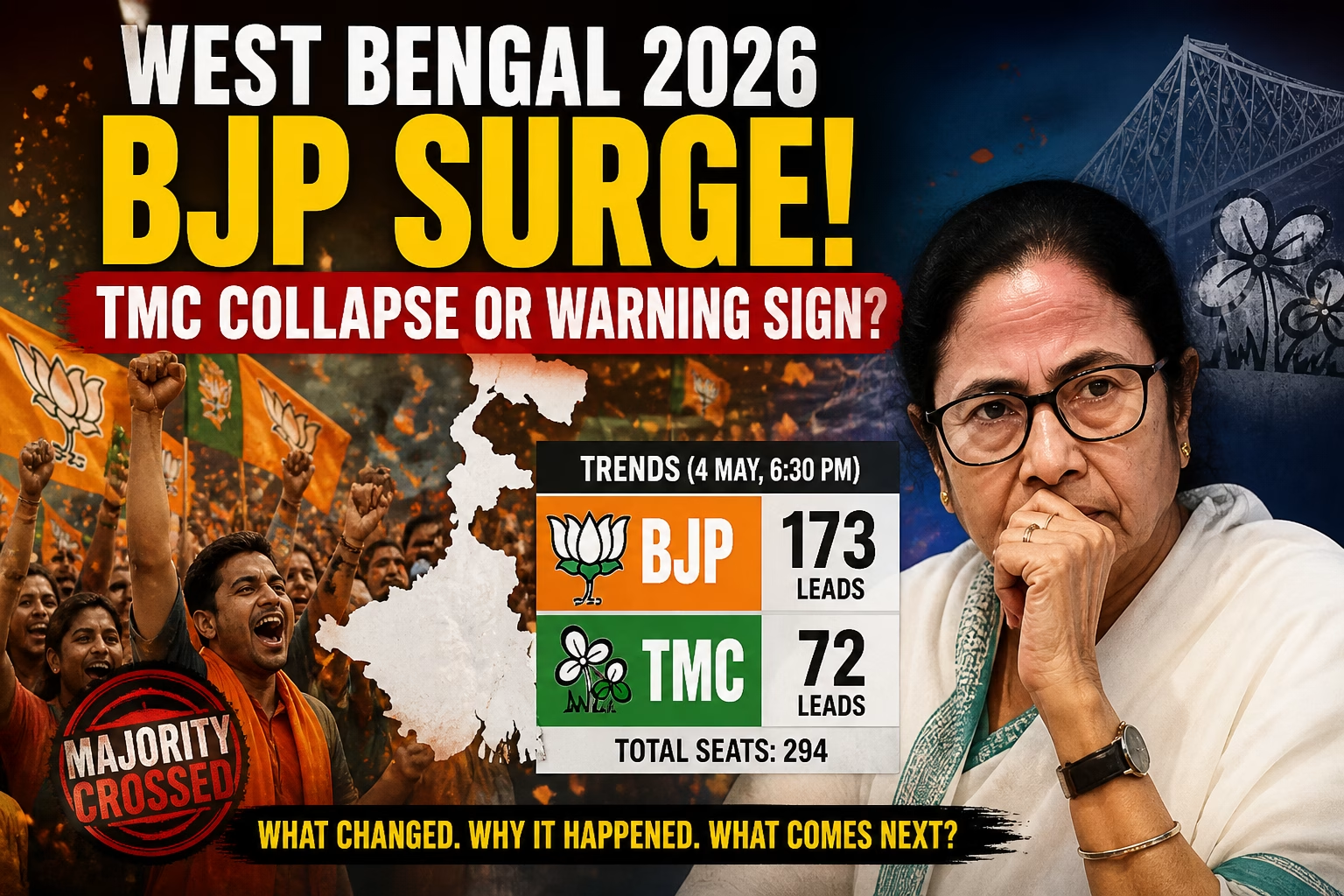
As counting trends unfold on 4 May 2026, West Bengal is not just witnessing a change in numbers. It is witnessing a possible shift in political identity.
Early leads show the Bharatiya Janata Party (BJP) crossing the majority mark comfortably, while the Trinamool Congress (TMC) is trailing far behind. On paper, it looks like a clean win.
But here is the uncomfortable question most headlines will avoid:
Did BJP win West Bengal… or did TMC lose it?
Because the answer to that question tells you what comes next.
Could the same mistakes cost Labour again in 2026? – WebfitNews
The Numbers at 6:30 PM: A Clear Direction
At the time of writing, trends suggest:
- BJP leading in 167 to 173 seats
- TMC leading in 72 to 82 seats
- Others barely visible
This is not a tight contest. This is a collapse on one side and consolidation on the other.
And when that happens, it is rarely just about one campaign.
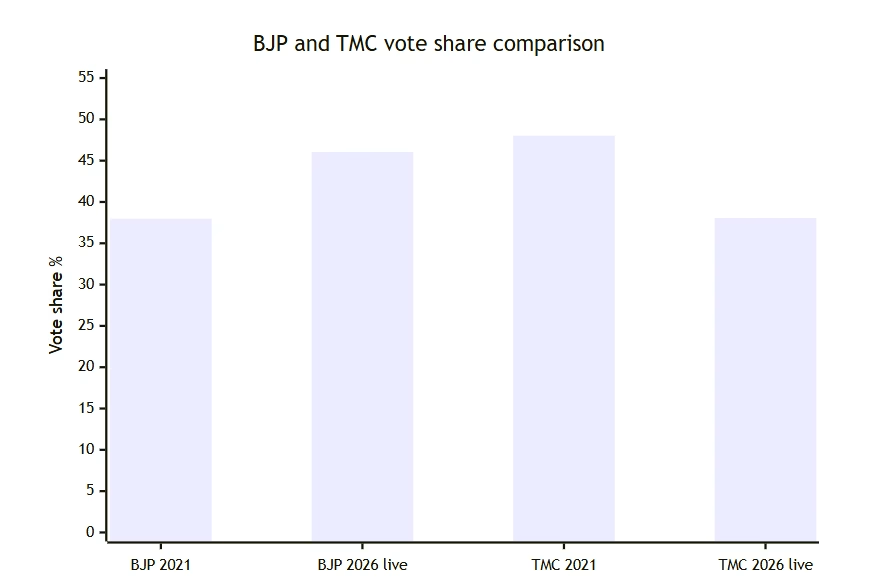
| Vote-share measure | 2026 live counted-vote snapshot | 2021 final |
|---|---|---|
| BJP | 46.04% | 37.97% |
| TMC/AITC | 38.05% | 48.02% |
| Congress | 1.73% | 3.03% |
| CPI(M) visible in live snapshot | 1.84% | Left total 5.66% |
| Others and minors | 12.34% | 5.32% |
The Real Story: A Collapse Years in the Making
Let’s be blunt.
TMC did not lose this election today. It started losing it over the last few years.
1. Governance Fatigue Became Real
Fifteen years in power creates a pattern:
- Systems become rigid
- Local leaders become powerful
- Accountability becomes weak
Voters may tolerate this for some time. But eventually, fatigue turns into frustration.
2. Corruption Narrative Stuck
From teacher recruitment scams to local-level allegations, the BJP did not need to prove everything.
They just needed to repeat it consistently.
And they did.
Once voters start believing “something is wrong,” perception becomes reality.
3. Safety and Trust Broke Down
The R.G. Kar hospital incident became a turning point.
It was not just about one crime. It became symbolic:
- Urban voters questioned law and order
- Women voters questioned safety
- Middle class questioned governance
That kind of emotional shift is hard to reverse with welfare schemes alone.
| Region | Live pattern in verified reporting | Evidence in retrieved sources |
|---|---|---|
| North Bengal | BJP dominant or strongly ahead | BJP leads in multiple seats in Alipurduar and Jalpaiguri; Dinhata, Mekliganj, Sitalkuchi among notable early BJP advantages |
| Tribal west and Jungle Mahal | BJP resurgence | BJP leading in 3 of 4 seats in Jhargram, 7 in Purulia, 6 in Bankura in an early regional breakdown |
| Central and industrial belt | BJP making deep inroads | Hooghly shown with BJP 7 and TMC 2 in one early regional cut; Purba Medinipur with BJP leads in 11; Agnimitra Paul among prominent early leaders in the Asansol industrial belt |
| Presidency and South Bengal | TMC still alive, but cracks visible | TMC ahead in much of South 24 Parganas and still leading in several Kolkata seats, but BJP was competitive in Rashbehari, Behala belts, Jadavpur-region narratives, and Diamond Harbour zone |
| Border Muslim-majority belt | Fragmented | BJP leading in 6 Malda seats and 2 Murshidabad seats in one early breakdown, while Congress and CPI(M) remained in contention in a few pockets |
The BJP Strategy: Simple, Focused, Relentless
While TMC was defending its record, BJP did something smarter.
They simplified the election.
Their core messaging:
- Corruption vs Clean governance
- Fear vs Security
- Welfare vs Development
No confusion. No overcomplication.
And more importantly:
They became the only real alternative.
| Constituency | What the live count showed | Why it mattered |
|---|---|---|
| Bhabanipur | Mamata Banerjee led by 8,482 votes after 4 of 20 rounds in one verified snapshot | Symbolic test of whether the BJP could wound Mamata on her own home turf after early fluctuations |
| Nandigram | Suvendu Adhikari was ahead in early rounds | Proof that Adhikari’s personal base remained intact while he also fought Bhabanipur |
| Panihati | Ratna Debnath led by 2,763 after the first round | The RG Kar case had become a proxy referendum on women’s safety and anti-incumbency |
| Diamond Harbour | BJP led by 2,580 in one live update | Politically embarrassing for the TMC because of the area’s association with Abhishek Banerjee’s zone of influence |
| Dinhata | BJP’s Ajay Ray led by 13,188 after 6 rounds | Strong sign that North Bengal remained central to the saffron strategy |
| Gaighata | BJP’s Subrata Thakur was later shown leading again in the Matua heartland | One of the best indicators of how citizenship and Matua politics were landing |
| Domkal | CPI(M) briefly showed life against TMC in one early round; AJUP was weak there | Evidence that minority-belt contests were not uniform and that anti-TMC votes were splintered in different ways |
The Death of the Third Front Helped BJP
Look at this carefully.
The Left and Congress are almost irrelevant now.
This matters more than people realise.
Because when opposition votes do not split:
- Anti-incumbency consolidates
- One challenger gets stronger
That is exactly what happened.
From 30 percent vote share in 2011 to almost nothing in 2021, the Left collapse created space.
BJP filled that space completely.
The SIR Factor: The Most Controversial Game-Changer
The Special Intensive Revision (SIR) removed around 90 lakh voters.
That is massive.
Two possible interpretations:
TMC view:
Targeted removal of minority and pro-TMC voters
BJP view:
Cleaning duplicate and fake entries
But here is what matters practically:
- Voter base shrank
- Turnout percentage jumped to over 92 percent
- Ground-level mobilisation advantage changed
And in a state where booth-level control matters, that shift is huge.
Regional Shift: The Real Warning Sign for TMC
Forget overall numbers. Look at geography.
North Bengal:
BJP dominance strengthened
Jungle Mahal:
Clear swing towards BJP
South Bengal:
TMC’s strongest zone… now breached
This is the real story.
When your core strongholds start cracking, it is not a bad day.
It is a structural problem.
Urban Bengal: The Silent Revolt
Kolkata is still partially holding for TMC.
But not fully.
Seats like:
- Jadavpur
- Behala
- Rashbehari
show BJP leads or strong competition.
Urban voters are shifting.
And urban shifts usually come before wider state shifts.
Women and Welfare: Why It Didn’t Hold
TMC relied heavily on schemes like:
- Lakshmir Bhandar
And it did help them survive earlier elections.
But in 2026, something changed.
Voters seem to have asked:
Is money enough if safety and trust are missing?
BJP countered with:
- Higher financial promises
- Government salary reforms
- Stronger law-and-order messaging
That combination chipped away at TMC’s base.
The Bigger Question: What Happens Next?
If BJP forms the government, this is not just a state-level change.
This has national implications.
1. BJP Breaks Eastern Barrier
West Bengal has long resisted BJP expansion.
This changes that story completely.
2. TMC Weakens Nationally
Mamata Banerjee has been a key opposition voice.
A loss here reduces her national leverage.
3. 2029 Lok Sabha Impact
This election becomes a test case for future national strategies.
Webfit News Perspective
Let’s not oversimplify this.
This is not just a “BJP wave.”
This is what happens when:
- A long-term government loses trust
- Opposition becomes unified
- Narrative becomes simple
- Voters feel heard elsewhere
If TMC sees this as just a temporary setback, they will repeat the mistake.
If BJP sees this as guaranteed dominance, they might overestimate their control.
Because here is the truth most political parties ignore:
Voters are not loyal. They are transactional.
They reward performance. They punish complacency.
Final Thought: A Turning Point or Just a Warning?
West Bengal 2026 could be remembered as:
- The beginning of a new political era
or - A strong warning that power is never permanent
Right now, it looks like a landslide.
But what really happened here is deeper:
A system that worked for years… stopped working.
And once that happens, no campaign can save you.
References
- Election Commission of India (ECI) official trends portal
- Historical election data and vote share analysis
- Public reports on SIR electoral roll revision
- Field reports and constituency-level trends
- Political campaign statements and rally speeches