By Webfit News | International Affairs
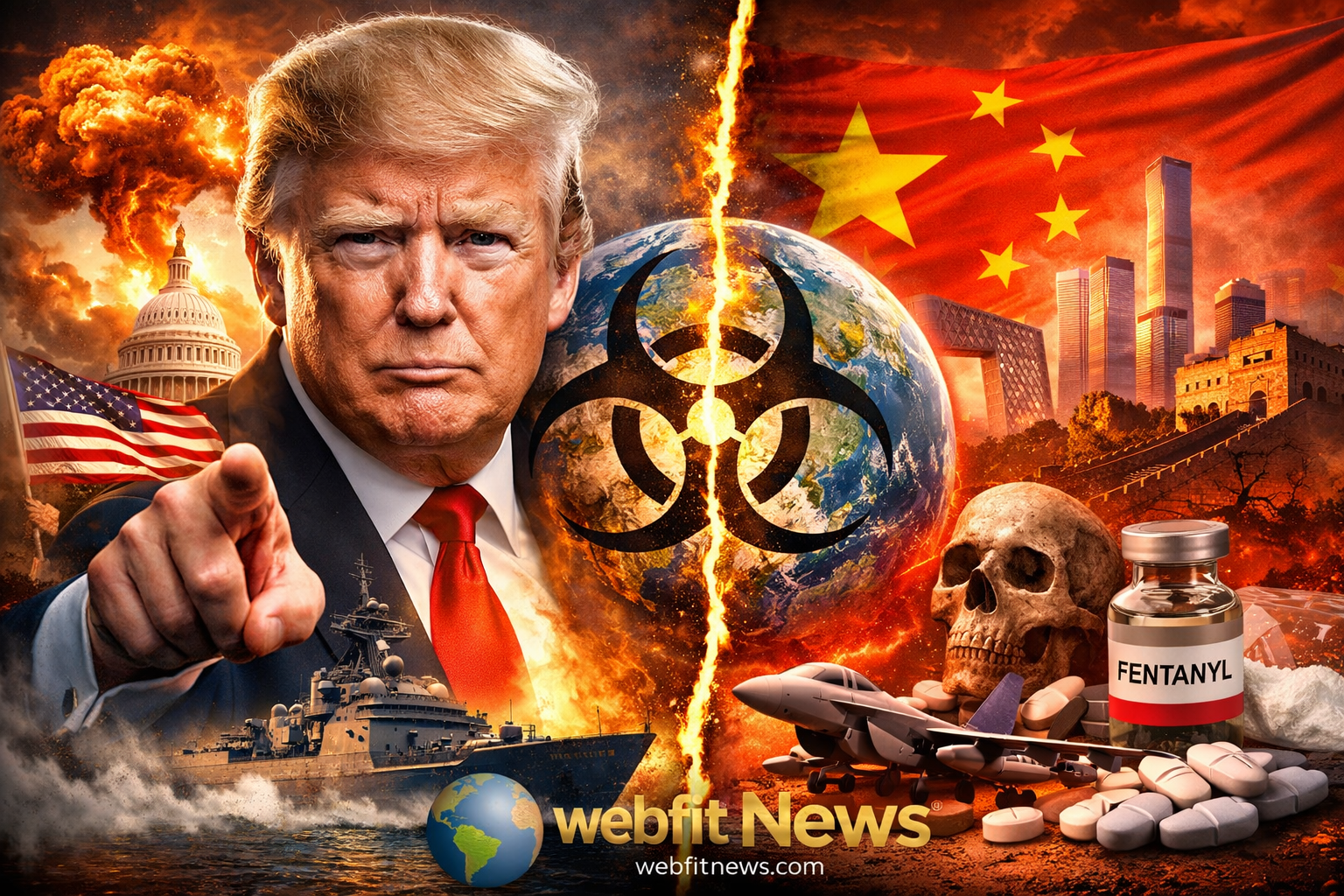
The United States and China are again testing the boundaries of cooperation after US President Donald Trump formally labelled illicit fentanyl a “weapon of mass destruction” in a new executive order. The language is striking. The implications are more complicated.
While the order raises the temperature of US rhetoric, analysts say it does not automatically signal a breakdown in US-China relations. In fact, it may leave space for continued cooperation on drug control, at least in the short term. The real risk lies further down the road.
What the executive order actually does
The order classifies illicit fentanyl as closer to a chemical weapon than a narcotic. It frames drug trafficking networks as national security threats and warns that fentanyl could be used for mass-casualty terror attacks. Senior US officials across defence, state, and homeland security are now directed to treat fentanyl as a strategic threat, not just a criminal one.
Notably, China is not named in the order.
That omission matters. Washington has long accused China of being a major source of fentanyl precursor chemicals, but this time the focus shifts outward, toward transnational criminal networks and Latin American trafficking routes.
Why was China left out
According to analysts, leaving China unnamed was a deliberate choice. Beijing and Washington have resumed cooperation on fentanyl control after years of stop-start engagement.
Canada’s fentanyl coordinator, Kevin Brosseau, recently said Ottawa is seeking closer collaboration with China on stopping precursor chemicals, stressing this is not an indictment of the Chinese government. That view reflects a broader Western effort to keep Beijing engaged on the issue rather than cornered.
For China, this matters politically. Tony Zhao Xiuye, a China policy researcher in Hong Kong, argues the designation is “not necessarily bad” for Beijing if cooperation continues and produces results that Washington can point to domestically.
In simple terms, if fentanyl enforcement becomes a political win for Trump, China benefits from being seen as part of the solution.
The long-term risk for US-China relations
Still, the language of “weapon of mass destruction” carries heavy historical baggage. Under US law, the term has previously been used to justify military action, most famously in Iraq in 2003.
That precedent worries analysts.
Once fentanyl is placed in a national security category, it becomes easier for future administrations to escalate responses, especially during political crises. If cooperation falters or domestic pressure rises, China could once again be blamed for US drug deaths, regardless of the facts.
As Zhao put it, the danger is not today’s order but what it enables tomorrow.
Latin America is the immediate target
Most experts agree the order is aimed less at China and more at Latin America, particularly Venezuela and Mexico.
The Trump administration has already authorised air strikes on suspected drug-carrying vessels in the Caribbean and eastern Pacific. More than 90 people have reportedly been killed since September, with US Southern Command confirming additional engagements this week.
Josef Gregory Mahoney, a professor of international relations in Shanghai, says the order provides broader justification for military action against countries accused of enabling drug production or trafficking.
From Washington’s perspective, fentanyl is now both a public health crisis and a security rationale.
A fragile history of cooperation
US-China fentanyl cooperation has never been stable.
It began in earnest after Trump met Chinese President Xi Jinping at the G20 summit in 2018, when Beijing agreed to tighten controls on fentanyl-class substances. That cooperation collapsed during heightened tensions after US House Speaker Nancy Pelosi’s 2022 visit to Taiwan.
Talks resumed after Xi met US President Joe Biden in California in 2023 and appear to have continued following a recent Trump-Xi meeting in South Korea.
Beijing has since pledged to restrict precursor shipments and strengthen export controls, even as US tariffs on Chinese imports remain in place.
What happens next
For now, fentanyl remains one of the few areas where Washington and Beijing can plausibly work together without public loss of face. It is a shared problem with measurable outcomes.
But trust is thin.
Mahoney warns that Trump has a history of reopening settled issues when politically convenient. Pang Zhongying, an international affairs expert in Sichuan, adds that if cooperation disappoints, fentanyl could again be “weaponised” diplomatically.
The balance is delicate. Cooperation could stabilise ties. Failure could inflame them.
Why this matters beyond Washington and Beijing
The fentanyl crisis has already killed hundreds of thousands in North America. How it is framed will shape global drug policy, military engagement in Latin America, and the tone of US-China relations well beyond this administration.
Calling fentanyl a weapon of mass destruction may rally domestic support in the US. It may even strengthen enforcement. But it also raises the stakes of failure.
For China and the United States, this is less about words and more about follow-through. Cooperation keeps the temperature down. Politics turns it into a fuse.
Webfit News will continue to track how this designation reshapes global diplomacy, security policy, and the fragile equilibrium between the world’s two largest powers.
References
- US Executive Order on fentanyl designation, White House
- Bloomberg interview with Canada’s fentanyl coordinator
- Analysis from the University of Hong Kong and East China Normal University
- US Southern Command statements on maritime drug operations
- Public records on the US-China fentanyl cooperation history