
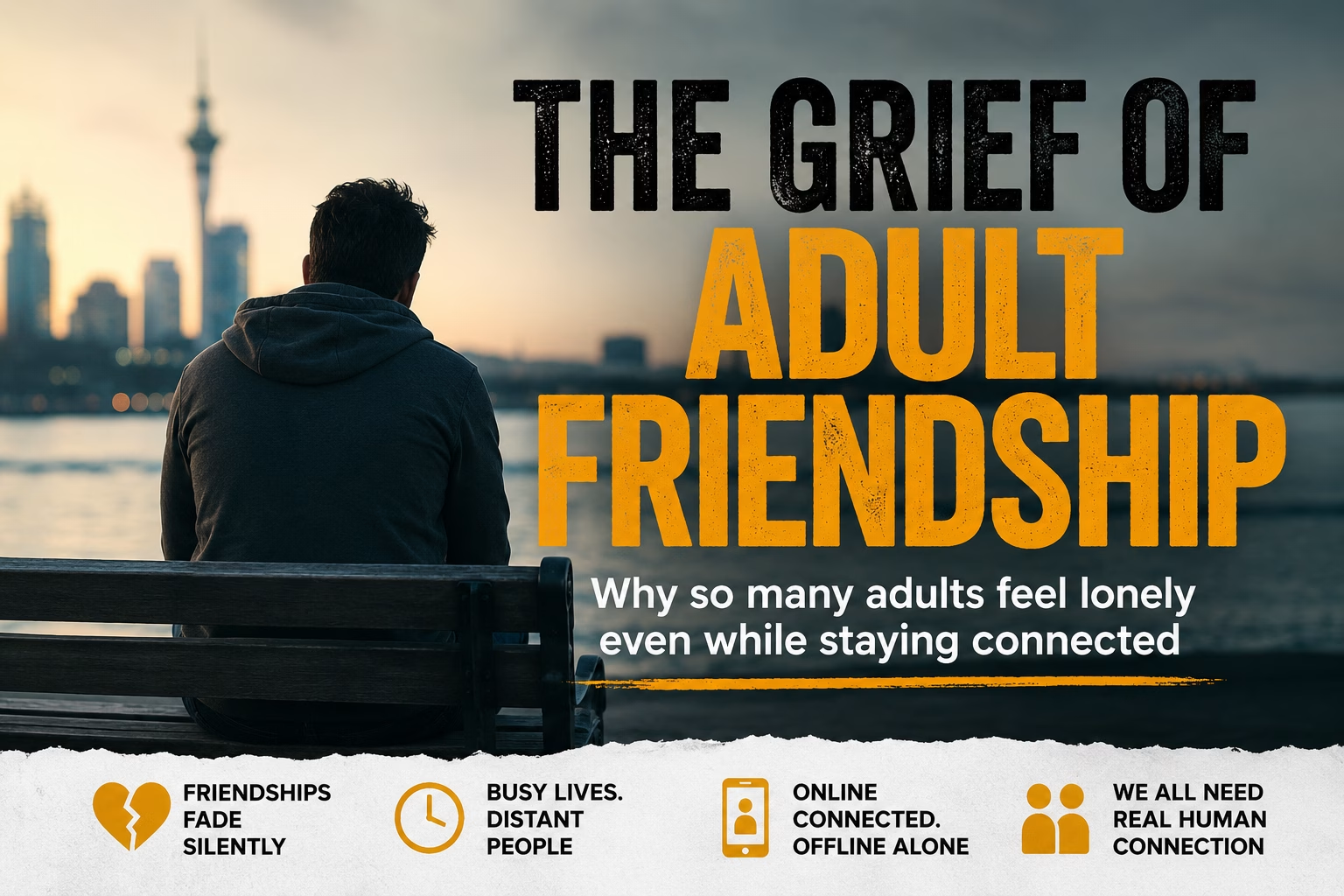
Why So Many Adults Feel Lonely Even When Surrounded by People
There was a time when friendship did not require effort.
You did not need Google Calendar invites to meet someone.
You did not need to check if next Saturday worked three weeks in advance.
You did not need to send “Hey, long time!” messages to people you once spoke to every single day.
Friendship simply existed.
You walked to someone’s house unannounced.
You shared lunch without calculating expenses.
You spent hours talking nonsense that somehow felt deeply meaningful.
And maybe the saddest thing about growing older is realizing how naturally connection existed when life itself was slower.
In 2026, adult friendship has become emotionally complicated in a way previous generations rarely experienced.
Not because people stopped caring.
But because modern life slowly reorganized itself around productivity, survival, and digital convenience instead of human closeness.
The result is something millions of adults quietly carry:
The grief of friendships that did not officially end, but slowly disappeared.
New Zealand Immigration Changes in 2026: A More Selective System Takes Shape – WebfitNews
The Loneliness Nobody Talks About
Modern adulthood is full of invisible emotional losses.
People talk about heartbreak.
People talk about divorce.
People talk about grief after death.
But almost nobody talks about the pain of drifting away from people who once felt like family.
The college friend who knew your biggest dreams.
The office colleague who helped you survive a terrible phase.
The childhood friend who once felt permanent.
Most adult friendships do not explode dramatically.
They fade silently.
One postponed meeting becomes six months.
Daily calls become birthday messages.
Eventually, even memories begin feeling distant.
And strangely, nobody teaches us how to process that kind of grief.
The Psychology Behind Adult Friendship Loss
Psychologists have increasingly started studying what social scientists now call “friendship shrinkage” in adulthood.
Research from the American Psychological Association and multiple global loneliness studies show that adult friendships often decline sharply after major life transitions such as:
- Marriage
- Parenthood
- Migration
- Career pressure
- Financial stress
- Relocation
- Mental burnout
One widely discussed study by British anthropologist Robin Dunbar suggested that humans can maintain roughly 150 meaningful social relationships, but close emotional friendships dramatically reduce as adult responsibilities increase.
Another important reality is cognitive overload.
Earlier generations had fewer constant distractions.
In 2026, people are mentally exhausted almost all the time.
Notifications.
Emails.
Bills.
Traffic.
Algorithms.
Performance pressure.
Economic uncertainty.
Modern adults are overstimulated yet emotionally undernourished.
What the Data Says
Recent global research paints a concerning picture.
| Topic | Key Findings |
|---|---|
| Adult loneliness | A 2023 Gallup and Meta global survey found nearly 1 in 4 adults worldwide reported feeling very or fairly lonely |
| Friendship decline | Studies show adults often lose close friendships after age 25 unless effort is intentionally maintained |
| Male isolation | Research shows men are significantly less likely to maintain emotionally open friendships in adulthood |
| Social media paradox | Higher social media use is increasingly linked to feelings of social comparison and emotional isolation |
| Mental health impact | Chronic loneliness has been associated with anxiety, depression, sleep issues, and increased stress levels |
The data is uncomfortable because it exposes something modern society often hides behind productivity:
A lot of adults are lonely.
Even successful adults.
Even married adults.
Even people constantly posting smiling photos online.
The Social Media Illusion
Perhaps the biggest emotional deception of the modern era is this:
We see everyone, but we rarely truly connect anymore.
Instagram makes it look like old friends are still part of our lives because we occasionally see their vacations, children, achievements, or selfies.
But visibility is not intimacy.
Watching someone’s story is not the same as hearing their real struggles.
A “❤️” reaction is not emotional support.
Many people today have constant digital interaction but very little emotional safety.
And psychologically, that creates confusion.
Your brain sees connection.
Your heart still feels alone.
Why Adult Friendship Feels More Fragile Today
Earlier generations had built-in social repetition.
People met naturally through:
- Neighbourhoods
- Religious gatherings
- Family systems
- Community events
- Long-term workplaces
Modern life disrupted many of those structures.
People move countries more often.
Jobs change rapidly.
Remote work reduces physical interaction.
People spend more time consuming content than participating in community.
Friendship now requires intentional maintenance.
And honestly, many adults are too emotionally tired to maintain everything.
That is the brutal reality nobody likes admitting.
Men, Women, and Emotional Isolation
Psychologists also point toward important gender differences in adult friendship patterns.
Men
Many men were raised with emotional restrictions:
- “Be strong”
- “Do not cry”
- “Handle it yourself”
As a result, many male friendships revolve around activities instead of emotional openness.
When life gets busy, the activity disappears, and the emotional connection often weakens too.
Women
Women statistically maintain emotional communication more consistently, but many women experience friendship loss after:
- Marriage
- Motherhood
- Migration
- Caregiving responsibilities
In both cases, adulthood reduces available emotional energy.
People still care deeply.
They just struggle to sustain closeness.
The Economic Reality Behind Friendship Loss
This part matters more than people realize.
Friendship is not declining only because of technology.
Economics plays a major role.
In cities across the world, including Auckland, Sydney, and Toronto, people are working longer hours while carrying higher living costs.
Financial survival consumes emotional bandwidth.
When someone spends their week worrying about:
- Rent
- Mortgage
- Visa stress
- Childcare
- Layoffs
- Career instability
Friendship unintentionally becomes secondary.
Not because it is unimportant.
Because exhaustion wins.
The Silent Grief of “Almost Friendships”
One of adulthood’s strangest experiences is realizing some people were only meant for a certain chapter of your life.
And that truth hurts.
Because while growing up, we imagined our closest friends would stay forever.
Reality is more complicated.
Some friendships are:
- Seasonal
- Situational
- Proximity-based
- Identity-based
The friend who matched your teenage personality may not fit your adult life anymore.
That does not mean the friendship was fake.
It simply means humans evolve.
And evolution sometimes creates emotional distance.
But Here Is the Important Part
Not all fading friendships are failures.
That is something emotionally mature adults slowly begin understanding.
Sometimes people disappear because:
- They are overwhelmed
- They are depressed
- They are ashamed of struggling
- They are emotionally exhausted
- They are fighting private battles
Modern adulthood has made many people emotionally unavailable, not emotionally uncaring.
That distinction matters.
What Actually Helps
Psychologists increasingly say the solution to modern loneliness is not more online engagement.
It is intentional human rituals.
Simple things:
- Regular phone calls
- Walking with friends
- Eating together
- Checking in without needing a reason
- Small repeated interactions
Human connection survives through repetition.
Not grand gestures.
And maybe this is where modern society went wrong.
We optimized life for efficiency but accidentally removed many of the slow, repetitive moments where friendships naturally survived.
The Bigger Truth About 2026
The world in 2026 is more connected technologically than at any point in history.
Yet emotionally, many people feel more alone than ever.
That contradiction says everything.
People have followers but no confidants.
Group chats but nobody to call during a breakdown.
Hundreds of contacts but very few emotionally safe spaces.
And maybe the grief of adult friendship is ultimately grief for something larger:
A slower world.
A more available world.
A less exhausted world.
Because deep down, most people are not asking for luxury.
They are asking for presence.
Someone who remembers them.
Someone who notices when they disappear.
Someone who still makes life feel human in a world becoming increasingly mechanical.
And perhaps the hardest realization of adulthood is this:
You can deeply love people who are no longer truly part of your daily life.
That grief stays quietly inside many adults.
Especially at night.
Especially after success.
Especially during pain.
Especially when your instinct is still to message someone you slowly lost along the way.
And maybe that is why adult friendship hurts so much.
Not because people stopped mattering.
But because they still do.