By Geet G | Webfit News
On what was meant to be a symbolic night celebrating press freedom, the United States came within seconds of a national security disaster.
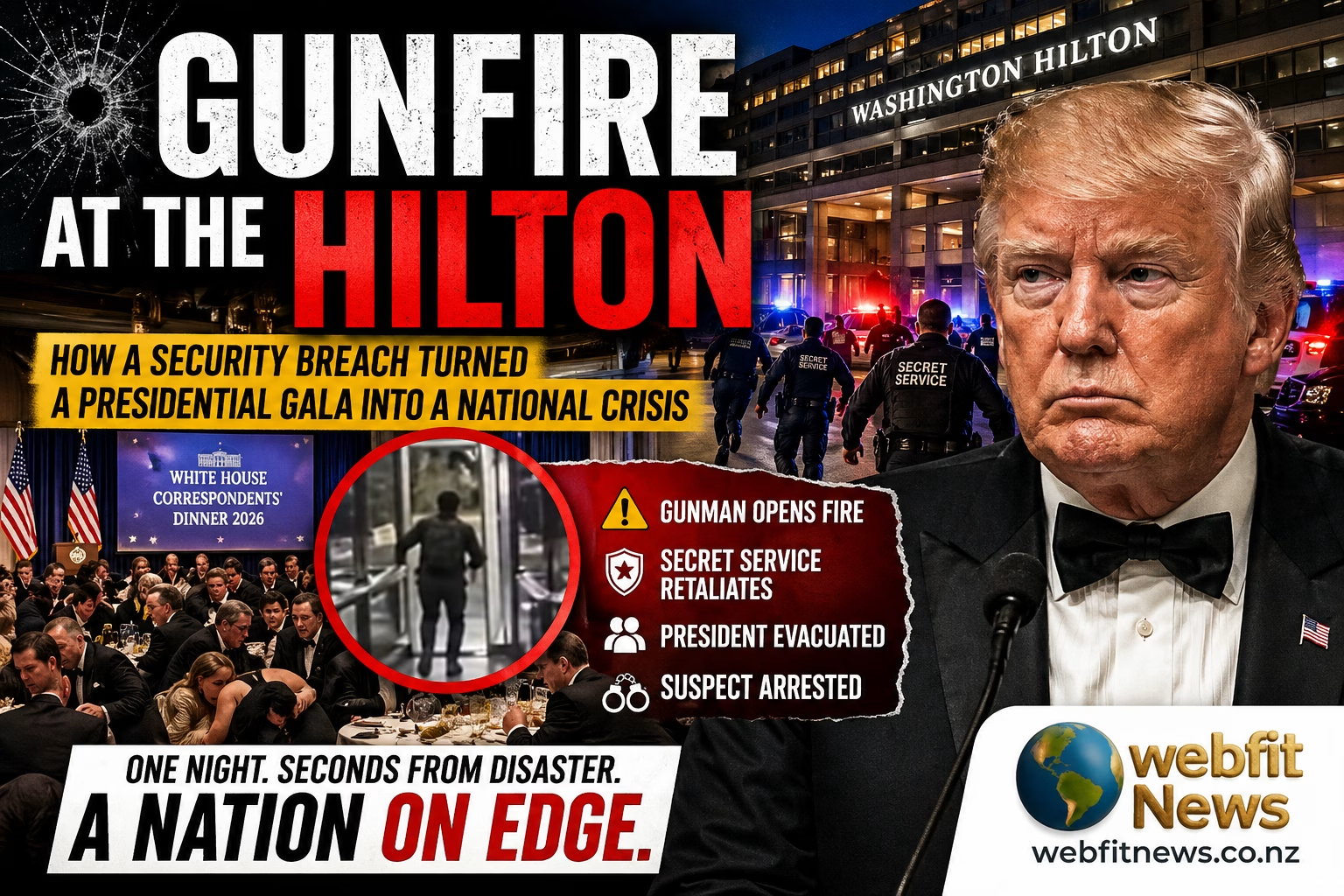
On April 25, 2026, inside the Washington Hilton in Washington DC, gunfire shattered the annual White House Correspondents’ Dinner. President Donald Trump was on stage. Hundreds of journalists were seated. Much of the US political leadership was present in one room.
Then, within minutes, the entire event collapsed into chaos.
What followed was not just an attempted attack. It has raised serious questions about presidential security, public venues, and the evolution of modern threats.
What Happened Inside the Hilton
The White House Correspondents’ Dinner had just begun. Around 2,600 guests were seated. Security was tight, described by officials as “national-level”.
Yet at 8:36 PM (EDT), everything changed.
Timeline of the Incident
- 8:35 PM – A man is spotted near a secondary checkpoint
- 8:36 PM – He charges the security screening area
- 8:37 PM – Gunfire erupts
- 8:38 PM – Secret Service evacuates President Trump
- 8:39 PM – Suspect is restrained and arrested
- 9:20 PM – Event officially cancelled
The attacker, identified as Cole Tomas Allen, forced his way through a checkpoint carrying multiple weapons.
He fired at least one shot at close range, hitting a Secret Service officer. The officer survived due to a ballistic vest.
Inside the ballroom, guests initially thought the sound was broken glass. Seconds later, panic spread.
People dropped under tables. Agents rushed the stage.
The President was removed immediately.
Who Is the Attacker
This is where the story becomes more unsettling.
The suspect does not fit the usual profile.
Cole Tomas Allen – Key Facts
- Age: 31
- Location: Torrance, California
- Education:
- Mechanical Engineering from Caltech
- Master’s in Computer Science (2025)
- Profession:
- Teacher for 6 years
- Software and engineering background
No criminal history.
Described by peers as quiet and polite.
That is exactly what makes this case dangerous.
A New Kind of Threat
This is not a typical “unstable lone attacker” narrative.
Allen was:
- Educated
- Technically skilled
- Socially functional
He also reportedly told investigators he intended to target Trump administration officials.
This suggests a shift in threat patterns.
Not random. Not impulsive.
More calculated.
And harder to detect.
How Security Failed
Here is the uncomfortable truth.
Security did not fully fail.
It was bypassed.
The attacker:
- Was a registered hotel guest
- Used internal movement access
- Avoided outer perimeter restrictions
This exposes a critical gap:
Public venues cannot be fully controlled, even with high security.
That is the real issue now being debated in the US.
The Immediate Response
The Secret Service reacted fast.
- President Trump was shielded and removed
- The Vice President was evacuated first
- Cabinet members were moved to secure zones
Within minutes, the building was locked down.
At 10:30 PM, Trump addressed the nation from the White House.
Still in formal attire.
Trump’s Response and Messaging
The President did not take a cautious tone.
He called the attacker:
- “A sick person”
- “Evil”
He also made a broader statement:
“When you’re impactful, they go after you.”
The message was clear.
This was framed not just as an attack, but as a consequence of political influence.
The Bigger Shift: A “Fortress Presidency”
This incident may change how US presidents operate.
Trump has already been pushing a $400 million White House ballroom project.
After this attack, the argument becomes stronger.
Why This Matters
- Public venues are now seen as vulnerable
- Security risks are harder to control externally
- Government-controlled spaces offer tighter protection
The proposal includes:
- Reinforced concrete structures
- Bullet-resistant materials
- Underground security systems
In simple terms:
Move everything inside a controlled environment.
What This Means for Democracy
Here is where things get complicated.
If presidents stop appearing in public venues:
- Media access reduces
- Public interaction declines
- Events become government-controlled
That changes the relationship between leaders and the public.
Critics argue this could weaken democratic transparency.
Supporters say it is necessary for safety.
Global Context Matters
This incident did not happen in isolation.
The US is currently involved in a high-tension conflict environment, including ongoing tensions linked to Iran.
Recent patterns show:
- Increased direct threats
- More aggressive lone-actor attempts
- Reduced deterrence
This creates a more volatile domestic security landscape.
Legal Action and What Happens Next
The suspect is now in custody.
Expected Charges
- Assault on a federal officer
- Firearm-related offences
- Possible attempted assassination charges
The investigation is ongoing.
Authorities are:
- Analysing digital records
- Searching his residence
- Examining possible motivations
This is expected to become a high-profile federal case.
Webfit News Perspective
This incident is not just about one attack.
It highlights a deeper shift.
Security threats are evolving faster than traditional systems.
Highly educated individuals, operating alone, are now capable of breaching even high-level protection layers.
For countries like New Zealand, the lesson is clear:
- Public event security models need rethinking
- Access control is just as important as perimeter security
- Threat profiling must evolve beyond traditional assumptions
Because the next risk may not look dangerous at all.
Conclusion
The White House Correspondents’ Dinner is often remembered for humour and political satire.
This year, it will be remembered for something else.
A moment where:
- Security was tested
- Systems were exposed
- And the future of presidential access may have changed permanently
The question now is simple:
Do leaders remain accessible, or do they retreat behind walls?
The answer will shape how power is seen in the modern world.