By Geet G | Webfit News | Content Intent: BALANCED HYBRID
Introduction: A Result Nobody Can Ignore
On 4 May 2026, Tamil Nadu did not just deliver election results. It delivered a disruption.
For nearly six decades, politics in the state has followed a predictable pattern. The power alternated between two giants. The Dravida Munnetra Kazhagam (DMK) and the All India Anna Dravida Munnetra Kazhagam (AIADMK) defined everything.
That pattern has now been broken.
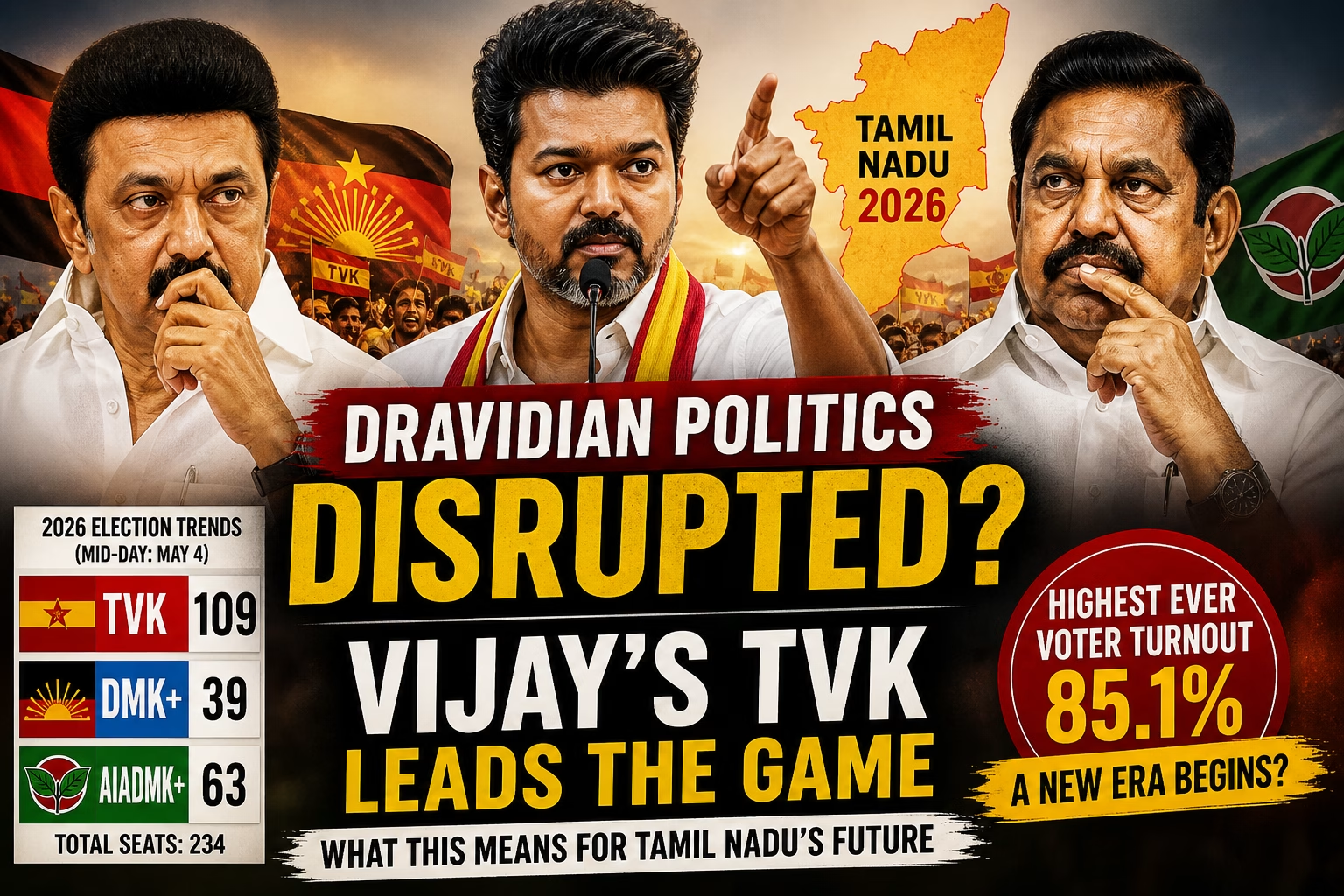
The emergence of Tamilaga Vettri Kazhagam (TVK), led by actor-turned-politician C. Joseph Vijay, is not a side story. It is the main story. Early trends showing TVK leading in over 100 seats are not just numbers. They represent a shift in voter behaviour.
But here is the real question.
Did Vijay win this election… or did the system collapse from within?
West Bengal 2026: Is This a Political Earthquake or a Slow Collapse Finally Exposed? – WebfitNews
What the Numbers Actually Tell Us
The early trend data is brutal for traditional parties.
- TVK: ~109 seats leading
- DMK alliance: massive drop from 159 (2021)
- AIADMK alliance: stagnation and limited growth
- Others: fragmented and irrelevant in outcome
The majority mark is 118.
TVK is within striking distance. That alone changes everything.
Even if the final number fluctuates, one fact is already locked in. Tamil Nadu is no longer a two-party battlefield.
| Party / Alliance | Seats Leading (Mid-Day May 4) | 2021 Seats (Final) | Projected Swing |
|---|---|---|---|
| Tamilaga Vettri Kazhagam (TVK) | 109 | 0 | +109 |
| AIADMK-led Alliance (ADMK+) | 63 | 75 | -12 |
| Secular Progressive Alliance (SPA/DMK+) | 39 | 159 | -120 |
| Pattali Makkal Katchi (PMK) | 6 | 5 | +1 |
| Indian National Congress (INC) | 5 | 18 | -13 |
| Bharatiya Janata Party (BJP) | 3 | 4 | -1 |
| Others (NTK, AMMK, DMDK) | 9 | 0 | +9 |
The Real Story: This Was Not Just a “Vijay Wave”
Let’s be clear. If you think this is just celebrity politics, you are missing the bigger picture.
Vijay did not just show up and win.
He built a political machine.
- Grassroots network through Vijay Makkal Iyakkam since 2009
- Reported membership in millions before elections
- Full 234-seat contest strategy without alliances
- Strong booth-level mobilisation
That last point matters.
Most new parties collapse at booth level. TVK did not.
This was not hype. This was execution.
Why DMK Lost Ground
Now the uncomfortable part.
DMK did not lose because of one issue. It lost because of accumulation.
1. Governance fatigue
After years in power, even strong welfare models lose emotional impact.
2. Perception of dynasty politics
Leadership concentration became a talking point, especially among younger voters.
3. Urban dissatisfaction
Cities like Chennai showed clear signs of voter shift.
4. Law and order narrative
Even perception is enough to damage incumbents. DMK struggled here.
5. Middle-class pressure
Electricity costs, inflation, and everyday expenses hit harder than welfare benefits could compensate.
Here is the blunt truth.
DMK did not collapse overnight. It slowly disconnected from a section of voters who stopped feeling represented.
| Constituency | Leading Candidate (Party) | Trailing Candidate (Party) | Margin / Status |
|---|---|---|---|
| Kolathur | V.S. Babu (TVK) | M.K. Stalin (DMK) | 8,393 (Leading) |
| Perambur | C. Joseph Vijay (TVK) | R.D. Shekar (DMK) | 6,469 (Leading) |
| Chepauk-Thiruvallikeni | Selvam D (TVK) | Udhayanidhi Stalin (DMK) | 3,757 (Leading) |
| Mylapore | Venkataramanan P (TVK) | Velu Dha (DMK) | 11,896 (Leading) |
| Edappadi | Edappadi K. Palaniswami (AIADMK) | K. Premkumar (TVK-Ind) | 3,830 (Leading) |
| Tiruchi East | C. Joseph Vijay (TVK) | S. Inigo Irudayaraj (DMK) | (Leading) |
| Saidapet | Arul Prakasam M (TVK) | M.A. Subramanian (DMK) | 4,334 (Leading) |
Why AIADMK Failed to Capitalise
This is where it gets interesting.
Normally, when a ruling party weakens, the opposition benefits.
That did not happen here.
AIADMK had its chance. It missed it.
Key reasons:
- Internal power struggles weakened credibility
- Leadership clarity was missing
- Alliance confusion with BJP created mixed messaging
- No fresh narrative to excite voters
In simple terms, AIADMK looked like the past.
TVK positioned itself as the future.
Guess which one the voters chose.
The Youth Factor: The Election Was Rewritten Here
If you want to understand 2026, focus on one group.
Youth voters.
This election saw:
- Record turnout at 85.1%
- Surge in first-time voters
- Strong digital campaign engagement
TVK did one thing extremely well.
It spoke the language of aspiration.
Not just jobs.
Not just welfare.
But identity in a digital future.
“Vision 2035” was not just a slogan. It was a signal.
And young voters picked it up.
| Metric | 2021 Election | 2026 Election (Trends) | Implications |
| Voter Turnout | $72.7\%$ | $85.1\%$ | Massive mobilization of youth/silent voters |
| Majority Mark | 118 seats | 118 seats | TVK approaching majority |
| Principal Conflict | DMK vs AIADMK | TVK vs Establishments | Fracturing of bipolarity |
| Turnout in Chennai | Moderate | Record High | Urban middle-class rejection of incumbents |
Women Voters: The Silent Shift
Traditionally, women voters have leaned toward welfare-backed governance.
This time, something changed.
TVK’s messaging around:
- safety
- opportunity
- governance transparency
created a subtle but important shift.
Women voters did not abandon welfare politics.
They expanded their expectations beyond it.
That is a structural change.
The Collapse of the “Dravidian Binary”
Since 1967, Tamil Nadu politics has been simple.
DMK vs AIADMK.
That simplicity is gone.
What replaces it?
Not chaos. Something more complex.
- A three-pole system
- Issue-based voting rather than loyalty-based
- Reduced predictability in outcomes
This is where most analysts are getting it wrong.
This is not just a one-election story.
This is the beginning of competitive politics in a state that had become structurally predictable.
The TVK Model: Risky or Revolutionary?
Now let’s challenge the hype.
TVK’s promises sound powerful:
- AI-driven governance
- Super App for public services
- Digital transparency systems
But here is the uncomfortable question.
Can they actually deliver this?
Because ideas are easy.
Execution is brutal.
They will face:
- Bureaucratic resistance
- Funding challenges
- Centre-state political friction
- Ground-level implementation complexity
If they fail here, this wave will not last.
Coalition Politics: The Real Game Starts Now
Even if TVK emerges as the largest party, it may fall short of majority.
That opens the real battlefield.
Possible scenarios:
- TVK minority government
- Issue-based support from smaller parties
- Unexpected alignments with AIADMK factions
Here is the truth nobody wants to say openly.
Power in India is not just won in elections.
It is negotiated after them.
Webfit News Perspective
This election is not about Vijay.
It is about voters saying something very specific.
“We are ready to move on.”
Not from ideology.
But from stagnation.
Tamil Nadu has not rejected the Dravidian model completely.
It has demanded an upgrade.
Whether TVK becomes that upgrade or just a temporary disruption depends on what happens next.
Because history shows this clearly.
Breaking a system is easy.
Running a new one is where most fail.
Conclusion: Shock Wave or Structural Shift?
Tamil Nadu 2026 is now a case study.
If TVK sustains this momentum and governs effectively, this will be remembered as a historic political reset.
If it struggles, this will be remembered as a protest vote that briefly disrupted the system.
Right now, both possibilities are alive.
And that is what makes this election one of the most important political moments in modern India.