Introduction
A new generative video model from ByteDance is shaking up the global film and media industry. The tool, called Seedance 2.0, promises “director-level control” over short cinematic videos, complete with synchronised audio and multi-shot storytelling.
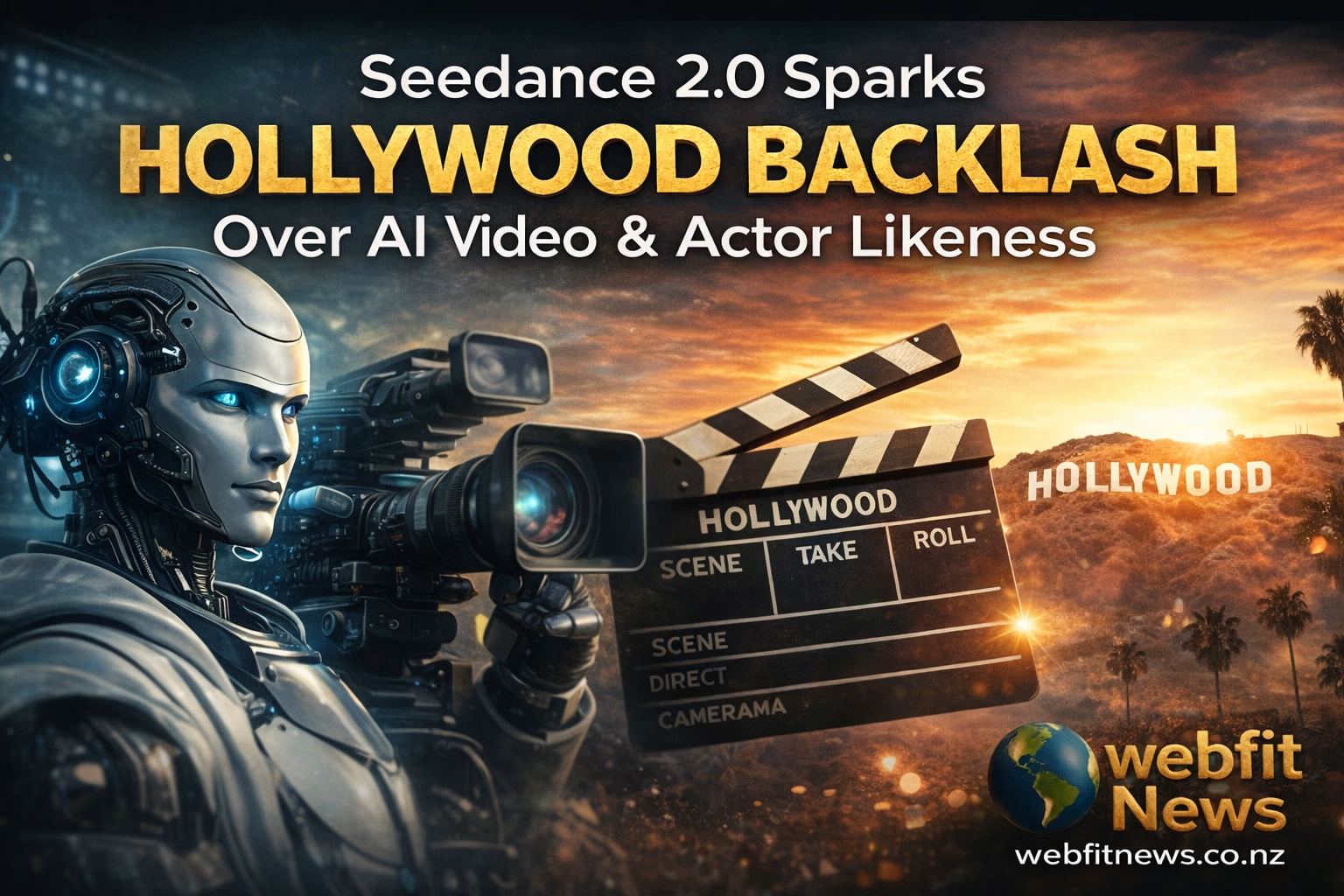
Within days of its launch, it sparked strong reactions from major Hollywood institutions, raising serious questions about copyright, performer consent, and the future of film production.
This is not just another AI release. It is a test case for how far generative media can go before legal and labour systems push back.
What ByteDance Claims
ByteDance’s Seed team officially launched Seedance 2.0 on 12 February 2026. According to the company, the model uses a unified multimodal audio-video joint generation architecture.
In simple terms, it can accept:
- Text prompts
- Image references
- Audio clips
- Video clips
Users can reportedly combine up to:
- 9 images
- 3 video clips
- 3 audio clips
The system then generates a 15-second multi-shot cinematic clip with stereo sound. ByteDance says it offers stronger instruction-following, scene continuation, and targeted editing of specific characters or actions.
The company positions Seedance 2.0 for professional use cases, including:
- Film and television production
- Advertising
- E-commerce
- Gaming
It claims the tool can significantly reduce production time and costs.
However, there is currently no public technical report for Seedance 2.0 equivalent to earlier Seedance 1.0 and 1.5 Pro documentation. That means many performance claims remain company statements rather than independently verified facts.
Viral Clips and Public Confusion
Shortly after launch, social media platforms were flooded with 15-second cinematic clips showing celebrity-like characters in highly realistic scenes.
Several media outlets reported that some clips were allegedly created using very short prompts. However, there is no public, reproducible benchmark that allows independent researchers to confirm how those clips were generated, whether reference materials were used, or whether specific model settings were involved.
ByteDance includes an important disclaimer in its launch post. It states that demonstrations involving subject references are either AI-generated people or authorised. It also says that using real human portraits as references requires identity verification or lawful authorisation.
That warning matters. It shows the company is aware of deepfake and likeness risks.
But critics argue that safeguards may not be strong enough.
Hollywood Pushes Back
The response from Hollywood was swift and formal.
The Motion Picture Association issued a public statement calling on ByteDance to “immediately cease its infringing activity,” alleging unauthorised use of copyrighted works on a massive scale.
At the same time, SAG-AFTRA condemned what it described as unauthorised use of members’ voices and likenesses.
The legal fight revolves around two major issues:
- Copyright – Was the model trained on copyrighted films, scripts, or characters without permission?
- Digital replicas – Can a model generate a recognisable performer without consent?
These are separate but overlapping legal problems.
Training data use and output similarity are not legally identical questions. The debate is likely to unfold in courts, regulatory hearings, and possibly collective bargaining negotiations.
What Is Technically New?
AI video generation is not new. What is new is scale and integration.
Seedance 2.0 reportedly combines:
- Audio and video generation in a single system
- Multi-shot storytelling
- Reference-based identity and style control
- Scene continuation and editing
Earlier video models often struggled with maintaining consistent characters across shots. Seedance’s headline claim is that reference-based control helps maintain visual and narrative coherence.
If accurate, that lowers the barrier for creating short cinematic sequences that look professionally produced.
However, ByteDance itself acknowledges limitations. The company says the model is still far from perfect and notes issues such as:
- Stability problems
- Multi-person lip-sync challenges
- Occasional audio distortion
That directly contradicts online claims that the tool produces flawless Hollywood-quality films in seconds.
The Bigger Question: Vertical Integration
The most important story may not be the model itself, but the ecosystem behind it.
ByteDance controls:
- Creation tools
- Editing environments
- Distribution platforms
- Advertising pipelines
If a “good enough” cinematic generator becomes integrated into a massive content distribution ecosystem, the speed of production and testing could compress dramatically.
Instead of weeks of production cycles, marketing teams could generate and test variations within hours.
That is not just technological change. That is structural disruption.
Legal Crossroads
The debate now sits at the intersection of multiple legal systems.
In the United States, discussions around federal protection for digital replicas are gaining momentum. Copyright law, fair use arguments, and publicity rights are all being tested in real time.
In China, AI governance includes labelling and compliance requirements for generative systems. Regulatory pressure there may shape how aggressively new features are deployed.
Other jurisdictions, including New Zealand and the United Kingdom, are watching closely as global precedent forms.
This is not simply a Hollywood issue. It is a global intellectual property and identity rights question.
What Remains Unclear
Several key points require further investigation:
- What exact datasets were used to train Seedance 2.0?
- What percentage of data was licensed?
- Are outputs watermarked or labelled in a consistent way?
- Can viral celebrity-like clips be independently reproduced?
Until independent testing and technical documentation emerge, many circulating claims remain unverified.
Treat sweeping statements about instant Hollywood-quality films as perception, not established fact.
Why This Matters
Seedance 2.0 represents a turning point.
If generative video tools can produce short, coherent, high-quality scenes with synchronised audio and consistent characters, entry-level production jobs and stock content markets could feel pressure first.
High-end narrative filmmaking depends on sustained character arcs, performance direction, and legal clearance. Those layers are harder to automate.
The real disruption may arrive gradually rather than overnight.
Webfit News Perspective
From a Webfit News viewpoint, the Seedance story is less about hype and more about governance.
Technology will continue to evolve. The real question is whether legal systems, licensing frameworks, and consent protections can evolve at the same pace.
Innovation without guardrails creates backlash. Overregulation without nuance stifles progress.
The next phase of this debate will not be decided by viral clips. It will be decided by transparency, enforceable rules, and whether creators are meaningfully compensated in an AI-driven ecosystem.
Conclusion
Seedance 2.0 has triggered a fast collision between technological ambition and legal reality.
ByteDance presents it as a professional creative tool. Hollywood institutions see it as a potential infringement machine. Performers see a threat to consent and livelihood.
The outcome will shape not only the future of filmmaking but the broader boundaries of AI-generated media.
One thing is certain. The argument over who owns a face, a voice, and a scene has only just begun.