NELSON-TASMAN, 11 August 2026
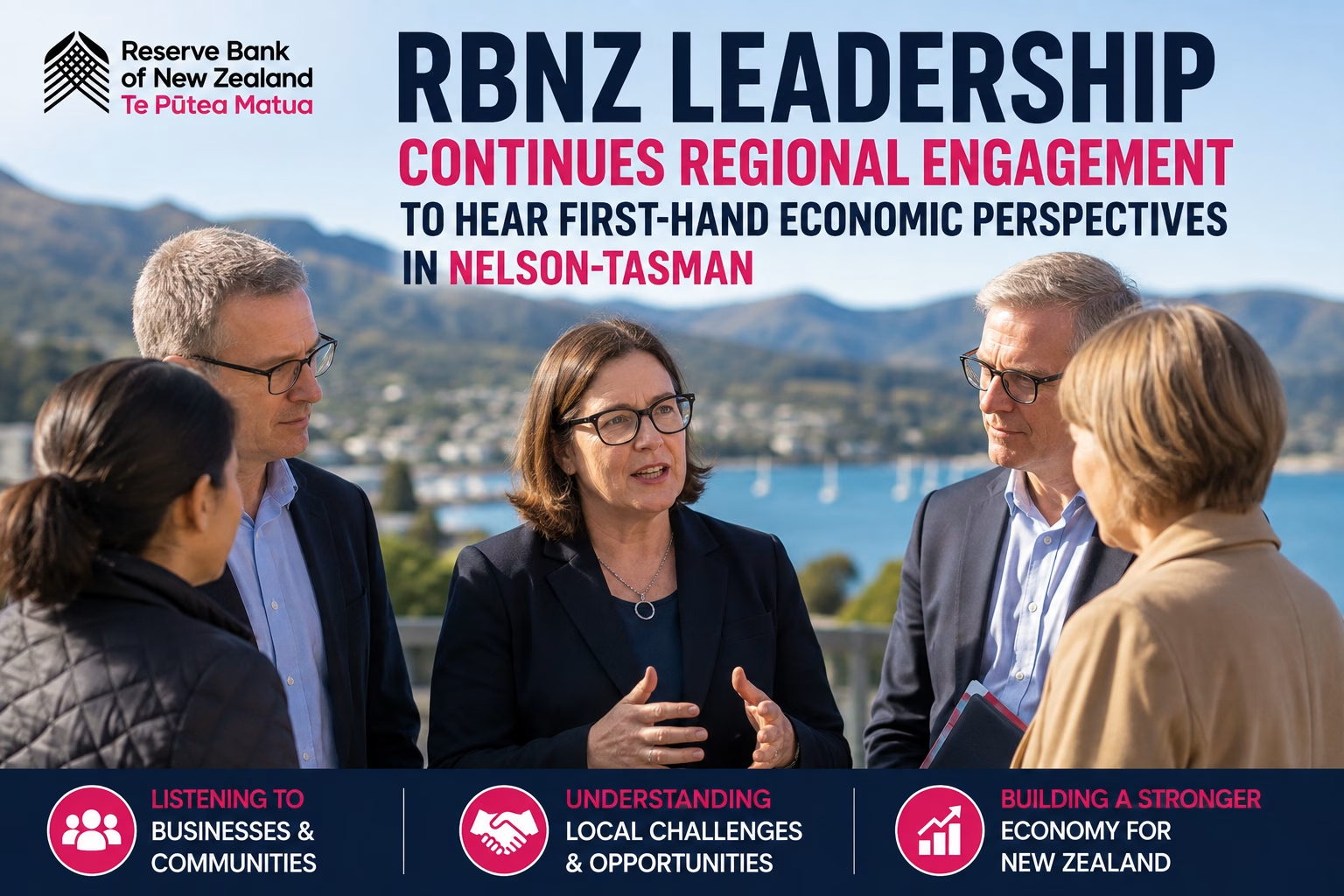
Reserve Bank of New Zealand Governor Dr Anna Breman has continued the Bank’s regional engagement programme with a visit to Nelson-Tasman, meeting local businesses, iwi, industry representatives and community groups to hear first-hand how economic conditions are affecting the region.
The visit forms part of a broader effort by the Reserve Bank to understand what is happening beyond national headline statistics.
So far in 2026, RBNZ leaders have travelled to six regional centres outside Wellington and Auckland, including Canterbury, Waikato, Hawke’s Bay, Rotorua, Tauranga and Nelson-Tasman.
Across those visits, the Bank says its leadership team has met with more than 50 organisations and connected directly with around 600 business operators and community members.
The engagement matters because national economic data can often hide large differences between regions, sectors and households.
A strong export sector in one area can exist alongside weak consumer spending in another. Tourism may be recovering in some places while construction, retail or farming remains under pressure elsewhere.
The Reserve Bank says those differences are important when it assesses the wider economy.
Nelson-Tasman meetings focus on local conditions
During the Nelson-Tasman visit, the RBNZ delegation met with a range of local stakeholders.
These included:
- Local iwi
- The regional economic development agency
- Aquaculture representatives
- Retirement providers
- Transport companies
The purpose was to better understand local economic conditions, financial pressures, investment opportunities and the challenges businesses are facing.
Governor Dr Anna Breman was joined by Board Member Jeremy Banks, External Monetary Policy Committee Member Carl Hansen and Director of Stakeholder Engagement Naomi Mitchell.
Dr Breman said direct conversations with people across New Zealand are an important part of the Bank’s work.
“Hearing directly from people living and working in communities across New Zealand is an important part of our work,” she said.
Unemployment rises, but labour market picture is mixed
One of the key themes raised by Dr Breman was the current state of the labour market.
She acknowledged that economic conditions remain difficult for many New Zealanders and pointed to the recent increase in the unemployment rate.
However, she also cautioned against looking at one number in isolation.
“I acknowledge that economic conditions remain challenging for many New Zealanders, and the recent increase in the unemployment rate reflects that,” Dr Breman said.
“However, if we look a bit deeper, we can now see more people in employment and more people participating in the labour market.”
That is an important distinction.
An unemployment rate can rise even when the number of people with jobs increases, particularly if more people enter the labour force and begin actively looking for work.
For households, however, the practical reality remains more complicated.
Employment growth does not automatically mean people feel financially secure.
Mortgage costs, rents, food prices, insurance, electricity and other household expenses can continue to place pressure on people even while broader indicators begin to improve.
Why regional conversations matter
The Reserve Bank operates primarily through national economic policy.
Its most visible role is setting the Official Cash Rate through the Monetary Policy Committee.
But the effect of monetary policy is not uniform.
Higher or lower interest rates can affect regions differently depending on their housing markets, business mix, debt levels and exposure to exports.
A rural economy heavily dependent on agriculture may respond differently to changing interest rates than a tourism destination or a major urban centre.
Likewise, households with large mortgages may feel monetary policy changes more quickly than households with little debt.
Dr Breman said regional conversations help the Bank understand those differences.
“Conversations on these topics like these help us understand how nationwide economic developments are affecting different regions, industries, businesses, communities, and households, and how experiences can vary across the country,” she said.
“They also provide an opportunity for us to explain the work we do.”
Inflation remains central to the Bank’s mandate
The Reserve Bank’s core monetary policy objective remains keeping inflation low and stable.
The Monetary Policy Committee is required to keep annual inflation between 1 and 3 percent over the medium term, with a focus on the midpoint of 2 percent.
At the same time, the Bank is expected to avoid creating unnecessary volatility in the economy.
That balancing act is difficult.
If interest rates are kept too high for too long, economic activity can weaken more than necessary, putting additional pressure on businesses, employment and households.
If rates are reduced too quickly while inflation pressure remains, price growth can accelerate again.
That is why information beyond standard data releases can be useful.
Formal statistics show what has happened.
Regional conversations can sometimes give policymakers an earlier sense of what may be happening next.
RBNZ uses surveys and meetings alongside official data
The Nelson-Tasman visit is only one part of the Reserve Bank’s engagement programme.
The Bank also conducts regular surveys and consultations.
According to the RBNZ, these include:
- Quarterly surveys of between 500 and 700 businesses
- Quarterly engagement with around 1,000 households
- Public consultations
- Speaking engagements
- Bilateral stakeholder meetings
- Regional visits led by different RBNZ teams
The information gathered is used alongside economic and financial data.
The Bank says the aim is not to replace formal statistics with anecdotal feedback, but to add context.
That distinction matters.
A handful of business conversations cannot tell policymakers what is happening across the whole country.
But they can highlight emerging problems, sentiment changes or sector-specific pressures that may not yet be fully visible in official data.
Nelson-Tasman brings its own economic mix
Nelson-Tasman has a distinctive economic profile.
The region is exposed to sectors such as aquaculture, horticulture, transport, tourism, retirement living and export activity.
That means global demand, freight costs, labour availability, interest rates and domestic consumer confidence can all have a significant impact.
Businesses in those industries may experience very different conditions even within the same region.
That is exactly why the Bank’s leadership programme is structured around direct regional engagement.
Webfit News perspective: national averages do not tell the whole story
The most useful aspect of the Reserve Bank’s regional programme is not the travel itself.
It is the recognition that New Zealand does not experience one single economy.
Auckland, Nelson, Hawke’s Bay, Waikato and Canterbury can all be moving through different phases at the same time.
A national unemployment rate, inflation number or GDP figure can be useful, but it cannot fully explain what a small exporter, hospitality operator, farmer or transport company is experiencing on the ground.
That is where direct engagement has value.
The challenge for the Reserve Bank is to ensure those conversations genuinely inform its understanding and do not become symbolic consultation exercises.
The quality of economic policymaking depends on both hard data and an accurate understanding of how those numbers are being experienced by people.
Regional engagement can help provide that missing layer.
As New Zealand continues through an uneven economic recovery, the gap between headline statistics and household reality will remain important.
For the Reserve Bank, listening to regions such as Nelson-Tasman is one way of making sure the national picture does not become too detached from what is actually happening on the ground.