By Webfit News | 15 December 2025
Introduction
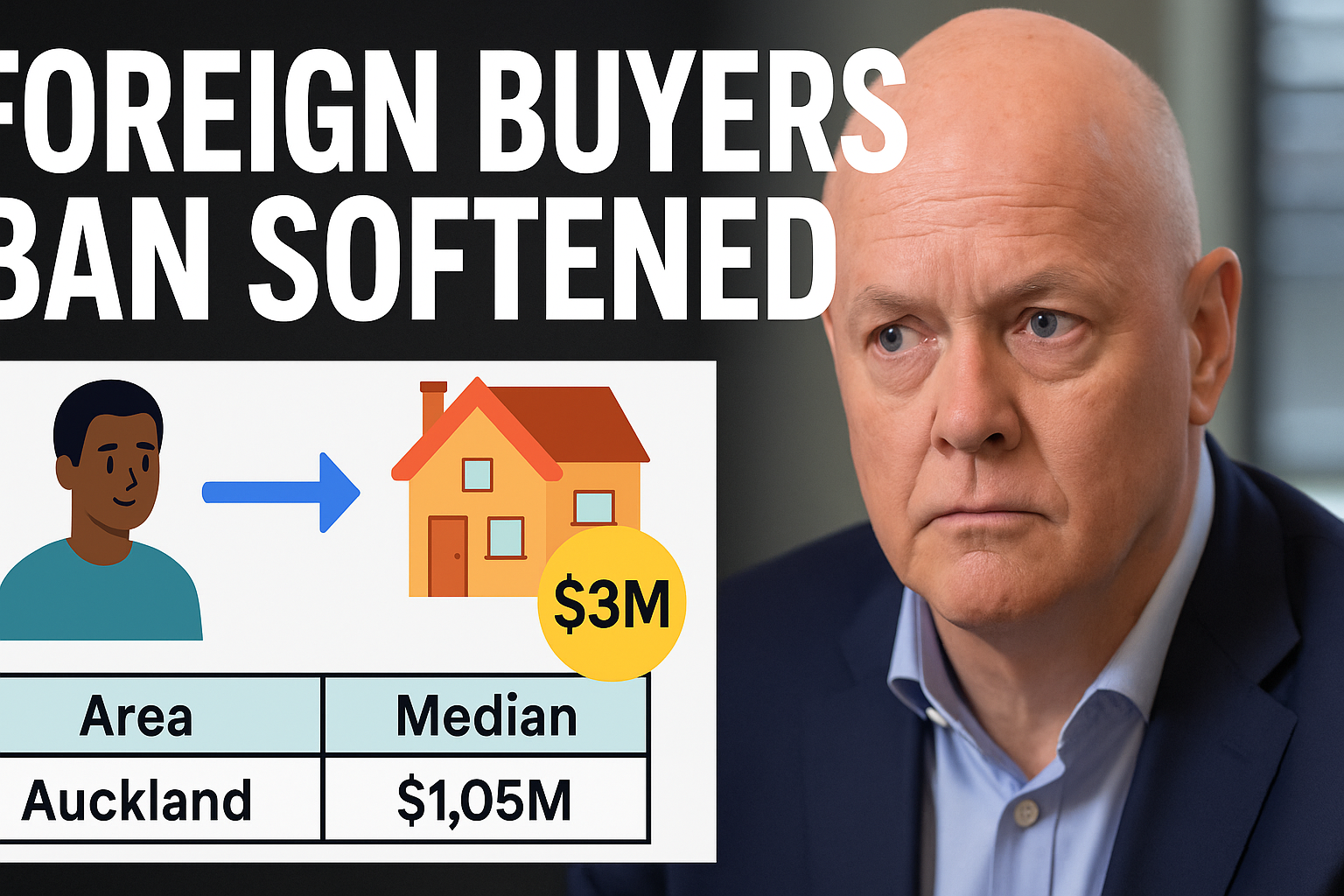
The New Zealand Government has softened the foreign buyers ban, allowing some overseas investors to purchase residential property under strict conditions. Parliament passed the change under urgency late last week, marking a clear shift in housing policy.
While the Government says the move targets only luxury homes and aims to attract overseas capital, critics warn it could still affect house prices, public trust, and confidence in the housing system.
Here is a clear breakdown of what changed, who benefits, and what it could mean for everyday New Zealanders.
What Has Changed
New Zealand introduced the foreign buyers ban in 2018 to reduce overseas demand and protect housing affordability. The new amendment does not remove the ban entirely. Instead, it creates a limited pathway for wealthy overseas investors to buy high-value residential property.
The change was introduced through legislation progressed by Associate Finance Minister David Seymour and supported by the Luxon-led Government.
Who Can Buy Property Under the New Rules
| Buyer Type | Can Buy NZ Homes? | Conditions |
|---|---|---|
| NZ citizens and residents | Yes | No change |
| Australian and Singaporean citizens | Yes | Existing trade agreements |
| Overseas investor (non-resident) | Yes | High-value homes only |
| Overseas buyer below threshold | No | Still banned |
The rules continue to block most foreign buyers from purchasing standard residential homes.
What Is Considered a High-Value Home
Officials’ analysis focused on properties well above the national median price.
| Location | Median House Price (Approx.) | Likely Investor Target |
|---|---|---|
| Auckland | $1.05 million | $2 million and above |
| Queenstown | $1.6 million | $3 million and above |
| Wellington | $950,000 | $1.8 million and above |
This shows the policy mainly affects luxury properties rather than typical family homes.
A Simple Example to Explain the Impact
Example:
- An overseas investor purchases a $3 million home in Auckland.
- That home was unlikely to be affordable for first-home buyers.
- The seller then uses the funds to buy a $1.5 million property.
This creates a ripple effect. While the first sale happens at the top end, money can flow into lower price bands, increasing competition.
Officials say this effect should remain limited. Housing advocates argue even small increases matter in tight markets.
What Officials Warned the Government About
Advice released alongside the legislation flagged several risks:
- High-end purchases could lift price expectations.
- Auckland and Queenstown are most exposed.
- Public confidence in housing policy could weaken.
The Government acknowledged these risks but said the economic benefits justified the change.
Broader Policy Concerns: Investment Without Control Carries Risk
Beyond housing prices, policy analysts warn the softened foreign buyers rules raise wider questions about how New Zealand manages overseas investment.
The central issue is not whether foreign capital is welcome, but whether the country retains sufficient control over it.
Analysts note that overseas investment does not come without risk. Unlike domestic investors, offshore buyers are not tied to local economic conditions, employment obligations, or long-term community outcomes. Their investment decisions can change quickly, particularly during global downturns or geopolitical shifts.
“If we do not retain control, overseas money becomes vulnerable capital. You cannot rely on it in the long term,” a senior political commentator said.
Selective Investment Versus Open Door Policies
Experts argue New Zealand does not need every type of overseas investor.
Only a narrow group of high-net-worth individuals and corporations typically consider New Zealand due to its market size, distance, and regulatory framework. This means the country has leverage to be selective.
The concern is that broad or loosely defined policy settings may prioritise investor volume over national benefit.
“There is a difference between targeted investment and open-door investment,” the analyst said. “New Zealand should only attract investors who create clear, measurable value for locals.”
Housing Versus Productive Investment
A recurring criticism is the difference between property investment and productive investment.
| Type of Investment | Local Benefit | Long-Term Impact |
|---|---|---|
| Residential property purchase | Limited | Asset growth for owner only |
| Business acquisition | Moderate | Employment and supply chains |
| Infrastructure or retail investment | High | Jobs, tax base, community use |
Property purchases generate wealth mainly for the investor. By contrast, investments such as supermarkets, logistics hubs, or large retailers create employment and ongoing economic activity.
Analysts argue housing policy should favour productive investment over asset accumulation.
Tax Contribution and Community Impact
Another concern raised is taxation.
Large overseas investors often structure their operations so profits are shifted offshore. While they may employ local workers, wages are treated as expenses, reducing taxable income in New Zealand.
This raises questions about fairness.
- Overseas executives may access New Zealand healthcare and education.
- Infrastructure, transport, and public services support their operations.
- Yet corporate tax contributions can remain minimal.
“Employment alone is not enough,” the commentator said. “If the tax base does not grow, communities carry the cost.”
Lessons From Immigration and Workforce Policy
The transcript also draws parallels with immigration policy.
Analysts argue both immigration and investment policy suffer when they are not targeted.
For example:
- Doctors, nurses, and teachers address genuine shortages.
- However, long qualification delays reduce immediate benefit.
- Policies that fail to fast-track critical skills weaken outcomes.
The same principle applies to investment. Without clear criteria tied to national needs, policies risk becoming cosmetic rather than structural.
Infrastructure First, Not After
Experts stress that investment should follow infrastructure readiness.
Encouraging investment in housing or population growth without strengthening health, transport, and education systems creates pressure rather than prosperity.
“You cannot focus on appearances while ignoring foundations,” the analyst said. “Infrastructure must come first.”
Why This Matters Now
The foreign buyers policy debate is not just about luxury homes. It reflects a deeper question about national priorities.
- Who benefits from overseas investment?
- Who carries the long-term risk?
- And who controls the outcome?
As New Zealand approaches future elections, housing, tax, immigration, and overseas investment are likely to remain tightly linked issues.
The challenge for policymakers is ensuring that openness does not come at the cost of control.
Media and Transparency Concerns Raised
Speaking to Webfit News, senior New Zealand and geopolitical journalist Mr Shailesh Bagwe from NZ World News Media House raised concerns about how quietly the policy shift occurred.
Bagwe said the issue has received limited attention in mainstream media despite its long-term implications.
“This is a policy change with real consequences, yet much of the prime media is either not discussing it in depth or is choosing not to challenge it,” he said.
He also questioned the process used to pass the change.
“When policies of this scale can be enabled almost overnight, without wider public discussion or scrutiny, it raises serious questions about transparency and democratic accountability,” Bagwe said.
He added that housing policy affects not just investors, but generations of New Zealanders.
“Even if the policy targets high-value homes, the signal it sends matters. Housing decisions should not be rushed or softened quietly.”
Political and Public Reaction
Opposition parties criticised the decision, saying it favours wealthy investors over struggling buyers and renters. They also questioned why the law was passed under urgency with limited public debate.
Housing advocates warned the policy sends the wrong message during a housing shortage.
Real estate and development groups welcomed the change, saying it could unlock stalled luxury projects and support jobs.
Expert View
Property analysts say the real impact depends on enforcement.
If price thresholds remain high and approvals stay limited, national price effects may be small. If thresholds drop in the future, pressure could increase.
Experts also note that markets often respond to policy signals, not just written rules.
What Happens Next
The law is now in force. Key things to monitor include:
- Number of overseas purchases approved
- Concentration of sales in Auckland and Queenstown
- Any future changes to price thresholds
The long-term impact will become clearer over time.
Why This Matters
Even if most New Zealanders never buy a luxury home, housing markets are connected. Decisions at the top end can affect prices, confidence, and trust across the system.
Understanding the numbers helps cut through political noise.