Primary source: New Zealand Parliament Hansard, Oral Questions to Ministers, 22 Oct 2025. Secondary source: item carried on Scoop (content sourced from scoop.co.nz).
Why this matters
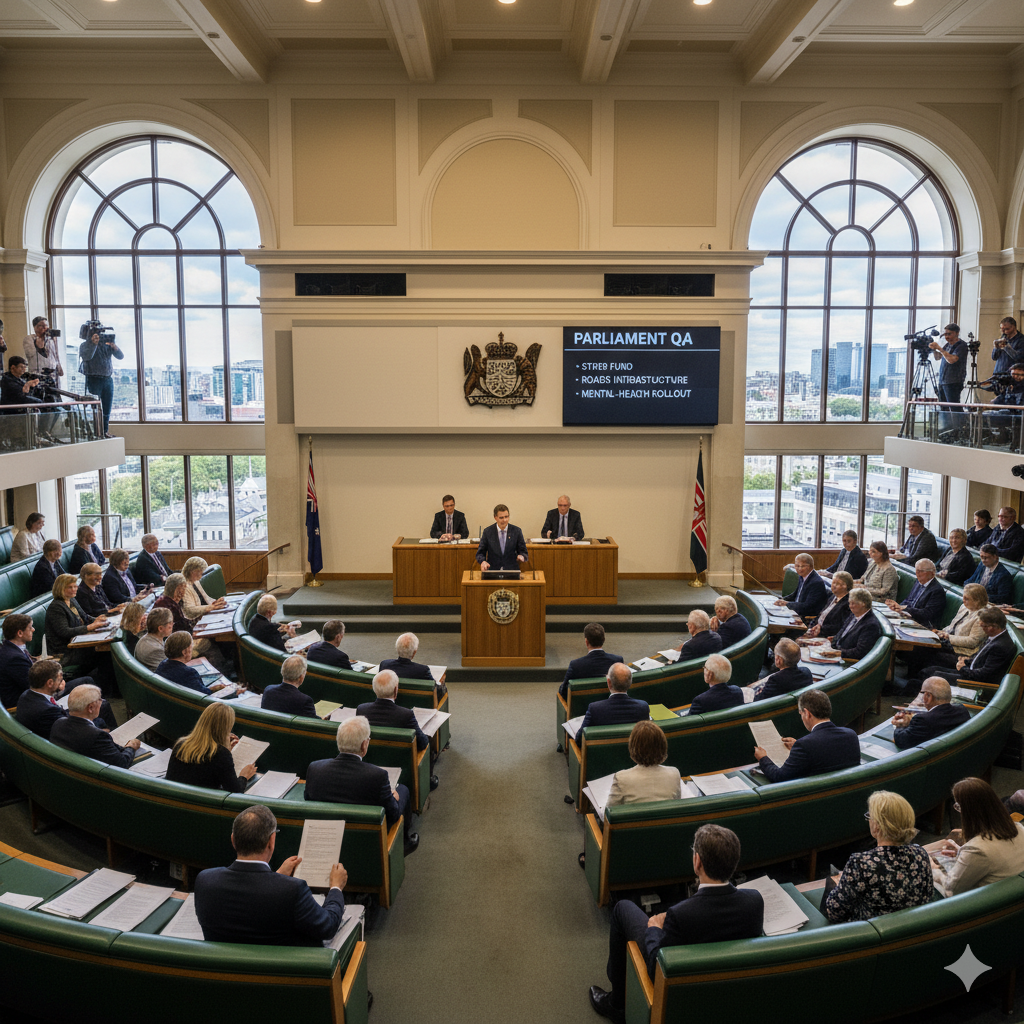
MPs clashed over strikes, pay pressure, public-service ads, crime and infrastructure. Ministers also announced more peer-support workers in hospital emergency departments for people in mental distress. Here are the key takeaways, in plain English.
1) Strikes and pay: PM pressed on limits and offers
- Chris Hipkins asked Prime Minister Christopher Luxon if Ministers sought advice to limit the right to strike. Luxon said he was not aware of any request and stressed a balance between strike rights and impacts on parents, patients and children.
- Hipkins said pay offers for teachers, doctors and nurses trail inflation. Luxon pointed to bargaining with the Public Service Commission and said some offers had not gone to union members.
2) Game-dev rebate and sector growth
- Hipkins pushed for wider eligibility so the existing rebate budget gets used.
- Luxon praised sector growth and cited broader priorities such as fast-track approvals and skills changes. He noted strong primary sector export numbers.
3) Super Fund report and how sovereign funds work
- Acting Finance Minister Chris Bishop highlighted the NZ Super Fund size at 30 June 2025: 85 billion dollars with a 10.1 percent average annual return since inception.
- He explained that global funds buy and sell assets, diversify overseas and reinvest returns. He used Temasek and GIC as examples of active portfolio management and international diversification.
4) Inflation, cost of living and public-sector pay
- Labour’s Barbara Edmonds challenged the Government on inflation and real pay.
- Bishop said inflation sits within the target band at 3 percent, down from 7.3 percent three years ago, and repeated that detailed bargaining sits with the Commission. He pointed to Budget 2025 learning-support funding as part of the education response.
5) Roads of National Significance: next phase funded
- Transport Minister Chris Bishop confirmed 1.2 billion dollars to move the next tranche to development.
- Examples:
- Northland Expressway could cut Auckland to Whangārei travel times by 38 minutes and reduce deaths and serious injuries.
- East West Link and Hamilton Southern Links progress.
- Wellington package includes a second Mount Victoria tunnel, a second Terrace tunnel, Basin grade separation and SH1 improvements.
- South Island plans include the Hope Bypass and the Christchurch to North Canterbury corridor, plus work on the Ashburton bridge.
6) Education strikes and curriculum roadshow
- Labour’s Willow-Jean Prime asked why educators felt forced to strike.
- Education Minister Erica Stanford listed investments such as learning support, teacher registration fees and bonding schemes. She said hundreds attended curriculum roadshows in Christchurch and Lower Hutt and urged unions back to the table.
7) Nurses, staffing and hospital safety
- Green Co-leader Chlöe Swarbrick raised reports of understaffed shifts and neonatal pressure.
- The Prime Minister said there is no hiring freeze and pointed to increased funding and extra nurses since the election. He said targets focus on shorter emergency waits, immunisation, faster first specialist appointments and elective surgery.
8) Justice: fewer victims and new fines-recovery tools
- Justice Minister Paul Goldsmith said the Government targets 20,000 fewer serious-violent-crime victims by 2029 and reported 29,000 fewer victims in the 12 months to May compared with when the Government took office.
- A trial that clamps or seizes vehicles of people with unpaid court fines recovered more than 225,000 dollars and seized 115 vehicles in three months.
- Forthcoming legislation will strengthen consequences for crime and make stalking a specific offence.
9) Public-service ads about strikes
- Labour’s Camilla Belich asked about taxpayer-funded ads during the strike week.
- Acting Public Service Minister James Meager said the decision sat with the Commissioner and that the ads clarified offers and disruption impacts.
10) Organised crime: “Lead Boldly, Act Decisively” report
- Associate Police Minister Casey Costello said a ministerial advisory group flagged transnational organised crime as a major threat.
- Priorities include stronger cross-government cohesion, hitting cash flows, supporting Pacific partners and building community resilience. She said Police and Customs continue to seize record drug volumes.
11) Firefighters: equipment, stations and pay talks
- Acting for Internal Affairs, Deputy Prime Minister David Seymour said the Government backs firefighters and is replacing an ageing fleet with 78 appliances on order, including five aerial trucks, although delivery takes time.
- He later corrected the record, noting FENZ negotiates for itself, not the Public Service Commission.
12) Health: are working conditions safe for nurses
- Health Minister Simeon Brown said about 2,000 more nurses and hundreds more doctors now work in the public system than in 2023, backed by 16.68 billion dollars of extra health funding over three Budgets. He said the focus is on front-line delivery and hitting performance targets.
13) Mental health: peer support now in all major Auckland EDs
- Mental Health Minister Matt Doocey confirmed peer-support workers now operate in North Shore, Auckland City and Middlemore EDs, as well as Dunedin, Christchurch, Wellington and Waikato.
- The goal is faster access, more front-line workers and a better crisis response. Peer specialists use lived experience to support people in distress and link them to community services.
- Doocey said the lived-experience workforce has almost doubled and also works in recovery cafes, eating-disorder services and youth services.
- He said national wait-time targets aim for support within one week in primary care and three weeks in specialist services, ending postcode gaps.