By Geet G | Webfit News
Auckland, New Zealand
The idea sounds almost unbelievable in New Zealand politics.
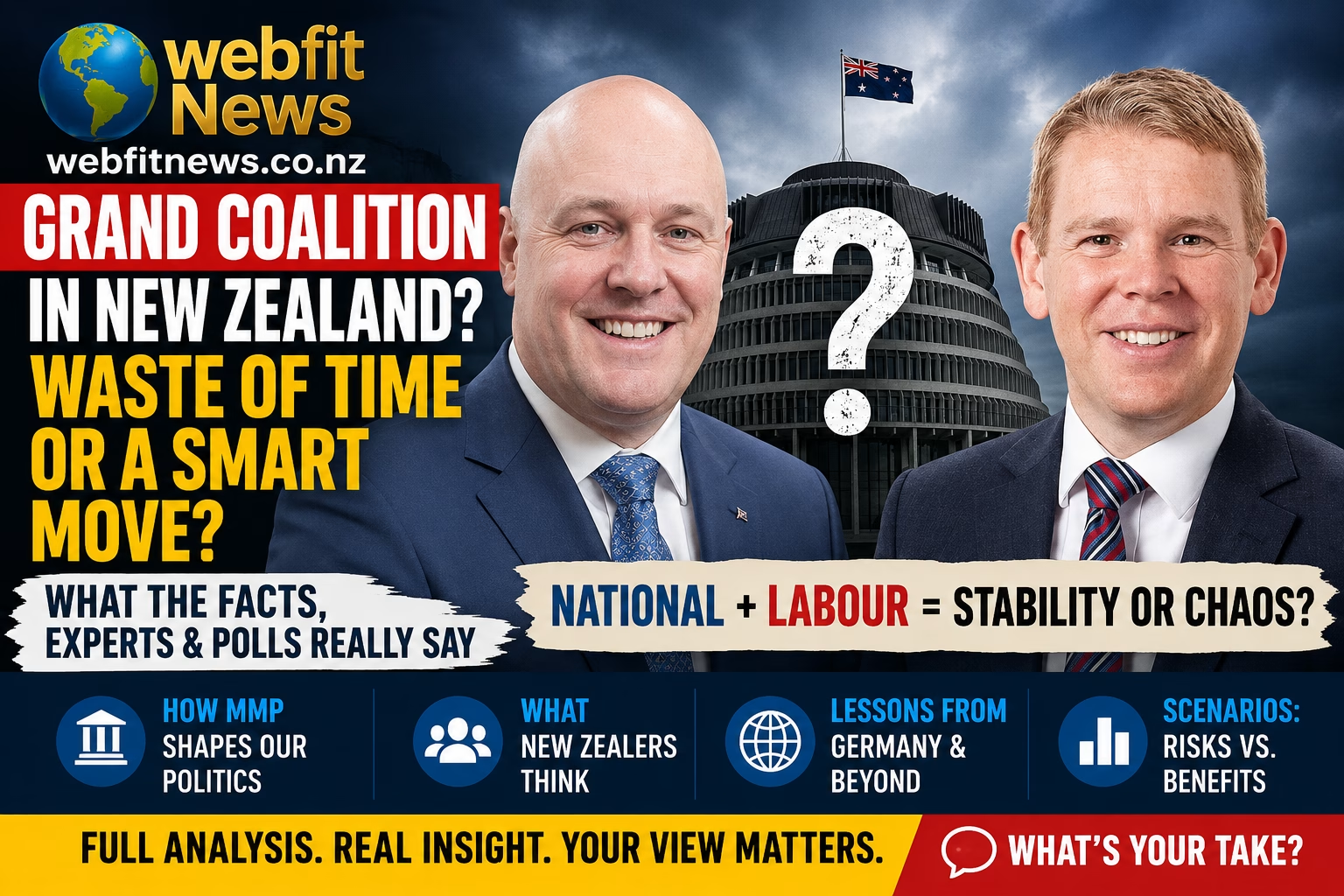
Christopher Luxon and Chris Hipkins sitting on the same side of Parliament.
National and Labour governing together.
ACT, Greens, NZ First, and Te Pāti Māori all pushed into opposition while the country’s two biggest political rivals run the government together.
For many Kiwis, that sounds ridiculous.
For others, especially voters frustrated with coalition instability and endless political fighting, it sounds strangely logical.
And lately, as the 2026 election race tightens and bloc politics become more unpredictable, the conversation around a possible “grand coalition” has quietly started surfacing again in political circles, opinion columns, and online debates.
But once you move beyond the headlines and actually examine how New Zealand’s MMP system works, a much clearer picture emerges.
Technically, a National-Labour coalition is possible.
Politically, however, it remains extraordinarily unlikely.
And according to most political analysts, party insiders, and even the major leaders themselves, the idea is far closer to political fantasy than genuine strategy.
If New Zealand Voted Today, The Election Would Be Almost Impossible To Call – WebfitNews
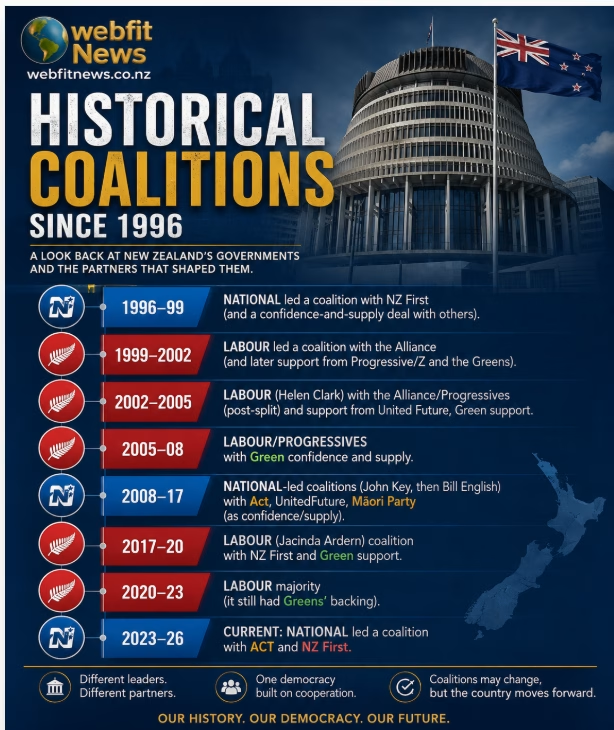
Historical Coalitions Since 1996
- 1996–99: National led a coalition with NZ First (and a confidence-and-supply deal with others).
- 1999–2002: Labour led a coalition with the Alliance (and later support from Progressive/Z and the Greens).
- 2002–2005: Labour (Helen Clark) with the Alliance/Progressives (post-split) and support from United Future, Green support.
- 2005–08: Labour/Progressives with Green confidence and supply.
- 2008–17: National-led coalitions (John Key, then Bill English) with Act, UnitedFuture, Māori Party (as confidence/supply).
- 2017–20: Labour (Jacinda Ardern) coalition with NZ First and Green support.
- 2020–23: Labour majority (it still had Greens’ backing).
- 2023–26: Current: National led a coalition with ACT and NZ First.
What Is a Grand Coalition?
A grand coalition usually refers to a government formed by the two largest political parties in a country, often during periods of crisis, deadlock, or national emergency.
In New Zealand’s case, that would mean the National Party and Labour Party governing together after the election while smaller parties are excluded from power.
The concept is most commonly associated with countries like Germany, where centre-left and centre-right rivals have occasionally joined forces during periods of instability.
But New Zealand’s political structure operates very differently.
Since the introduction of MMP in 1996, governments have almost always been built through coalition negotiations between one major party and smaller support partners.
National traditionally works with ACT and sometimes NZ First.
Labour traditionally aligns with the Greens and Te Pāti Māori.
That coalition culture is now deeply embedded in New Zealand politics.
Which is exactly why the idea of National and Labour suddenly governing together feels so politically unnatural.
Current Party Positions and Statements
- National (Christopher Luxon): Completely dismissive. At a press conference he quipped “Oh hell yeah…that would be insanity” if asked about a grand coalition. He accused Labour of fiscal recklessness and positioned National as the true conservative party. National’s manifesto emphasizes tax cuts and market-driven policies – hardly convergent with Labour’s agenda. Implication: National intends to govern with ACT/NZF or alone, not with Labour.
- Labour (Chris Hipkins): Also rejects the idea. Hipkins said Labour’s and National’s “values are utterly incompatible”. He stresses bipartisanship on certain issues (e.g. infrastructure pipelines) is welcome, but a formal coalition is out of the question. Labour remains committed to its left-leaning coalition partners (Greens, Māori Party, possibly NZ First). Hipkins specifically ruled out even informal talks with fringe parties like The Opportunities Party or Te Pāti Māori under current leadership.
- ACT (David Seymour): As National’s junior partner, ACT firmly aligns with National, championing small-government policies. It has no incentive to join anything resembling Labour’s agenda. While ACT hasn’t publicly discussed “grand coalition,” its platform of tax cuts and liberal economics is far from Labour’s vision. ACT’s implied position is that it belongs in any National-led government, not with Labour.
- NZ First: Once adept at kingmaking, NZ First’s stance is unclear. Winston Peters (who died 2022) kept options open historically, but the party’s recent polling gains suggest it sees itself aligned more with the current National-led government. NZ First has previously worked with both sides (it supported National in 1990s, Labour in 2017). However, it has expressed hostility toward Hipkins and the Greens before, making it an unlikely partner for a grand coalition.
- Green Party (Chlöe Swarbrick & Marama Davidson): The Greens would never join forces with National. Their progressive agenda on climate and social issues is fundamentally at odds with National’s stance. They have consistently backed Labour (as in 2017–2023) and view Labour–Green cooperation as natural. On grand coalition talk, Greens have stayed silent publicly (since they simply don’t entertain the possibility) but implicitly oppose it.
- Māori Party / Te Pāti Māori: Both Māori-focused parties are left-leaning and have only worked with Labour in government (Māori Party in late 2000s, TPM after 2020). They would be sidelined by a Nat–Lab government, so their interest is in opposing it and strengthening Labour/Green appeal in Māori electorates.
- The Opportunities Party (TOP) and others: TOP or fringe parties have no realistic chance in a Nat–Lab coalition scenario. Hipkins even joked about refusing a “cup of tea” with TOP or TPM. TOP positions itself centrist but lacks MPs, and sees itself as an alternative to both major blocs.
In summary, every party publicly indicates the grand coalition idea is a non-starter – either out of principle (Labour, Greens, Māori parties) or strategic interest (National, ACT). This unanimity of skepticism itself signals low feasibility.
Why Is The Discussion Happening Now?
The answer is simple.
The 2026 election is shaping up to be extremely close.
Polling across recent months has shown the centre-right bloc and centre-left bloc sitting almost neck-and-neck. Some polling projections suggest both sides could end up around the 60-seat mark, creating another highly fragmented Parliament.
Whenever elections become this tight, public anxiety around instability increases.
And once voters start worrying about unstable governments, coalition chaos, or prolonged negotiations, discussions around “unity governments” begin appearing again.
Supporters of the grand coalition concept argue that a National-Labour government could provide:
- Greater political stability
- Faster decision-making
- Long-term infrastructure planning
- Bipartisan economic reforms
- Reduced dependence on smaller parties
On paper, that argument sounds reasonable.
But politics is not governed by spreadsheets alone.
It is governed by ideology, voter identity, political survival, and public trust.
And that is where the entire concept starts becoming extremely difficult.
Comparative International Examples
- Germany: The term “grand coalition” originates here. The CDU/CSU and SPD have governed together several times (e.g. 2005–09, 2013–17) when no other majority was possible or to block extremes. These German coalitions lasted several years, but were often plagued by slow decision-making and voter disgust (the SPD struggled in subsequent elections). A recent German example (2022–25) even found that a grand coalition was partly motivated by the rise of the far-right AfD, which mainstream parties wanted to isolate. New Zealand has no AfD equivalent; our “extremist” parties (like NZ Outdoors or Vision NZ) barely register in polls. Thus the key rationale for Germany’s alliances – “keep out radicals” – doesn’t apply here.
- Netherlands: Dutch politics often requires broad coalitions among multiple parties. For example, recent negotiations involved three center/centre-right parties (VVD, D66, CDA), who contemplated adding the centre-left GroenLinks–PvdA to secure a majority. That would have been a broad centrist coalition akin to New Zealand’s grand coalition idea. However, one participant (VVD) explicitly ruled out including that left party, illustrating how even there common ground may fail. The takeaway is that multi-party systems can in theory combine across left-right lines, but practical politics and ideological distances still prevail. (In fact, the Dutch mainstream had already excluded the far-right PVV from power, similar to how NZ parties rule out some fringe deals.) Reuters notes: “adding the Greens–Labour party GL-PvdA to a coalition… would secure a majority”, yet it was off the table because of core disagreements.
- Australia: Australia’s system (Westminster, preferential voting) has no formal mechanism for grand coalitions. Major parties (Liberal-National vs Labor) generally fight to the end. Yet interestingly, pre-2025 polling showed 41.7% of Australians supporting some form of cross-party power-sharing. This suggests a portion of voters value cooperation over conflict. Still, no Australian coalition has ever united Labor with the Liberals—their two-party tradition remains intact. By analogy, Kiwi voters might be open-minded about stability, but cultural norms and party discipline make a Nat–Lab coalition highly atypical here as well.
- Other: In New Zealand’s own history, the nearest approach was the “historic” Labour–NZ First deal in 1999 which allowed a Labour government despite National winning the most votes. That upset National supporters, showing how unconventional coalitions can backfire. Internationally, aside from Germany and the Netherlands, “grand coalitions” have happened in some European countries (e.g. Austria’s ÖVP-SPÖ), usually as a last resort. The common thread: they are often born of stalemate or crisis. New Zealand is not in crisis, and stalemate is avoided by smaller coalitions being viable. This puts NZ outside the usual rationale for a grand coalition.
Both Luxon and Hipkins Have Already Rejected The Idea
Both major party leaders have publicly dismissed the possibility.
Christopher Luxon reportedly joked that such an arrangement would be “insanity.”
Chris Hipkins has also rejected the idea outright, saying the values of Labour and National are fundamentally incompatible.
And realistically, they are not wrong.
Because once you examine the policy differences between the two parties, the contradictions become impossible to ignore.
National is campaigning heavily around:
- Tax reductions
- Fiscal restraint
- Market-driven economics
- Smaller government
- Tougher spending controls
Labour, meanwhile, continues focusing on:
- Public investment
- Social programmes
- Climate initiatives
- Worker protections
- Greater state involvement
Trying to combine those visions into one stable government would likely create constant internal conflict.
Not stability.
Policy Trade-offs and Governance Implications
Stability: A Nat–Lab coalition would command a commanding majority, which on paper is stable. Legally it could pass any law since it could muster >60% of votes, avoiding precarious confidence agreements. However, this very “stability” might prove brittle. With both parties being antagonists, every policy compromise could spark discontent in one camp. Research (e.g. Geddis) warns the larger partner (Prime Minister’s party) would get the lion’s share of credit, and the junior partner could wither during the term. Moreover, leaving the ministerial benches devoid of opposition means there’s no effective internal check; the government could push unpopular measures more easily but at the cost of legitimacy.
Mandate and Accountability: Combining Labour and National blurs the policy mandate. Voters who chose a major party expecting distinct policies would suddenly find their parties merging agendas. In effect, the government could claim it has a bipartisan mandate, but actually it has circumvented usual electoral choices. Critics argue this dilutes accountability: if tax cuts or reforms fail, which party takes the blame? With minor parties locked out, the government would answer only to itself, raising the risk of complacency or groupthink. Accountability traditionally flows through opposition criticism; here, the usual “opposition” would consist of fringe parties, making government scrutiny weaker.
Policy Dilution: Both major parties have core policies that conflict. For example, a grand coalition might temper Labour’s plans for new spending or environmental regulation, and equally curtail National’s tax cuts. In practice, the government’s platform would have to be a lowest-common-denominator set of priorities. Some argue that solving long-term problems requires such bipartisanship, but opponents note it would frustrate partisans on both sides. Indeed, so-called centrists themselves might feel betrayed: left-wing voters would see Labour water down redistributive policies, while right-wing voters see National abandoning small-government principles.
Minority Party Exclusion: Putting Labour and National together automatically excludes the Greens, Māori Party, ACT, NZ First, etc. These parties would be entirely outside government. They would gain a narrative as the “true opposition,” likely energizing their base. For instance, the Greens could say “see, Labour abandoned us,” and ACT/NZ First could claim National cut a backroom deal with Labour. This could polarize politics further at the fringes. In other words, sidelining moderate voices might ironically boost more ideologically pure alternatives.
Governance: On governance, a grand coalition could in principle push through major reforms smoothly (no minor partner to appease on every vote). But the process of governing could become slow and bureaucratic, as was sometimes the case in Germany. Internal negotiation to keep both parties satisfied might sap energy. By contrast, a traditional coalition (one major + minors) provides a clear leader who defines the agenda, and smaller parties influence niche areas. With two equals in charge, forming a coherent cabinet portfolio split would itself be a sensitive issue.
The Real Risk Might Actually Be Damage To MMP
This is where the conversation becomes much more serious.
A grand coalition could potentially undermine one of the core principles behind New Zealand’s MMP system itself.
Under proportional representation, voters expect meaningful political choice and ideological diversity.
If National and Labour suddenly merged into one governing bloc, millions of voters could feel politically stranded.
ACT supporters would accuse National of abandoning conservative principles.
Greens supporters would accuse Labour of betraying progressive politics.
NZ First would immediately position itself as the “real opposition.”
And smaller parties could actually become stronger as frustrated voters search for alternatives outside the political centre.
Ironically, a coalition designed to reduce division could end up creating even more political polarization across the country.
Risks and Benefits
- Risks:
- Political backlash: Voters may feel disenfranchised. “How did I vote for National if they ended up governing with Labour?”: such questions could depress turnout or increase protest votes.
- Policy paralysis: Constant infighting could slow decision-making. Leadership scraps over ministerial appointments could distract from governing.
- Electoral rebound: Past grand coalitions abroad have faced voter rebellion at the next election (e.g. SPD’s losses in Germany after GroKo). Minor parties could siphon disaffected voters.
- Strengthening extremes: Parties like the Greens, NZ First, or Act could capitalize. If two big parties occupy the center, smaller ones can claim to represent lost ideological extremes. Indeed, experts fear the fringe parties would be invigorated if they alone voiced alternative views.
- Benefits (theoretical):
- Big stable majority: No need to negotiate with many small parties.
- Possible long-term reforms: If both sides agree, could enact big changes with wide support (e.g. tax reform, infrastructure investment).
- Reduced adversarial politics: Supporters of cooperation argue that many issues (infrastructure, tech, climate) transcend party lines and would benefit from a unified approach. In interviews PM Luxon and Mayor Brown even note infrastructure as one area for cross-party focus. But note: bipartisan working groups already exist informally, so the same aims might be achieved without a formal coalition.
Overall, our reading is that risks far outweigh the benefits in the NZ context. The emotional, cultural, and partisan costs of a Nat–Lab coalition seem too high for the vague promise of “stability.”
Germany Is Often Used As The Example. But New Zealand Is Not Germany
Supporters of the idea frequently point toward Germany’s grand coalitions as proof that rival parties can govern together successfully.
But context matters enormously.
Germany has historically used grand coalitions during periods of constitutional pressure, fragmentation, or concerns about extremist political movements.
New Zealand is not currently facing that level of institutional crisis.
In fact, New Zealand’s coalition system already functions relatively well compared with many democracies around the world.
Messy? Yes.
Slow at times? Absolutely.
But functional.
And importantly, MMP already forces compromise through smaller coalition arrangements without requiring National and Labour to erase their political identities entirely.
That distinction matters.
Scenario Comparison
| Coalition Scenario | Stability | Policy Coherence | Public Reaction | Feasibility |
|---|---|---|---|---|
| Grand Coalition (Nat + Labour) | Mixed: Very large majority, but internal tensions could emerge. Much sturdier than thin blocs, yet prone to infighting if leadership clashes. | Low: Divergent agendas mean compromises dilute both sides’ platforms. (“Utterly incompatible” values.) Lacks a clear ideological focus. | Low: Likely unpopular. Both parties’ bases feel betrayed; commented analysts call it “insanity”. Political commentators warn it betrays democracy. | Very low: Top leaders have categorically ruled it out. No historical precedent in NZ; parties see it as politically toxic. |
| Centre-Right (Nat + ACT + NZ First) | High: Experienced partnership (current government). Shares broad economic principles. Stable in past terms. | Moderate: ACT/NZF align more with National than Labour, so less dilution. Smaller compromises needed. | Moderate: Roughly reflective of ~47.5% support, but some voters dislike NZ First. More conventional than grand coalition. | High: Historically proven. These parties are already allied; renewal is straightforward if seats allow. |
| Centre-Left (Lab + Greens + NZ First) | Moderate: Labour/Green have common ground. Would depend on NZ First’s role (less ideological alignment). Formerly worked (2017–20). | Moderate: Left-leaning coalition, more coherent on social/environmental policies. Without minor partners, policy could advance more smoothly. | Moderate: Polls show ~45% backing for Labour+Greens. NZ First addition might erode some left credibility, but many left‑leaners would cheer Labour+Greens together. | Possible: Labour has governed this way before. If election results allow (Lab+Greens ~56 seats now), NZ First or Māori Party support might be needed. It’s more realistic than Nat–Lab. |
Could It Ever Actually Happen?
Technically, yes.
There is no constitutional barrier preventing National and Labour from governing together.
If election numbers became extremely chaotic and neither bloc could reach a workable majority, pressure could theoretically increase for broader negotiations.
For example:
- National + ACT + NZ First fail to reach 61 seats
- Labour + Greens + Te Pāti Māori also fail
- Coalition talks drag on for weeks
- Markets react negatively
- Political instability grows
Only under that kind of extreme scenario would serious conversations around a grand coalition likely emerge.
Even then, however, both parties would probably exhaust almost every other option first.
Because politically, the risks are enormous.
The Webfit News Perspective
There is one important point many people miss in this debate.
The growing discussion around a grand coalition reflects something real happening in New Zealand politics.
Many ordinary voters are becoming increasingly exhausted by constant political warfare, ideological tribalism, and unstable coalition arithmetic.
People want governments that function.
They want infrastructure delivered.
They want cost-of-living pressures addressed.
They want long-term thinking instead of endless political point-scoring.
That frustration is genuine.
But a National-Labour coalition probably solves the wrong problem in the wrong way.
New Zealand’s MMP system was specifically designed to ensure multiple voices remain part of government formation.
And despite all its frustrations, the system still provides representation, negotiation, compromise, and accountability.
Replacing that structure with one giant political merger could actually weaken democratic choice rather than strengthen it.
In reality, the current coalition model already provides what New Zealand needs:
- Negotiation
- Compromise
- Diverse representation
- Shared power
- Political accountability
It may not always look clean.
But democracy rarely does.
And right now, the idea of a National-Labour grand coalition appears far more useful as political commentary and media debate than as a realistic governing strategy.
What’s your take on it? Share your opinion 💬 #NZPolitics #GrandCoalition #YourView
In short: A National–Labour grand coalition is a waste of time. It would only materialize in Parliament if the two leaders somehow forgot their own identities – and neither is about to do that. Observers calling it “worth considering” are giving it too much credit. It might score headlines, but it makes neither strategic nor policy sense.
Recommendations and Next Steps
Parties: National and Labour should continue to rule out a grand coalition, as they have, and instead clearly lay out their preferred coalition partners so voters aren’t kept in suspense. If one side can’t govern alone, it should negotiate in good faith with like-minded parties (e.g. National with ACT/NZF, Labour with Greens/NZF) rather than staging media stunts. Minor parties (Greens, Māori, NZ First) should sharpen their policy pitches now, since they’ll remain kingmakers in any serious scenario. Transparency in talks is crucial: parties should publish coalition “deal points” so the public sees what they’re conceding.
Government & Governor-General: The GG should remind parties of their duty to find a stable majority; there is no constitutional trick needed for Nat–Lab beyond normal processes, but the Governor-General can encourage open and fair negotiations. If talks drag on, the GG might offer informal guidance (as is custom) to avoid a deadlock.
Media: Journalists should critically interrogate the grand coalition hype. Contextual reporting (like this) is needed so the public understands MMP norms. Debunking unrealistic scenarios will help voters focus on credible outcomes. Comparative analysis (e.g. Germany, Netherlands) can illustrate the real trade-offs involved.
Public/Voters: Citizens should ask their MPs and candidates what coalitions they actually plan, and hold them to it. If voters don’t like minor parties’ influence, the answer isn’t to merge the big parties – it’s to elect bigger mandates or tweak MMP (long-term). Public forums could discuss whether NZ should ever consider such broad coalitions (perhaps a Constitutional Convention on future election rules, as some have suggested).
Electoral Commission/Parliament: Currently there’s no legal impediment to any coalition, and probably none needed. However, officials could review whether MMP rules (like the 5% threshold) still serve democracy well, or if voters should directly approve new coalition norms (the 2012 MMP Review touched on related issues). Any formal proposals for “grand coalition” powers (like fixed-term bipartisan governments) would require broad public input.
In conclusion, stakeholders should treat the grand-coalition talk as a thought exercise, not a policy to enact. Focus should remain on achievable agreements that respect voters’ choices and maintain the accountability and diversity that MMP was designed to ensure.