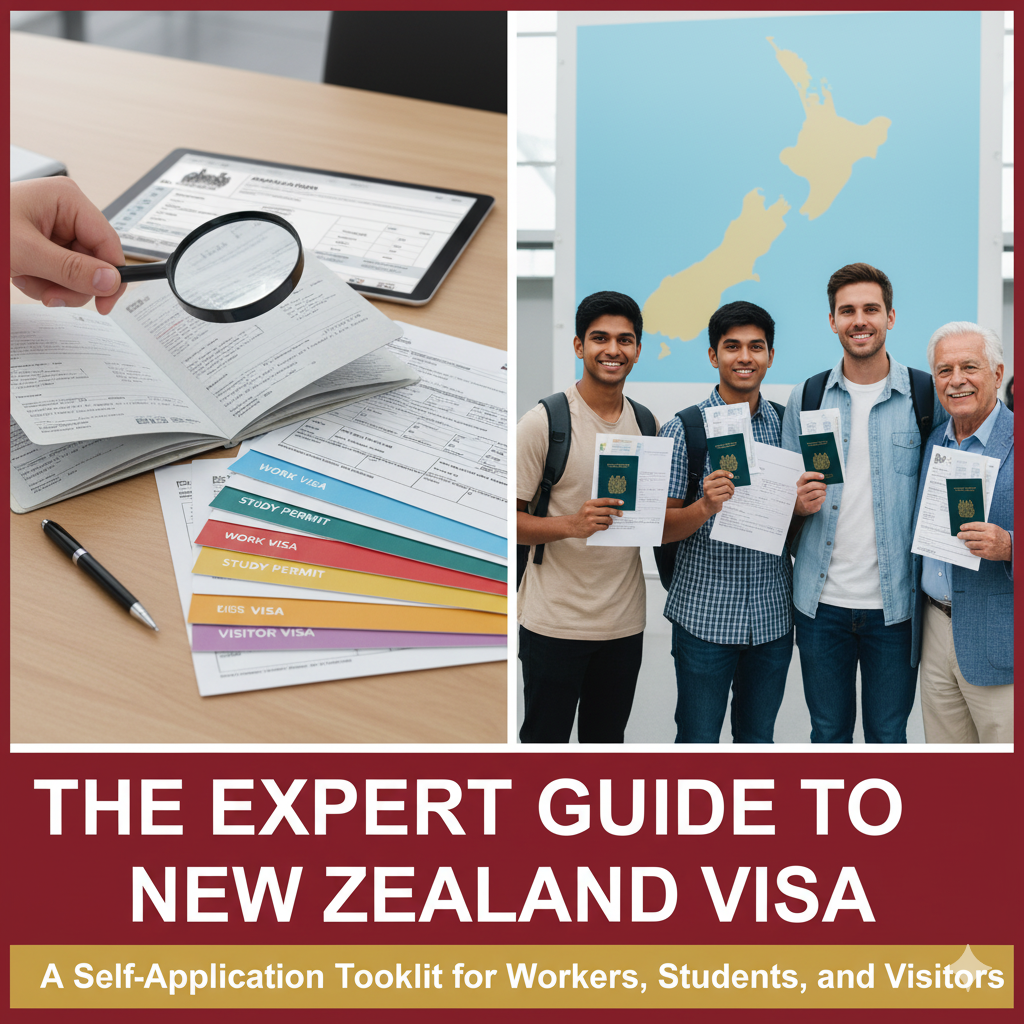
Policy is changing fast in 2025. Use this verified, plain-English guide to apply on your own, avoid common mistakes, and keep your documents in order.
Auckland | November 2025
New Zealand’s visa rules are shifting to match economic needs. You can still apply on your own if you plan well and follow the rules closely. This guide explains the key policies, fees, documents, timelines, and practical steps for visitors, students, and workers. It also covers partnership and residence pathways.
1) Know the rules before you start
• INZ policy now uses the National Occupation List. Updates took effect in July 2025, with 87 more occupations recognized from 3 November 2025.
• Wage thresholds are indexed. From 18 August 2025, the median wage for many visas is NZD 33.56 per hour.
• Every application has a fee. Most short-term visas also include the IVL levy of NZD 100. The IVL is not refunded if your visa is declined.
• Most applications are online. Processing times vary by visa. Plan for delays during peak periods.
Typical processing guide
Visitor Visa: Many decisions are made within 2 weeks for 80 percent of cases.
AEWV: often 5 to 6 weeks.
Student Visa: Apply at least 8 weeks before travel.
2) Health, character, and identity are non-negotiable
• Police certificates must be less than 6 months old on the date you apply.
• Medicals and chest X-rays, when required, must be less than 3 months old when INZ receives them.
• Names, dates of birth, and passport numbers must match across all documents.
• Your passport should be valid for at least 3 months beyond the date you plan to leave New Zealand.
Tip: Time your police and medical checks so they stay valid until a decision is made.
3) Visiting New Zealand
Choose one route
NZeTA: for eligible nationalities. Cost is NZD 17 in the app or NZD 23 online. Valid for 2 years. Stay up to 3 months per visit, or 6 months for UK citizens.
Visitor Visa: for others or longer stays. Stay up to 6 or 9 months, with a 9-months-in-18-months limit. Fees from NZD 441.
Key conditions
• No work in New Zealand for gain or reward. Remote work for an overseas employer is usually fine.
• Study allowed up to 3 months in any 12 months.
• Show plans to leave and proof of funds.
Funds test
• NZD 1,000 per month of stay, or NZD 400 per month if accommodation is prepaid.
• Provide bank statements in your name with at least 6 months of transactions.
Visitor Visa checklist
Identity: valid passport, acceptable photo.
Funds: 6 months of bank statements that meet the monthly threshold.
Return plans: onward ticket or money to buy one.
Ties to home: job letter with approved leave, property records, or family ties.
Health and character: medicals and police checks if required.
Itinerary: simple plan with bookings or event tickets.
4) Studying in New Zealand
Core documents
• Offer of Place from an approved provider.
• Evidence of tuition payment or a loan, or a scholarship that covers fees.
• Living costs: NZD 20,000 per year for tertiary study, or NZD 1,667 per month for shorter courses. For school years 1 to 13, the amount is NZD 17,000 per year.
• Financial proof can include 3 months of bank statements, fixed deposits held for at least 3 months, or full education loan papers. Sponsors outside New Zealand must file a Financial Undertaking for a Student and provide their own bank history.
Work rights
• From 3 November 2025, most eligible students can work up to 25 hours per week in term time.
• Full-time work is allowed in scheduled breaks for qualifying courses.
• Master’s by research and PhD students have unlimited work rights.
• No self-employment and no work in restricted sectors.
Student Visa checklist
Offer and enrolment.
Fee payment or loan letter.
Living funds with 3 months of history.
Ticket home or funds to buy one.
Health and character documents.
Insurance is required by your provider.
5) Working in New Zealand: AEWV pathway
How the AEWV works
Step 1: Employer gets accreditation.
Step 2: Employer completes a Job Check.
Step 3: The Employer invites you to apply with a token, job offer, job description, and signed agreement.
Your proof of skill
• Show at least 2 years of relevant experience, or a qualification at Level 4 or higher on the NZQCF.
• If using overseas qualifications below a bachelor’s level, apply for an NZQA IQA. Start early as this can take weeks.
• If your job needs registration, get it before you apply.
• English tests may be required for some roles at lower skill levels.
Wages and stay length
• From 18 August 2025, the median wage is NZD 33.56 per hour. Your pay must meet the market rate and any set threshold.
• Five-year maximum stay if the role is skill level 1 to 3, or if pay is at least NZD 50.34 per hour, or if the role is on the Green List.
• Three-year maximum stay for most skill level 4 or 5 roles that do not meet higher thresholds.
• After reaching the cap, you must leave New Zealand for 12 months before a new AEWV, unless you move to residence.
AEWV applicant checklist
Identity: passport and acceptable photo.
Job: signed agreement, job description, token.
Skills: certificates and transcripts, or reference letters on letterhead, pay slips, and tax records.
Registration: provide proof if required.
English: valid test result if needed.
Health and character: police and medical documents within validity.
6) Partner and family applications
Who can support a partner
• A New Zealand citizen or resident.
• A temporary work visa holder who meets the income level and policy settings.
What proves a genuine and stable relationship
Cohabitation: joint lease, joint utility bills, or mail to both of you at the same address.
Financial interdependence: joint bank accounts in frequent use, joint credit cards, shared assets.
Commitment: marriage or civil union papers, children’s birth certificates, shared household records.
Public recognition and communication: family letters, photos over time, message history.
Partnership checklist
Identity for both partners.
Proof of status for the supporting partner.
Form INZ 1146 if required.
Dated evidence in each of the four pillars above.
7) Residence: Skilled Migrant Category (SMC)
The 6-point system
You need 6 skilled resident points plus a skilled job or job offer from an accredited employer at 30 hours per week or more.
Pick one primary path:
Occupational registration: 3 to 6 points based on required training time.
Qualification: 3 points for a Level 7 bachelor’s, 4 points for Level 8, 6 points for Level 10 PhD.
Income: 3 points for at least NZD 50.34 per hour, 4 points for at least NZD 67.12 per hour, 6 points for at least NZD 100.68 per hour.
Add up to 3 points for skilled New Zealand work experience. If you use income as your primary path, you must show that your pay met the threshold during your claimed work period.
Future note for 2026
From August 2026, the residence system is set to add a skilled work experience pathway and a trades and technician pathway with simpler wage tests based on the median wage throughout the whole period of work.
8) The top 10 mistakes that cause refusals
- Missing or inconsistent details across forms, passports, and contracts.
- Bank statements without the required 3 or 6 months of history.
- Police certificates older than 6 months or medicals older than 3 months.
- Applying for the wrong visa for your goal.
- Weak evidence that you will return home at the end of your stay.
- No IQA when it is required for your qualification.
- Working when your visa does not allow it, or exceeding student work hours.
- Hiding previous visa issues or criminal history.
- Using a CV as the only proof of work experience.
- Leaving applications to the last minute and missing policy updates.
9) How to plan your DIY application like a project
• Build a timeline. Start with long tasks first, such as IQA and bank history.
• Keep a single folder for every document. Use clear file names that match your application answers.
• Double-check all dates and spellings.
• Read the official INZ page for your visa type before you submit. Search on immigration.govt.nz or govt.nz for the latest forms and fees.
Bottom line:
You can apply on your own and save money if you prepare like a pro. Match your job to the right occupation code, meet the wage, show real bank history, and keep police and medical documents in date. Clear, complete, and honest applications have the best chance of success.
This article is general information, not legal advice; please verify with official INZ and DIA sources or consult a licensed immigration adviser before applying.