Auckland, 8 August 2026
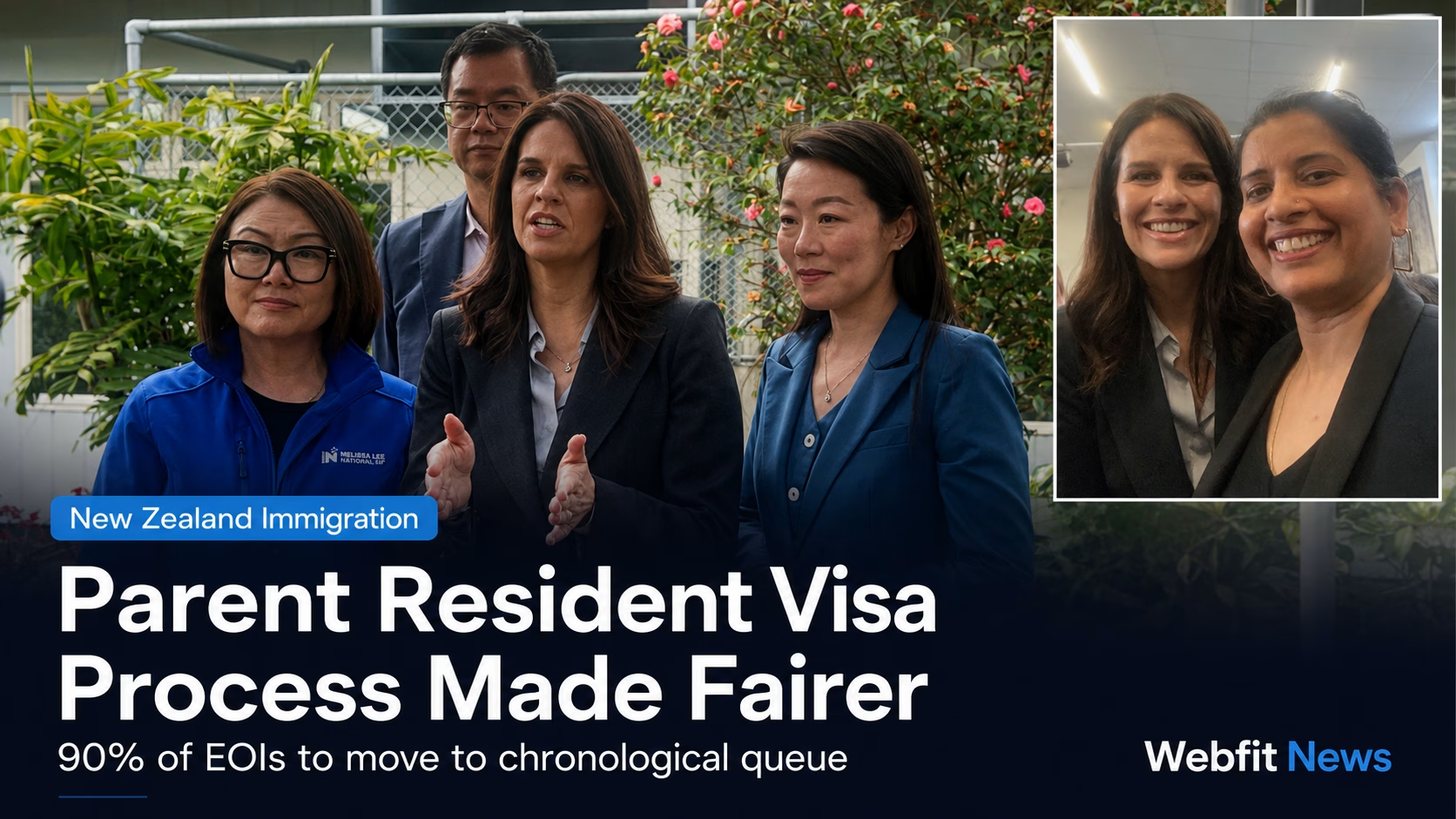
New Zealand families waiting to bring their parents to the country are set to receive a more predictable pathway under major changes to the Parent Resident Visa selection system announced by Immigration Minister Erica Stanford.
Webfit News attended the media briefing where the Minister outlined the new approach, which replaces the current fully random ballot-style selection process with a hybrid system designed to give greater priority to families who have already been waiting for years.
Under the new model, 90 percent of Expressions of Interest, known as EOIs, will be selected chronologically according to their original submission date, while the remaining 10 percent will continue to be selected through a ballot.
The annual Parent Resident Visa cap will remain at 2,500 visas per financial year.
The Government says the change is intended to provide greater certainty for families while still allowing newer applicants a limited opportunity to be selected earlier through the ballot component.
What is changing?
At present, eligible Parent Resident Visa EOIs are selected through a ballot system. This means families who have been waiting for several years may have no greater chance of selection than people who entered the pool much later.
The new approach changes that significantly.
| Parent Resident Visa change | New arrangement |
|---|---|
| Selection by chronological queue | 90% of EOIs |
| Selection by ballot | 10% of EOIs |
| Annual visa cap | 2,500 |
| New model takes effect | 5 October 2026 |
| First selection under new system | 10 November 2026 |
| Queue position notifications | October 2026 |
| EOI expiry | No longer expires every two years, subject to confirmation |
The chronological component means the majority of available selections will now go to applicants based on how long they have been waiting.
Stanford described the move as a response to families seeking greater certainty and stability from the immigration system.
Families will no longer need to reapply every two years
Another significant change concerns the expiry of Expressions of Interest.
Under the new model, EOIs will no longer automatically expire after two years, provided applicants confirm they still wish to remain in the process and keep their details up to date.
This also means families will no longer have to repeatedly pay an additional fee every two years simply to resubmit their EOI.
For families who have already waited several years, this could remove both administrative frustration and additional cost.
There are, however, important transition rules.
People whose current EOI expires before 5 October 2026 will need to submit a new EOI.
Those whose EOI expires on or after 5 October 2026 will not need to submit a fresh one.
Where an applicant previously resubmitted an EOI after the original two-year expiry, their position may still be based on the original submission date, provided the replacement EOI was submitted within 90 days of the earlier one expiring.
Nearly 12,000 people currently represented in the pool
The scale of demand is clear from figures released alongside the announcement.
As of 5 August 2026, there were 7,931 valid EOIs representing 11,904 people in the Parent Resident Visa ballot pool.
Parent Resident Visa EOIs by original submission year
| Original submission year | EOIs | People represented |
|---|---|---|
| 2022 | 140 | 228 |
| 2023 | 1,430 | 2,230 |
| 2024 | 1,181 | 1,778 |
| 2025 | 2,852 | 4,271 |
| 2026 | 2,328 | 3,397 |
| Total | 7,931 | 11,904 |
The figures demonstrate why waiting times will not disappear immediately.
With the annual visa cap remaining at 2,500, demand continues to substantially exceed the number of residence places available.
The Minister acknowledged there is no perfect system for allocating places when demand is higher than supply, but said the Government believes the new arrangement creates a fairer balance.
Why the Government says the change matters
For migrant families, the Parent Resident Visa is about considerably more than immigration administration.
Parents can play an important role in childcare, family support, cultural connection and helping households through difficult periods.
For migrants who have built careers, businesses and families in New Zealand, having parents nearby can also be an important part of establishing long-term roots in the country.
Stanford said she had been contacted by families concerned about the uncertainty created by a purely random ballot, particularly where people had already been waiting since 2022.
The new model aims to recognise that waiting time while retaining a small ballot component for newer applicants.
In practical terms, a family that entered the system several years ago should now have a clearer understanding of where it sits in the queue rather than simply waiting for another random draw.
Current ballot will have one final selection
The existing ballot system is not ending immediately.
According to the Minister’s announcement, the final selection under the current Parent Resident Visa ballot system will take place on Tuesday, 11 August 2026.
After that, Immigration New Zealand will begin preparing applicants for the transition to the new model.
People with existing EOIs are expected to be informed of their position in the new chronological queue during October.
The new selection settings formally take effect on 5 October 2026, with the first selection under the redesigned system scheduled for 10 November 2026.
Immigration New Zealand is expected to publish further operational information before the changes take effect.
Eligibility requirements are not changing
Importantly, being selected from the EOI pool does not mean a visa is automatically granted.
Applicants and sponsors will still need to satisfy all Parent Resident Visa requirements.
These include requirements relating to:
- sponsorship
- health
- character
- family relationships
- other immigration eligibility criteria
The Parent Resident Visa remains the main residence pathway for eligible parents who want to settle permanently in New Zealand.
Parent Boost Visa remains separate
The Government has also stressed that the Parent Resident Visa should not be confused with the Parent Boost Visa.
Parent Boost is a long-term visitor visa.
It does not provide a pathway to residence.
The Parent Resident Visa, by comparison, allows eligible parents of New Zealand citizens and residents to live in the country permanently if all requirements are met.
That distinction is important for families considering which immigration option best fits their circumstances.
What this means for migrant families
The biggest change is certainty.
Families will still face waiting periods because the number of applicants remains considerably higher than the annual quota, but the majority will now know that time already spent waiting matters.
For those who entered the pool several years ago, the shift from random selection to a mostly chronological system may be particularly significant.
The first major test of the new model will come with the 10 November 2026 selection.
Until then, families with an existing EOI should watch for communication from Immigration New Zealand and ensure their contact details and other information remain current.
For thousands of migrant families across New Zealand, including many in Auckland’s large Indian, Asian and other migrant communities, the announcement marks one of the most consequential changes to the Parent Resident Visa process in recent years.
Source: Office of Immigration Minister Hon Erica Stanford, media release dated 8 August 2026.