WELLINGTON, 27 July 2026
The National Party is placing household finances and support for parents at the centre of its election campaign, promoting a package that combines measures already introduced by the Government with new policies that would depend on National winning another term.
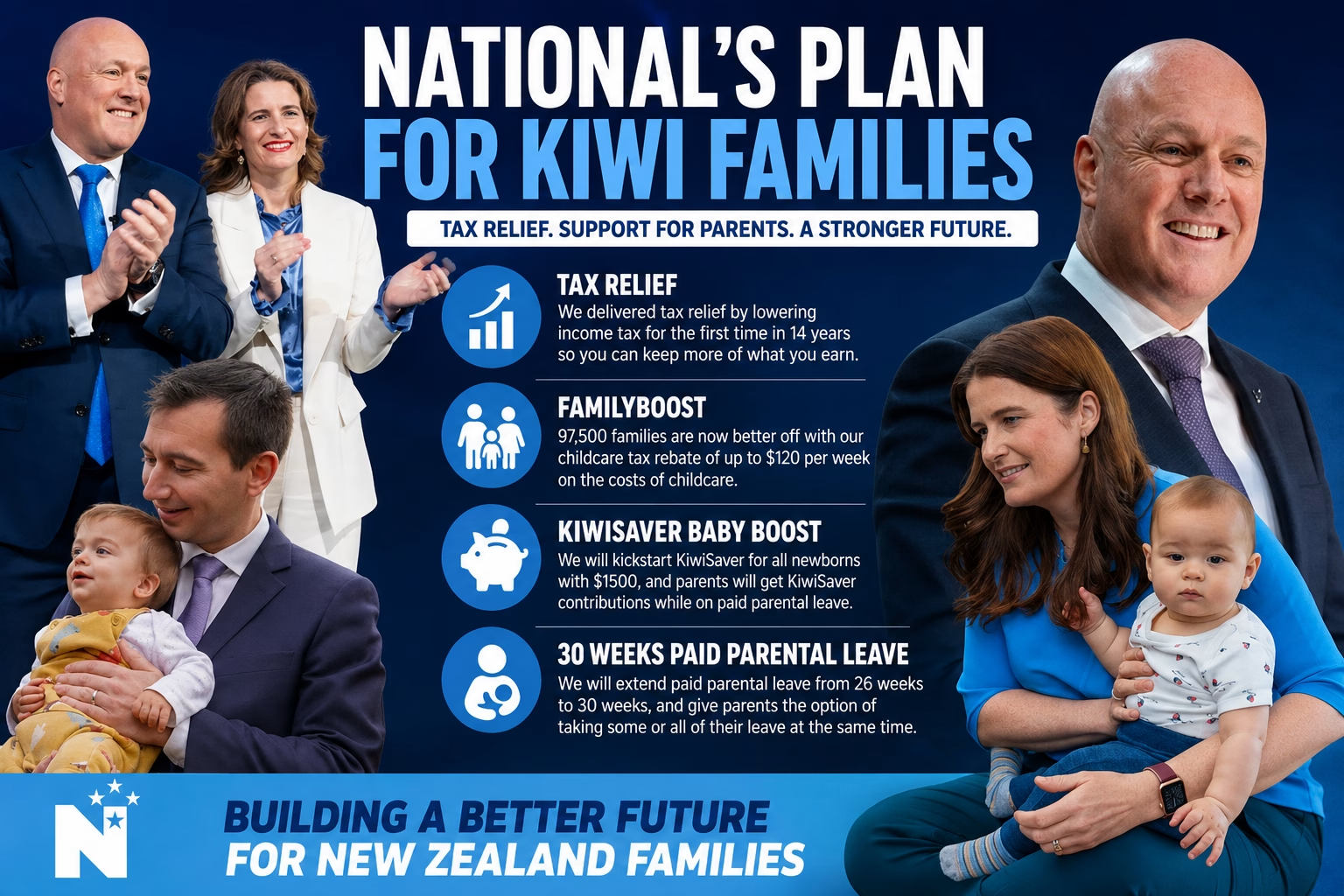
In a series of campaign messages, National has highlighted income tax changes, the FamilyBoost childcare rebate and two newly announced election commitments: a $1,500 KiwiSaver payment for newborns and an extension of paid parental leave from 26 to 30 weeks.
The party says the policies reflect an effort to provide practical support to New Zealand families while keeping government spending under control.
However, the package contains an important distinction for voters. The income tax changes and FamilyBoost are already operating, while the KiwiSaver Baby Boost and 30-week paid parental leave policies are promises for a future National-led government.
Four measures aimed at Kiwi families
National’s campaign identifies four main areas of support:
| Measure | Current position |
|---|---|
| Personal income tax relief | Introduced from 31 July 2024 |
| FamilyBoost childcare rebate | Currently available to eligible families |
| $1,500 KiwiSaver Baby Boost | National election policy, proposed from July 2027 |
| Paid parental leave extended to 30 weeks | National election policy, proposed to be phased in by 2029 |
The messaging is designed to show continuity between what the Government says it has already delivered and what National is promising if re-elected.
That approach allows the party to campaign on its record while also presenting a broader family-focused programme for the next parliamentary term.
Income tax relief already in place
National says it delivered personal income tax relief for the first time in 14 years by adjusting income tax thresholds and expanding some tax credits from 31 July 2024.
The Government said at the time that around 1.9 million households would receive some form of relief and that the package was targeted mainly towards low and middle-income earners.
The changes included adjustments to personal income tax brackets, an expansion of the Independent Earner Tax Credit and an increase to the In-Work Tax Credit for eligible working families.
The actual benefit varies according to income, household structure and eligibility for tax credits.
For some families, the changes provided a noticeable increase in take-home pay. For others, particularly households facing higher rent, food, insurance, electricity and transport costs, the additional income may have been absorbed quickly by everyday expenses.
National nevertheless sees the tax package as one of its strongest cost-of-living achievements, arguing that people should be able to retain more of what they earn.
More than 97,500 families receive FamilyBoost
The Government announced on 27 July that more than 97,500 families had received at least one FamilyBoost payment, while approximately 115,000 households had registered for the scheme.
FamilyBoost helps eligible households recover a portion of their early childhood education costs.
Following an expansion introduced in 2025, qualifying families can claim up to 40 percent of eligible childcare fees, with a maximum payment of $1,560 per quarter. That is equivalent to as much as $120 a week for families receiving the full entitlement.
Eligibility and payment levels depend on household income and the amount a family spends on approved early childhood education.
Households earning below $35,000 per quarter can receive up to 40 percent of eligible costs. Payments gradually reduce for households earning above that level and stop once income reaches the upper eligibility threshold.
Finance Minister Nicola Willis has promoted the growing number of FamilyBoost recipients as evidence that the scheme is reaching families facing significant childcare costs.
For parents with children in early learning, childcare fees can affect whether one or both parents return to work, how many hours they can afford to work and how much disposable income remains after essential expenses.
$1,500 KiwiSaver Baby Boost is an election promise
National’s proposed KiwiSaver Baby Boost would automatically enrol every child born in New Zealand into KiwiSaver and place a $1,500 government contribution into the child’s account.
The policy is proposed to begin on 1 July 2027, but only if National is returned to government.
National argues that investing money at birth would give every child a financial foundation and allow decades of compound investment growth.
The party estimates that a $1,500 payment earning an average long-term return of about 7 percent a year could grow to approximately $5,000 by the time the child turns 18, even without additional contributions.
The eventual balance would not be guaranteed because KiwiSaver returns depend on market performance, fees, fund choice and economic conditions.
The proposal forms part of a wider National plan to make KiwiSaver compulsory for most workers from July 2028 and progressively lift default employee and employer contributions.
Supporters may see the newborn payment as a way to encourage long-term saving and give all children a stake in the country’s retirement savings system.
Critics are likely to question whether universal payments to newborns should be prioritised over immediate support for families struggling with housing, food and healthcare costs.
Paid parental leave would rise to 30 weeks
National has also announced that a re-elected government would gradually extend paid parental leave from the current 26 weeks to 30 weeks by 2029.
The proposal would increase the entitlement to 27 weeks through the next Budget, with additional increases planned through the following two Budgets.
Parents would also be given more flexibility to take some or all of their leave at the same time.
Under the existing system, eligible parents can receive government-funded parental leave payments for up to 26 weeks. The maximum weekly payment increased to $811.05 from 1 July 2026.
An extra four weeks could provide valuable time for parents recovering from childbirth, caring for newborns and managing the transition back to employment.
The benefit would be particularly significant for households unable to afford unpaid leave.
National is presenting the policy as both a family support measure and a workforce initiative, arguing that greater flexibility can help parents remain connected to employment.
Delivered policies and future commitments
The campaign material brings current government programmes and future election promises together under one family support message.
That makes the package easy to communicate, but voters will need to separate what is already available from what has not yet been implemented.
Tax relief and FamilyBoost are operating programmes.
The newborn KiwiSaver contribution and 30-week paid parental leave entitlement would require National to win the election, form a government, allocate funding and pass any necessary legislative changes.
The final design of those policies could also change during coalition negotiations or the parliamentary process.
The debate over disciplined spending
National says it is making careful choices and controlling expenditure so it can support households without placing additional pressure on inflation, borrowing or government debt.
The Government’s fiscal strategy is to limit growth in core Crown spending and gradually reduce expenses towards 30 percent of gross domestic product.
Treasury forecasts and Budget documents show that fiscal restraint remains a major government objective, although New Zealand continues to face substantial spending demands in healthcare, education, infrastructure, defence and social services.
The political debate is therefore not only about whether families should receive more support. It is also about what form that support should take, how targeted it should be and which other areas of government spending may receive less funding.
National’s approach favours tax relief, targeted rebates and long-term savings incentives.
Opposition parties are likely to argue for different priorities, including broader public services, healthcare subsidies, housing assistance and more direct support for lower-income households.
Will families feel better off?
The effectiveness of the package will ultimately be judged by whether families experience a genuine improvement in their weekly finances.
Income tax relief can increase take-home pay, while FamilyBoost can reduce childcare costs for eligible parents.
The proposed parental leave extension could provide families with more time together after a child is born, while the KiwiSaver Baby Boost is designed to deliver a long-term rather than immediate financial benefit.
But household pressure remains influenced by factors beyond government tax and family policies, including mortgage rates, rents, grocery prices, fuel costs, insurance premiums and wage growth.
A family receiving tax relief may still feel financially stretched if its housing or food costs increase by more than the additional income.
Similarly, FamilyBoost provides meaningful assistance to eligible families using paid early childhood education, but offers no direct benefit to households without qualifying childcare expenses.
Families set to remain a major election battleground
With the general election scheduled for 7 November 2026, the cost of living is expected to remain one of the most important issues for voters.
National is positioning itself as the party of controlled spending, lower taxes and targeted family assistance.
Its campaign message is that careful economic management makes household support possible without returning to large, untargeted spending programmes.
The opposition will challenge whether National’s measures are sufficient, fairly distributed and capable of keeping pace with the real cost pressures facing New Zealanders.
For voters, the central question will be straightforward: after tax changes, childcare support and proposed family policies are taken into account, will their household be materially better off?
The answer is likely to differ considerably from one family to another.