By Geet G | Webfit News | Content Intent: ANALYSIS
Introduction: This Was Not a Surprise. It Was a Slow Burn.
If you think Labour Party lost the 2023 election because of one bad decision, you are oversimplifying it.
They did not lose in October 2023. They started losing the moment voters stopped feeling better under their leadership.
And that is the part most people ignore.
By the time voters went to the booths, the result was already baked in. The economy felt worse, the government looked tired, and trust had quietly eroded.
Meanwhile, National Party did not win by brilliance. They won by being the alternative people were willing to try.
6 Months to Election: Why Small Parties May Decide New Zealand’s Next Government – WebfitNews
| Party | 2020 vote % | 2020 seats | 2023 vote % | 2023 seats | Seat change |
|---|---|---|---|---|---|
| Labour | 50.0 | 65 | 26.91 | 34 | -31 |
| National | 25.6 | 33 | 38.06 | 48 | +15 |
| Green | 7.9 | 10 | 11.60 | 15 | +5 |
| ACT | 7.6 | 10 | 8.64 | 11 | +1 |
| New Zealand First | 2.6 | 0 | 6.08 | 8 | +8 |
| Te Pāti Māori / Māori Party | 1.2 | 2 | 3.08 | 6 | +4 |
| TOP | 1.5 | 0 | 2.22 | 0 | 0 |
The Brutal Numbers: From Dominance to Damage
Let’s not sugarcoat this.
- Labour fell from 50 percent vote and 65 seats (2020)
to 26.91 percent and 34 seats (2023) - National rose from 25.6 percent to 38.06 percent
That is not a swing. That is a collapse.
And here is the uncomfortable truth.
People still voted.
Turnout stayed relatively strong. This was not apathy. This was rejection.
| Date | Event | Likely impact |
|---|---|---|
| 19 Jan 2023 | Ardern resigns | Created a reset opportunity for Labour, but also confirmed the end of the 2020 era |
| 25 Jan 2023 | Hipkins becomes PM and prioritizes cost of living | Produced a short-lived Labour polling bounce |
| 13 Mar 2023 | “Bread and butter” reset and policy reprioritization | Signaled focus, but also looked like retreat from earlier ambitions |
| Mar 2023 | Stuart Nash scandal | Revived competence concerns just as Labour was recovering |
| 21 Jun 2023 | Michael Wood resigns over undeclared shares | Reinforced a narrative of ministerial disorder |
| 24–25 Jul 2023 | Kiri Allan crash, resignation, then exit | Deepened the sense of government fatigue and instability |
| 13 Aug 2023 | Labour announces GST-free fruit and veg | Concrete cost-of-living pitch, but modest in visible household gain |
| 30 Aug 2023 | National launches Back Pocket Boost tax plan | Gave National a simple economic contrast with Labour |
| 2 Sep 2023 | Labour campaign launch and free dental policy | Stronger policy offer, but late and phased |
| 19–20 Sep 2023 | First leaders’ debate | Luxon exceeded expectations and won the perception contest |
| Early Oct 2023 | NZ First rises in late polls | Made a three-party right government the likeliest post-election path |
| 14 Oct 2023 | Election day | National wins decisively; Labour records one of the worst incumbent defeats of the MMP era |
Sources and notes: The table synthesizes official announcements, policy launches, and major campaign reporting.
The Core Problem: People Felt Worse, Not Better
This election was decided in supermarkets, not debates.
- Inflation stayed high
- Interest rates hit hard
- Rent and groceries became painful
The Reserve Bank of New Zealand kept interest rates at 5.50 percent. That meant mortgages went up and spending power went down.
Now ask yourself this simple question.
When your life gets more expensive, who do you blame?
You blame the government.
Fair or not, that is politics.
Labour’s Biggest Mistake: They Lost the “Feeling”
Chris Hipkins tried to reset the narrative with “bread and butter” issues.
But here is where Labour got it wrong.
That reset looked like an admission they had been focusing on the wrong things.
Instead of confidence, it signaled panic.
Instead of leadership, it looked like retreat.
And voters are not stupid. They notice when a government changes direction mid-game.
The Competence Problem: Death by a Thousand Cuts
| Group or region | What the high-confidence evidence shows | What it suggests |
|---|---|---|
| Overall electorate | Turnout among enrolled voters was 78.2%, down from 82.2% in 2020; enrolment was still high at 94.7% | Participation slipped, but not enough to explain Labour’s collapse on its own |
| Younger voters | Enrolment among 18–29-year-olds reached 82.9%; the Commission said the youngest voters “held their own”; turnout among Māori voters aged 18–24 rose to 70.3%, above 2020 and 2017 | Youth disengagement was not the whole story; Labour’s problem was persuasion as much as mobilization |
| Women and men | NZES-based analysis by Sam Crawley found National won a higher share of women than men in 2023, 41% vs 37%; Labour also did slightly better with women, 28% vs 26%; ACT and NZ First did better with men | National cut across the usual small gender gap and took women from Labour’s broader coalition |
| Māori voters and Māori electorates | Māori enrolment rose to 567,012 by the election; Te Pāti Māori won all six Māori electorates, creating a two-seat overhang | Labour’s old dominance in Māori seats fractured badly, which damaged both seat count and centre-left arithmetic |
| Auckland | 1News found Auckland respondents more likely to put crime near the top of their concerns; the NZ Herald described Auckland as a “blue sea of change,” with historically Labour-held seats such as Mt Roskill and New Lynn under heavy pressure | Labour’s urban outer-ring and suburban vote eroded sharply where cost-of-living and crime rhetoric resonated |
| Inner-city progressive seats | Electorate-level results still showed stronger Labour/Green performance in central-city seats and Māori electorates than in suburban Auckland or many provincial seats | The left’s coalition did not disappear everywhere. It got squeezed geographically and socially |
Let’s be blunt.
Labour did not just look tired. They looked messy.
A series of scandals hit the government:
- Stuart Nash controversy
- Michael Wood conflict of interest
- Kiri Allan resignation
Individually, survivable.
Together, damaging.
Here is the pattern voters saw:
“This government is losing control.”
And once that belief sets in, it is almost impossible to reverse.
National’s Strategy: Simple, Repetitive, Effective
Christopher Luxon did not try to be clever.
He did something far more effective.
He kept it simple:
- Cost of living
- Tax relief
- Law and order
- “Back on track”
Was it perfect? No.
Was it easy to understand? Yes.
And in elections, simple beats complicated almost every time.
The Hidden Truth: National Did Not Need to Be Loved
This is where most analysis goes wrong.
National did not win because people loved them.
They won because people were ready to move on.
That is a very different thing.
In political terms, this was a change election, not a conversion election.
| Period | Source | Labour | National | What it meant |
|---|---|---|---|---|
| Oct 2020 | Official election result | 50.0 | 25.6 | Labour landslide; National wrecked |
| Aug 2022 | 1News Kantar | 33 | 37 | National recovery under Luxon becomes real |
| Jan 2023 | 1News Kantar | 38 | 37 | Hipkins bounce after leadership change |
| Mar 2023 | 1News Kantar | 36 | 34 | Labour still competitive, but only with allies |
| Jul 2023 | Roy Morgan | Labour–Greens 35 combined | National–ACT 47.5 combined | Opposition momentum hardens |
| 13 Sep 2023 | 1News Verian | 28 | 39 | National looks on track; NZ First back at threshold |
| 20 Sep 2023 | 1News Verian | 27 | 37 | National-ACT still viable, but margin slim |
| 6 Oct 2023 | Curia | 27.9 | 35.9 | ACT falls, NZ First rises, both blocs need Peters |
| 11 Oct 2023 | 1News Verian | 28 | 37 | Final stretch tightens, but Labour still trails |
| 14 Oct 2023 | Official result | 26.91 | 38.06 | Poll trend broadly vindicated |
Sources and notes: This is a summary table, not an exhaustive poll file. It is designed to show direction of travel and late-campaign movement.
The Māori Shift: A Silent Structural Blow
One of the most underestimated shifts happened in Māori electorates.
Te Pāti Māori won all six Māori seats.
That matters for two reasons:
- Labour lost a key part of its traditional base
- Coalition maths became harder for the left
This was not just symbolic. It directly affected power.
The MMP Reality: Winning Is Not Enough
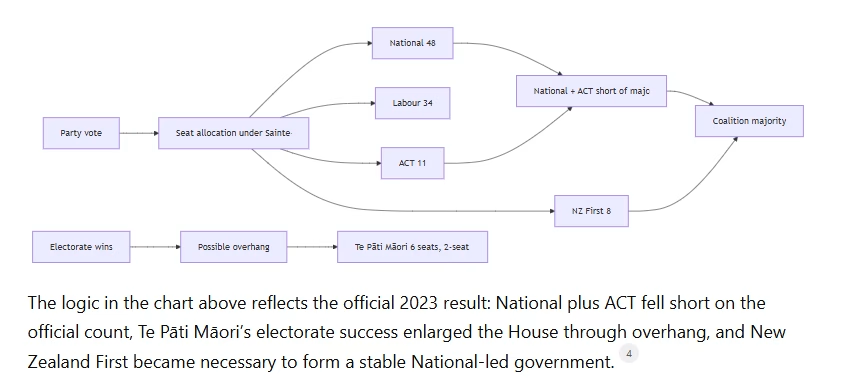
Under Mixed-member proportional representation, you do not just need votes. You need partners.
National + ACT New Zealand did not have enough seats alone.
Enter Winston Peters and New Zealand First.
Once again, kingmaker politics decided the final structure of power.
So yes, National won. But they still needed help to govern.
The Debate Illusion: Perception Beat Facts
Here is something that should make you uncomfortable.
In debates, Christopher Luxon was fact-checked more negatively.
Yet he still “won” in public perception.
Why?
Because voters were not scoring accuracy.
They were asking:
- Who feels like change?
- Who looks like control?
- Who seems fresh?
And on those emotional metrics, Labour lost.
| Date | Type | Event | Why it mattered |
|---|---|---|---|
| Mar 2023 | Gaffe / scandal | Stuart Nash interference controversy | Damaged Labour’s renewed “competence” story just after the Hipkins bounce |
| 21 Jun 2023 | Gaffe / scandal | Michael Wood resigns over Auckland Airport shares | Fed a narrative of sloppy ministerial management |
| 24–25 Jul 2023 | Gaffe / scandal | Kiri Allan crash, resignation, then withdrawal from re-election | Intensified impressions of instability and burnout |
| 13 Aug 2023 | Major announcement | Labour pledges GST-free fruit and vegetables | Visible cost-of-living move, but small savings invited ridicule |
| 30 Aug 2023 | Major announcement | National launches Back Pocket Boost | Clear, easy-to-repeat tax-relief offer |
| Early Sep 2023 | Vulnerability | National’s foreign-buyer tax funding model faces legal and revenue scrutiny | Exposed weakness in National’s fiscal story, though not enough to reverse the campaign |
| 2 Sep 2023 | Major announcement | Labour pledges free basic dental for under-30s | More ambitious offer, but late and slow-phased |
| 19–20 Sep 2023 | Debate moment | First leaders’ debate | Luxon won on perception despite weaker fact-checking |
| Early Oct 2023 | Strategic shift | NZ First surges in polls | Turned the race from two-bloc contest into a coalition chessboard |
The Real Voter Shift: Not Ideology, Just Frustration
There is a lazy narrative that New Zealand suddenly shifted right.
That is not fully true.
This was not a massive ideological shift.
It was something more practical.
“Things are not working. Let’s try someone else.”
That is classic anti-incumbent behaviour.
What Labour Missed Completely
Let’s call this out clearly.
Labour assumed:
- Strong past performance would carry forward
- Policy complexity would be understood
- Voters would consider global economic context
Reality check.
Voters care about:
- Weekly expenses
- Personal stress
- Immediate outcomes
Labour explained.
National simplified.
Guess which one wins elections.
Webfit News Perspective
Here is the uncomfortable truth most analysts avoid.
Labour did not just lose votes. They lost emotional connection with everyday life.
And once that breaks, no policy can fix it quickly.
National did not win because they had all the answers.
They won because they aligned with how people were feeling.
That distinction matters going into 2026.
Because if Labour still thinks this was about messaging tweaks, they are fooling themselves.
And if National thinks this victory means long-term loyalty, they are also wrong.
This election was not a mandate.
It was a warning.
Final Takeaway
The 2023 election followed a simple political law:
When people feel poorer and leadership feels weaker, governments fall.
No conspiracy. No mystery.
Just reality.
References
- New Zealand Electoral Commission official 2023 results
- Stats NZ inflation and household cost data
- 1News Vote Compass
- Reserve Bank of New Zealand monetary policy updates
- Public reporting and post-election analysis