By Webfit News Political Desk
A trade deal once promoted as a breakthrough in Indo-Pacific diplomacy has now become one of the most politically charged issues inside New Zealand’s coalition government.
The India–New Zealand Free Trade Agreement, concluded in December 2025 and hailed as a “historic milestone” by the National-led administration, has triggered a public clash at the highest levels of government. The controversy centres on a US$20 billion investment target and the legal meaning of one single word: “facilitate.”
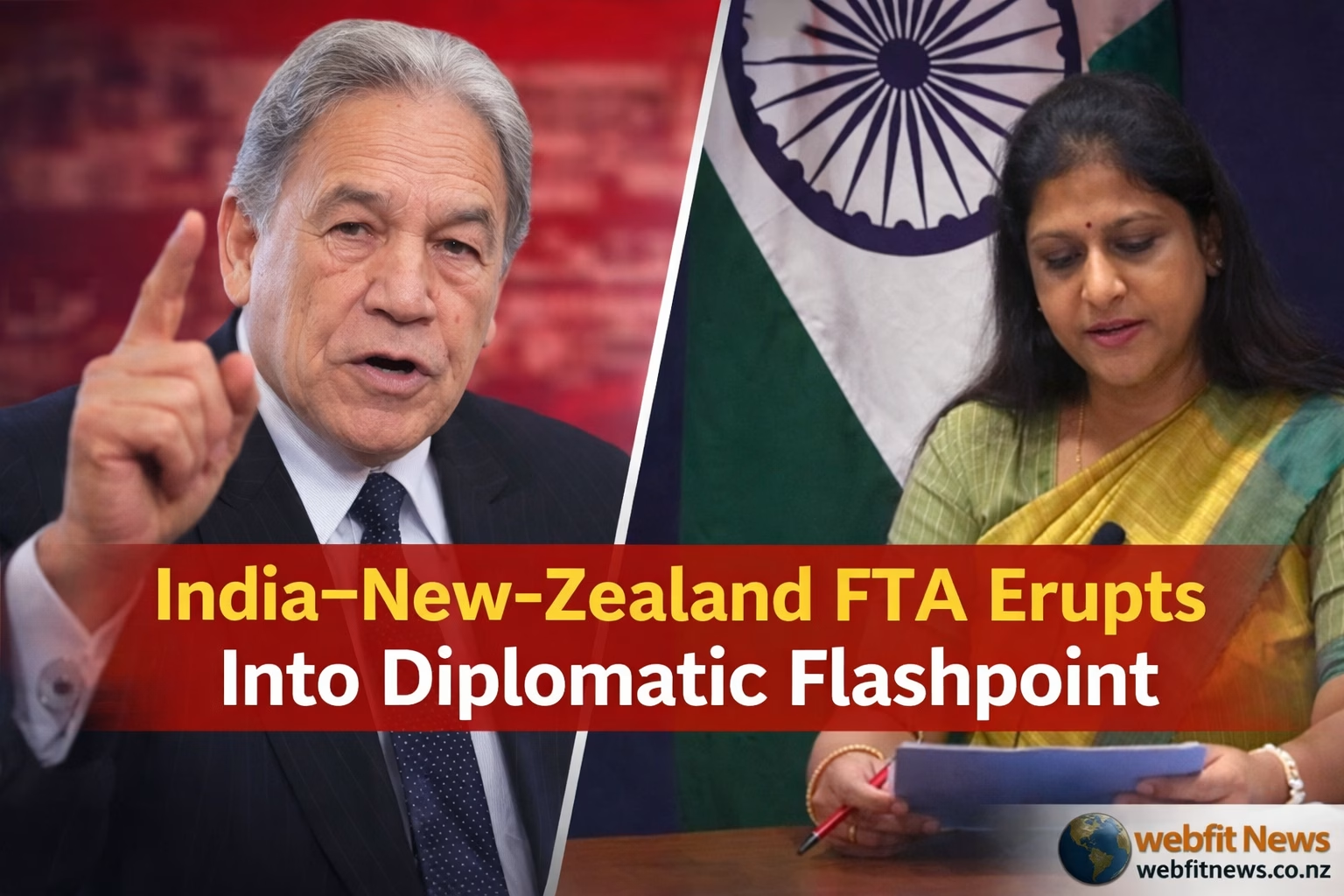
On February 18, 2026, Deputy Prime Minister and Foreign Affairs Minister Winston Peters publicly challenged the interpretation of the agreement offered by India’s outgoing High Commissioner to New Zealand, Neeta Bhushan. When Bhushan described the US$20 billion figure as “aspirational,” Peters pushed back sharply, arguing that the language in the treaty implies a binding obligation rather than a loose political target.
The dispute has exposed rare tensions inside the Cabinet and raised deeper questions about sovereignty, migration settings, and New Zealand’s long-term trade strategy.
The $20 Billion Question: Aspiration or Obligation?
Under the FTA, New Zealand has committed to “facilitate” US$20 billion, roughly NZ$33 billion, of investment into India over 15 years. The funds are expected to flow into manufacturing, infrastructure, and innovation sectors.
From India’s diplomatic perspective, the target is designed to encourage private sector investment, not create a government-guaranteed liability. High Commissioner Bhushan indicated that such figures function as directional goals within modern trade agreements.
However, Peters has argued that the wording creates a harder commitment. He pointed to language in Indian government documentation referencing “delivery” and the possibility of “remedial measures” if investment falls short.
At the centre of concern is a rebalancing clause, which allows India to take corrective steps if commitments are not met. Critics argue that this could theoretically enable India to revisit tariff concessions granted to New Zealand exporters.
Prime Minister Christopher Luxon and Trade Minister Todd McClay have downplayed the risk, maintaining that facilitation means promoting investment rather than underwriting it. But the public disagreement between senior ministers has given political oxygen to opponents of the deal.
What New Zealand Gains Under the Agreement
The FTA offers significant tariff reductions for New Zealand exporters entering the Indian market, which is projected to become the world’s third-largest economy by 2030.
Key gains include:
- Apples: Tariffs reduced from 50 percent to 25 percent within quota
- Kiwifruit: Reduced from 33 percent to zero within quota
- Manuka honey: Reduced from 66 percent to 16.5 percent over five years
- Sheep meat: Immediate elimination of 33 percent tariff
- Forestry products: Immediate elimination of tariffs
These concessions are managed through tariff-rate quotas and minimum import prices to protect Indian domestic producers.
India, in return, receives immediate zero-duty access to New Zealand’s market across all goods categories, benefiting its textiles, engineering goods, and manufacturing exporters.
For horticultural regions such as Hawke’s Bay and Bay of Plenty, the agreement represents expanded access to a high-growth market. However, the deal notably excludes dairy, India’s long-standing defensive red line in trade negotiations. This exclusion has been a sticking point for New Zealand First, which argues the agreement falls short of being “truly free trade.”
Migration Provisions Reignite Domestic Debate
Beyond goods, the agreement contains ambitious mobility provisions.
It removes caps on Indian students and guarantees:
- 20 hours of work per week during study
- Three-year post-study work visas for STEM graduates
- Four-year post-study visas for PhD holders
It also creates a Temporary Employment Entry visa pathway, capped at 5,000 Indian professionals at any time. The programme targets Green List occupations such as IT, healthcare, and engineering, alongside limited visas for cultural practitioner,s including chefs and yoga instructors.
While National ministers insist the visa caps are tightly controlled and non-renewable, New Zealand First has framed the provisions as opening the door to significant migration growth. The debate has already begun to influence positioning ahead of the 2026 general election.
Coalition Strain and Political Strategy
The disagreement over the FTA highlights broader coalition dynamics. National remains firmly pro-trade and sees India as central to diversifying New Zealand’s export exposure beyond China.
New Zealand First, meanwhile, has taken a more cautious stance, raising concerns about sovereignty, migration levels, and the enforceability of treaty language. The public nature of the “trained lawyer” remark aimed at High Commissioner Bhushan has drawn criticism from opposition parties and foreign policy commentators, who view it as a departure from standard diplomatic practice.
Labour has adopted a measured tone, seeking clarity on the rebalancing clause while avoiding outright opposition to the agreement.
The unusual invocation of an “agree to disagree” provision within Cabinet has allowed the government to proceed while acknowledging internal differences. However, the episode signals a more fragile coalition environment than earlier trade debates.
Geopolitical Context: Why India Matters
The FTA must be viewed against a broader Indo-Pacific strategy. As global trade tensions persist and reliance on a narrow set of export markets carries risk, India offers scale and long-term opportunity.
For India, the agreement fits into a wider push to secure new trade relationships following deals with the UK, UAE, and others. For New Zealand, it represents a strategic hedge in a region shaped by shifting power balances between China, the United States, and emerging economies.
Yet the diplomatic rupture shows how complex modern trade agreements have become. They now blend goods access, services mobility, investment frameworks, and strategic alignment into a single document that is politically sensitive on multiple fronts.
What Happens Next
The government intends to pass enabling legislation before the November 2026 election. Ratification debates are expected to intensify as more legal analysis emerges around the investment clause and its enforcement mechanisms.
The private sector’s response will also be critical. If New Zealand businesses actively pursue investment opportunities in India, the $20 billion target may become a manageable objective. If flows remain modest, political scrutiny will intensify.
For now, the deal stands as both opportunity and risk: a pathway to deeper economic integration with a rising power, but also a test of coalition cohesion and public confidence.
The Webfit News Perspective
At Webfit News, we view this moment as more than a trade disagreement. It reflects a broader shift in how New Zealand conducts foreign policy in an era of coalition politics and geopolitical uncertainty.
Trade agreements are no longer technical documents confined to negotiators. They shape migration settings, economic exposure, and national identity debates. The India–New Zealand FTA demonstrates how one clause can evolve into a domestic political flashpoint.
As this story unfolds, we will continue examining:
- The precise legal drafting of the investment chapter
- The practical impact on exporters and regional economies
- The migration numbers once implementation begins
- The diplomatic relationship between Wellington and New Delhi
Trade policy now sits at the intersection of law, economics, and politics. The India–New Zealand FTA is likely to remain a defining issue in 2026, both for the coalition government and for New Zealand’s place in the Indo-Pacific.
For deeper context on New Zealand’s evolving foreign policy posture, readers can revisit our earlier analysis on Indo-Pacific strategy and trade diversification on WebfitNews.co.nz.
This is a developing story, and it is one that could shape the country’s economic direction for years to come.