By Webfit News
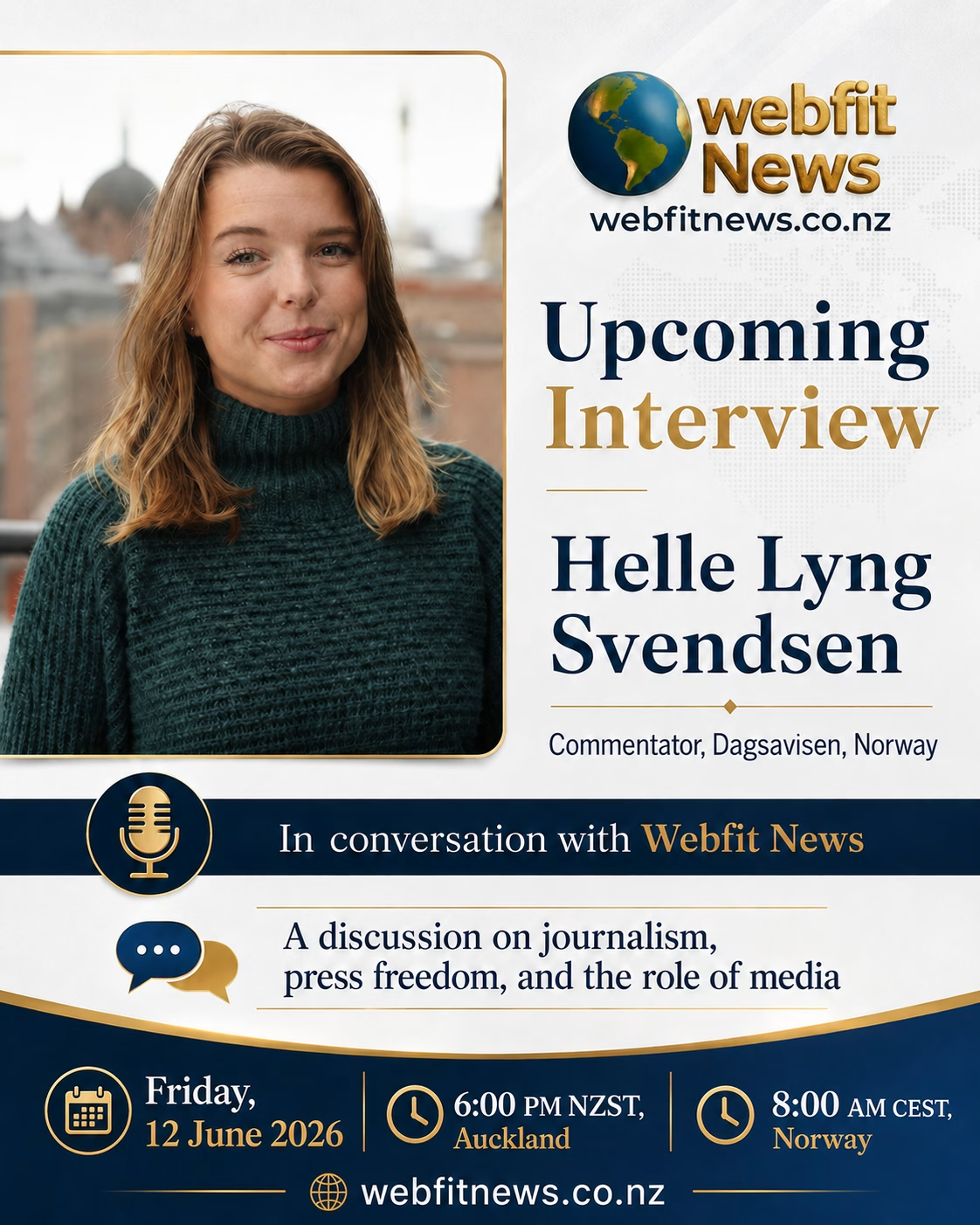
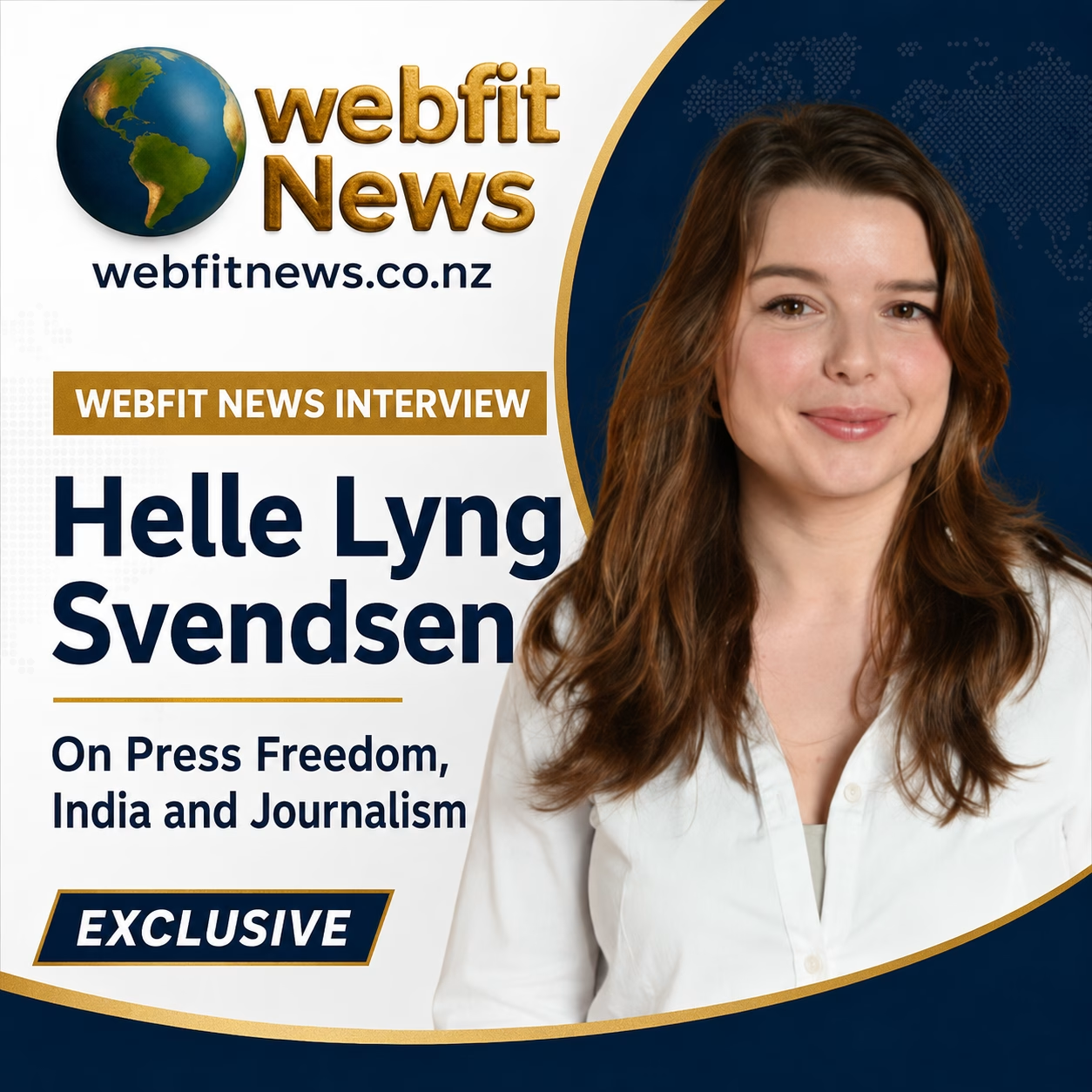
Norwegian journalist and commentator Helle Lyng Svendsen joined Webfit News for a video interview following the international attention surrounding her question to Indian Prime Minister Narendra Modi during an official media interaction in Norway.
The exchange, which later circulated widely on social media and in Indian media circles, sparked debate about press freedom, diplomatic protocol, journalistic responsibility and whether foreign journalists should challenge visiting world leaders.
In a conversation with Webfit News, Svendsen spoke about her intention behind the question, her limited previous coverage of Indian politics, the difference between media formats, criticism from sections of the Indian public, and the online reaction she received after the moment went viral.
Below is a cleaned and edited question-and-answer version of the interview.
Fieldays 2026 Opens at Mystery Creek with Ceremony, Culture and Strong Rural Optimism – WebfitNews
“I am a journalist from Norway”
Webfit News: For our audience in New Zealand and the Indian diaspora, can you briefly introduce yourself?
Helle Lyng Svendsen: My name is Helle. I am a journalist from Norway. I cover local affairs and sometimes foreign policy for my newspaper. I recently started working there as a commentator.
“India has not been my daily coverage area”
Webfit News: Before that moment involving Prime Minister Modi, how closely had you followed Indian politics and Indian media?
Helle Lyng Svendsen: It is definitely not a topic I cover daily. I think Western media and Norwegian media should cover Asia more. Since it is not close geographically, it is one of those things that can get neglected. I have covered US politics more closely, and in Norway we also look closely at our neighbouring countries and issues such as Greenland. India has definitely not been my regular coverage area.
“A question is just a question”
Webfit News: When you asked your question, what exactly was your intention?
Helle Lyng Svendsen: A question is just a question. The intention is to try to get answers. In a setting where it is already understood that there may not be time for questions, or that there will not be a full press conference where each reporter asks one or two questions, I saw it differently. By raising my voice and asking a question before Prime Minister Modi exited the room, I felt I was doing my job as a journalist, which is to try to get answers from power, including power that may not want to answer.
“I did not expect it to become so big”
Webfit News: Did you expect your question to become such a major international talking point?
Helle Lyng Svendsen: No, definitely not. When I posted it on X, I hoped it would spark a discussion. I thought maybe it would spark a discussion among some people in India, but definitely not among millions. It was a huge shock to see how quickly it blew up and how quickly Indian media jumped on the topic. What was strange to me was that much of the coverage became about me rather than the issue of press freedom.
Press freedom and criticism
Webfit News: Some people saw your question as a press freedom issue. Others saw it as disrespectful to a visiting foreign leader. How do you respond to that criticism?
Helle Lyng Svendsen: Constructive criticism is welcome. I think I see journalism differently from many others. To me, journalism should be critical. Sometimes questions will not have the same calm tone that a state leader uses when welcoming another leader. My prime minister has one role, and I as a journalist have another role. Journalism should be sharp, and sometimes questions have to be confrontational. My job is not to sugarcoat facts.
Should leaders answer questions during international visits?
Webfit News: Do you believe leaders should answer questions from the media during international visits?
Helle Lyng Svendsen: Yes, I do, especially if you are in a democracy. The fourth estate is vital for a functioning democracy. If a leader is on a state visit in a country, I believe they should answer some questions from the press. When President Macron was in Norway, he did not take many questions, but he took some from Norwegian and French journalists. That is not perfect either, because many questions still go unanswered, but at least there is an opportunity to question someone with power.
“Journalists also challenge the format”
Webfit News: Is press freedom only about journalists asking questions, or is it also about understanding the format and protocol of an event?
Helle Lyng Svendsen: It depends. I usually follow the general schedule. If interview slots are at a particular time, I follow that. But sometimes if the protocol is too strict, journalists cannot only follow what is said. Our job is also to challenge the format. I think many people may not understand that our job is also to challenge how the format is set up.
Press conference or press briefing?
Webfit News: Do you believe journalists should distinguish between a press conference, a press briefing, a media statement and a photo opportunity?
Helle Lyng Svendsen: The prime minister also called it a press conference afterwards in a statement. But I do not spend too much time evaluating the wording. I would have asked the question even if it was a press briefing. In Norway, there is a kind of contract that if the prime minister or any politician invites the press, we are not just there to listen to talking points. That is government work. Our job is to question the topic of the day or other relevant issues.
Webfit News: Do you think the format was accepted and understood by everyone in the room?
Helle Lyng Svendsen: I think the format was accepted by everyone in the room. I challenged the format. That is what I did.
India and the Western media lens
Webfit News: Many Indians felt that India was being judged through a Western media lens. Do you understand why that reaction happened?
Helle Lyng Svendsen: I think that is an important criticism. The West has a lot to learn about Asian countries. At the same time, I have spoken to many Indian journalists who are trying to do critical work on the ground, including on sensitive topics that can endanger their lives. Many of them valued my question. Some Indians supported the question, while others did not approve of it. Both sides are valid. People can be critical of my journalism or approve of it. I think the discussion is important.
Webfit News: India is the world’s largest democracy with a complex media environment, many languages, television channels, newspapers and digital platforms. How much do you think European journalists understand that complexity?
Helle Lyng Svendsen: I do not think we have covered it enough. For those in the West who followed this story, I think there was a broader understanding of how media is working under the current Indian prime minister and how it has developed. I find that alarming.
Webfit News: Do you think Western media sometimes simplifies India into one narrow political story?
Helle Lyng Svendsen: It is not black and white. India is a huge nation with many people and many issues. I do not think you can ever have a complete understanding of a country of that size. My intention was not to frame India’s whole political or religious system. I am not here to educate people on those topics because that is not my goal or expertise. My question was about press freedom.
Right to question foreign journalists
Webfit News: Do you think the Indian public has a right to challenge foreign journalists when they feel their country is being misrepresented?
Helle Lyng Svendsen: Yes, definitely. I welcome that discussion. I think it is a good discussion to have.
Nation, country and identity
Webfit News: Do you see India only as a modern state, or also as a civilisation with a much older national identity?
Helle Lyng Svendsen: I think both. India has so much history. It is also different for me because Norway is a small country and India is so large. India has such complex history, including its history with the British Empire.
Webfit News: Do you agree there is a difference between a country as a political state and a nation as people, culture and civilisation?
Helle Lyng Svendsen: Yes. When I read my comments on Instagram, I see many people who do not agree with the current political system in India. There is a separation between politics and a nation as a whole. That is also why, when all this happened, I received many direct messages from people thanking me. I had no idea how impactful my question would be for part of the population.
Criticism, abuse and online reaction
Webfit News: You received strong criticism online. Some of it may have been unfair or abusive, but some was genuine disagreement. How do you separate criticism from abuse?
Helle Lyng Svendsen: Abuse includes deepfakes, targeting my online accounts, getting me suspended from Instagram and Facebook, and trying to monetise my name. Discussion, even harsh criticism, is part of public conversation and part of a good discussion environment online.
Webfit News: Some Indian viewers believe your question was not neutral journalism but a political statement. What would you say to them?
Helle Lyng Svendsen: It was meant as neutral. But I understand that if people have not been exposed to much critical or confrontational journalism, they might see the question as loaded. It was a contrast question, placing free press and the current situation with the Indian prime minister against each other.
Webfit News: Would you accept that press freedom also includes the public’s freedom to question journalists?
Helle Lyng Svendsen: Yes. I have tried to respond to some public questions online and in direct messages. Press freedom is part of freedom of speech and the right to information. In the current media environment, where everyone can become a content creator, press freedom is continuously evolving.
Would she ask the same question again?
Webfit News: Has this experience made you rethink how journalists should ask questions in sensitive diplomatic settings?
Helle Lyng Svendsen: No, not at all.
Webfit News: Looking back now, do you still stand by the question exactly as it was asked?
Helle Lyng Svendsen: Yes, I would ask that question again.
Webfit News: Would you ask the same question in the same way again?
Helle Lyng Svendsen: Yes. I would not have done anything differently.
Webfit News: Are you willing to acknowledge that the wording or timing may have been seen as unfair by many Indians?
Helle Lyng Svendsen: I acknowledge that opinion, but I would 100 percent do it at the exact same time, with the exact same phrasing and the exact same voice level again. If it was tomorrow, I would do the exact same thing again.
Message to the Indian diaspora
Webfit News: What would you say directly to the Indian diaspora in New Zealand who felt offended by that moment?
Helle Lyng Svendsen: Journalism should spark debate. I cannot account for everyone’s feelings. If a journalist is constantly monitoring how every section of the world population may view a question, then you are never going to do your job. Journalism will always have people who agree and people who disagree.
Webfit News: Do you believe this controversy can still become a constructive conversation about journalism, respect and democratic accountability?
Helle Lyng Svendsen: Yes, I think it did become that.
“I am proud of myself for asking that question”
Towards the end of the conversation, Svendsen said she was thankful to Indian people who appreciated her journalism. She said the question may become one of the most valuable questions she has asked in her career.
“I am very thankful to all the Indian people that appreciated my journalism,” she said. “I think it will probably be one of the most valuable questions that I have ever asked anyone. You are not supposed to say you are proud of yourself, but I am very proud of myself for asking that question to the Indian prime minister.”
Webfit News Perspective
The interview reflected the wider debate that followed the viral moment: the right of journalists to question power, the right of the public to question journalists, and the need to understand cultural, diplomatic and political context when global stories cross borders.
For New Zealand’s Indian diaspora, the conversation raised important questions about how India is viewed internationally, how Western media frames large democracies, and how public debate should remain firm but respectful.
Webfit News thanks Helle Lyng Svendsen for joining the interview and engaging with questions from an Indian diaspora perspective.