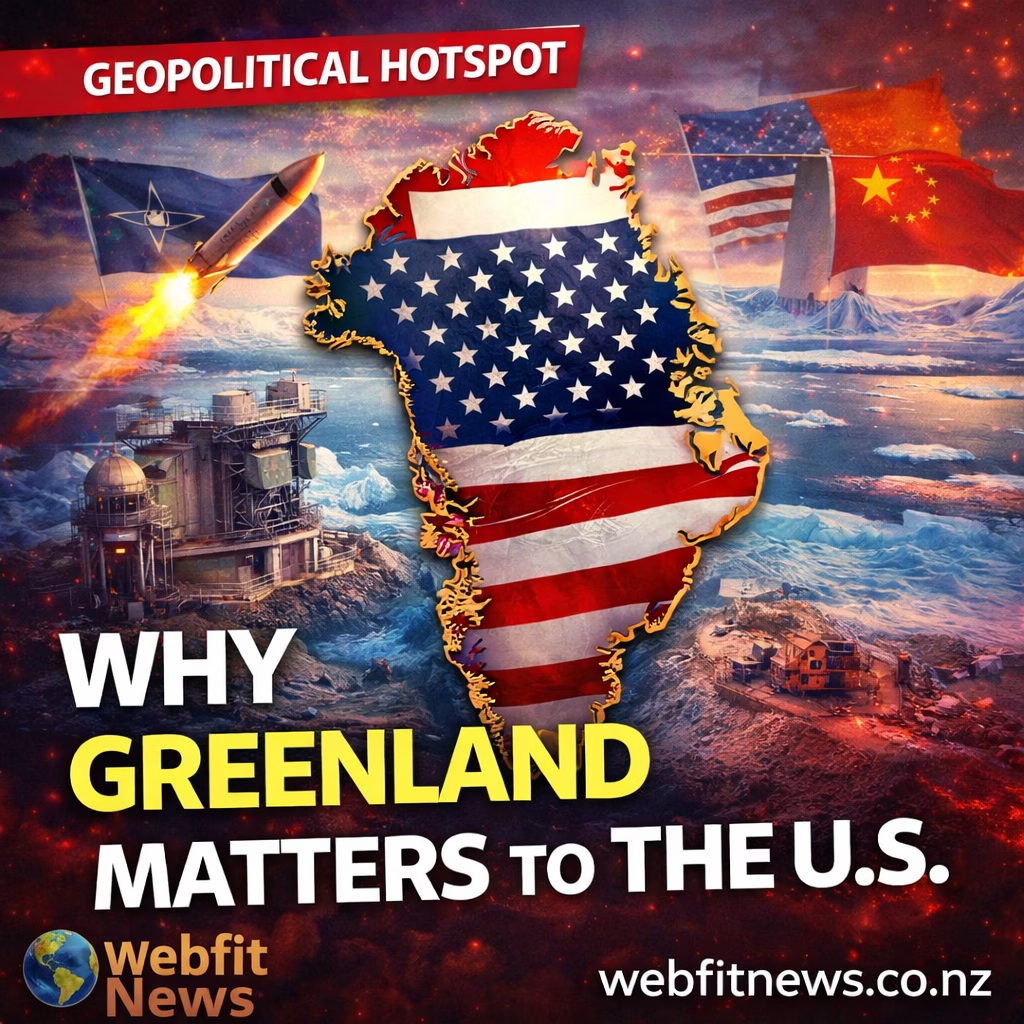
What once looked like a frozen blank space on the map has become one of the most contested strategic assets on Earth.
In 2026, Greenland has moved from geopolitical curiosity to geopolitical flashpoint. The United States, under Donald Trump’s second administration, has elevated control of Greenland from a rejected idea to a declared strategic necessity. What makes this moment different is not rhetoric alone. It is the convergence of military technology, Arctic climate change, rare-earth supply chains, and a revived expansionist doctrine that openly challenges post-World War II norms.
This is not about buying land. It is about rewriting power structures.
Webfit News breaks down what is actually happening, why Greenland matters now, and why this confrontation risks reshaping global alliances.
Why Greenland Suddenly Matters More Than Ever
Greenland’s importance is not emotional or symbolic. It is structural.
At the intersection of Arctic geography, missile defense, and mineral security, Greenland sits at the center of three overlapping strategic realities.
1. Geography That Controls the Arctic
Greenland occupies the shortest aerial and missile routes between Russia and North America. Any weapon launched across the North Pole passes Greenland first.
This makes Greenland the highest ground in Arctic warfare.
2. Military Infrastructure Already Exists
The United States already operates Pituffik Space Base in northwest Greenland under a defense treaty with Denmark.
That base hosts early-warning radar systems designed to detect intercontinental ballistic missiles.
What has changed is scale.
3. Resources the World Cannot Replace
Greenland holds some of the largest untapped reserves of rare earth elements outside China. These materials power:
- Electric vehicle motors
- Wind turbines
- Military guidance systems
- Artificial intelligence hardware
The global race for these resources has become a national security issue.
The Map Illusion That Shaped Political Imagination
A major psychological driver behind Greenland’s appeal is cartographic distortion.
Most people see Greenland through the Mercator projection, which dramatically exaggerates land near the poles.
Actual Size Comparison
| Region | Actual Land Area (sq km) |
|---|---|
| Greenland | ~2.16 million |
| Africa | ~30.37 million |
| Australia | ~7.69 million |
| India | ~3.29 million |
Africa is nearly 14 times larger than Greenland. Yet on most maps, Greenland looks comparable.
This visual inflation reinforces the idea of Greenland as a continental prize rather than a sparsely populated Arctic territory.
Politics follows perception.
A 150-Year American Obsession With Greenland
This is not a new ambition. It is a delayed one.
Key Historical Attempts
- 1868: U.S. studies Greenland after purchasing Alaska
- 1910: Proposed territory swap involving Danish colonies
- 1946: President Truman offers Denmark $100 million in gold
- 1951: Defense treaty allows U.S. bases without sovereignty transfer
Every attempt failed diplomatically. Military access was granted instead.
The 2026 push marks the first time forceful language has accompanied the ambition.
The Don-roe Doctrine Explained
The current administration has revived and rebranded Monroe Doctrine logic.
The updated doctrine asserts:
- The U.S. will not tolerate rival powers operating near its hemispheric perimeter
- Arctic access equals homeland defense
- Diplomatic delay is unacceptable when security timelines are tight
This doctrine is not symbolic. It underpins real legislation.
The Red, White, and Blueland Act
In 2025, U.S. lawmakers introduced legislation authorizing negotiations to acquire Greenland.
Bill Snapshot
| Item | Detail |
|---|---|
| Bill Name | Red, White, and Blueland Act |
| Year | 2025 |
| Purpose | Authorize Greenland acquisition |
| Renaming Clause | Mandatory |
| Public Support in Greenland | Approximately 6 percent |
The bill was rejected outright by Denmark and Greenland’s leadership.
Greenland’s position remains consistent.
They are not for sale.
The Golden Dome Missile Defense Factor
Greenland’s strategic value is tightly linked to the Golden Dome initiative.
This missile defense system aims to intercept threats across all phases:
- Pre-launch detection
- Boost phase interception
- Midcourse tracking
- Terminal defense
Why Greenland Is Central
| System Component | Greenland’s Role |
|---|---|
| Early Warning Radar | Detect polar launches |
| Space Sensors | Optimal orbital coverage |
| Hypersonic Tracking | Arctic flight path monitoring |
Without Greenland, Golden Dome effectiveness drops sharply.
This is why the rhetoric escalated from interest to necessity.
Rare Earths and the Resource Reality
China currently dominates rare earth processing. That dominance worries Washington.
Greenland may hold up to one-third of global heavy rare earth reserves.
Strategic Resource Potential
| Resource | Strategic Use |
|---|---|
| Rare earth elements | EVs, AI, defense |
| Uranium | Nuclear energy |
| Strategic metals | Batteries, electronics |
| Freshwater ice | Long-term scarcity buffer |
However, mining is complicated by:
- Environmental risks
- Uranium co-location bans
- Unstable terrain from ice melt
Resources exist. Access does not.
Climate Change as Strategic Accelerator
Melting ice has turned Greenland into an accessible frontier.
New shipping routes are emerging. Mining sites are opening. Military logistics are easier.
The paradox is stark.
Climate change makes Greenland more valuable while making development more dangerous.
NATO Under Strain
Denmark is a NATO ally.
Greenland is part of the Danish kingdom.
Threatening control over Greenland introduces a direct alliance contradiction.
Danish leadership has warned that any military coercion would rupture NATO cohesion.
This is the most severe internal alliance stress since the Cold War.
What Greenlanders Want
Polling consistently shows:
- Around 85 percent oppose U.S. annexation
- Strong desire for economic independence
- Deep distrust of external control
Greenland seeks investment, not ownership.
Their future, they insist, will be decided in Nuuk, not Washington.
Why This Moment Matters Globally
This is not only about Greenland.
It is about whether global order still runs on treaties or raw leverage.
Two Competing Futures
| Model | Outcome |
|---|---|
| Rule-based order | Sovereignty respected |
| Power-first doctrine | Territorial pressure normalized |
Greenland is the test case.
Final Word From Webfit News
Greenland is no longer a frozen footnote. It is the frontline of 21st-century power competition.
Missile defense, rare earths, climate change, and expansionist politics have collided in one place.
How this ends will shape not just Arctic borders, but the rules that govern global stability.
Stay informed.
Stay critical.
Follow the facts.
This analysis is brought to you by Webfit News.