
What Kiwi Families Need To Know Before Making the Next Big Move
Introduction
House prices in New Zealand have stopped falling. Mortgage rates have come down. Rents have flattened for the first time in years. All these changes have created a moment where many people are wondering if they should continue renting or try buying their first home.
This article breaks down the numbers with the goal of helping Kiwi households understand what is cheaper in the short term, what builds more wealth in the long term, and what makes sense depending on income, goals, and lifestyle.
The data below uses November 2025 figures. All examples are written in simple language so anyone can connect the dots and make sense of their own situation.
1. The Big Picture
Key findings in simple words
- Mortgage rates dropped to around 4.45 percent, which reduces monthly loan payments.
- House prices have stabilised near $761,000 nationally.
- Rents have stopped rising and even dipped in cities like Wellington.
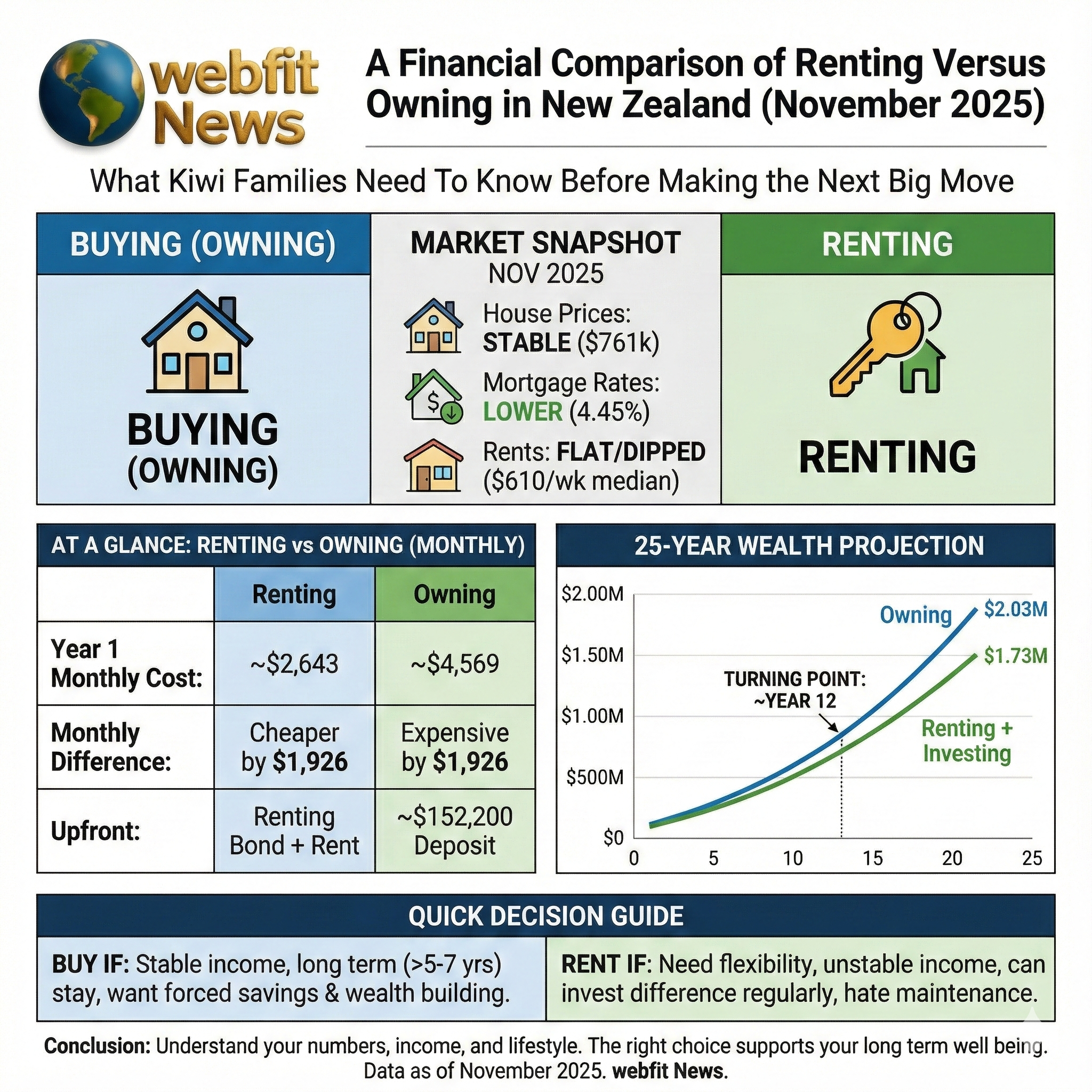
- Long term, buying still creates more wealth, but renting is cheaper in the first few years.
- The financial turning point comes around Year 12, when the owner’s equity overtakes the renter’s investment value.
Below is a simple table for quick understanding.
Table: Renting vs Owning at a Glance (NZ, November 2025)
| Factor | Renting | Owning |
|---|---|---|
| Year 1 monthly cost | About $2,643 | About $4,569 |
| Monthly difference | Cheaper by $1,926 | Expensive by $1,926 |
| Upfront requirement | Bond + first rent | About $152,200 deposit |
| Long term wealth (25 years) | $1.73 million (if disciplined) | $2.03 million |
| Best for | Flexibility, saving cash | Long term wealth, stability |
2. New Zealand Housing Market in 2025
2.1 Prices Have Stopped Falling
- National median price: $761,000
- Year on year change: down just 0.5 percent
- QV average house price: $902,020 (no big change from last year)
This tells us the market has found a stable floor. Banks are predicting a 6.8 percent rise in prices by late 2026.
For buyers, this means:
- Risk of further price drops is small.
- Price recovery is likely to pick up in 2026.
2.2 The Rental Market Is Calm
- National mean weekly rent: $569
- Trade Me median rent: $610, lowest since early 2023
- Wellington rent: $600, down 8 percent
- Auckland rent: $650, stable
- Christchurch: rents rising across all property types
On average, rent in New Zealand has historically increased 4.7 percent each year. This current drop is a temporary phase.
For renters, this means:
- It is a good short term period to continue renting.
- But long term, rent will almost certainly go up again.
2.3 Interest Rates and Bank Rules
- OCR reduced to 2.25 percent
- Mortgage rates: 4.39 percent to 4.45 percent
- LVR easing from December 1, 2025
- But DTI rules still limit borrowing based on income
For buyers, this means:
- Your ability to borrow now depends mostly on your income, not deposit size.
- Stronger income households benefit more from the current policy settings.
3. Cost Comparison: Renting vs Owning in Year One
This section shows exactly how much a typical Kiwi household would spend if they bought or rented the median priced home.
3.1 Basic Property Example
| Item | Amount |
|---|---|
| House price | $761,000 |
| Deposit (20 percent) | $152,200 |
| Mortgage required | $608,800 |
| Mortgage rate | 4.45 percent |
| Mortgage term | 25 years |
3.2 Cost of Owning in Year One
A. Mortgage repayment
- Monthly payment: $3,338
- Annual payment: $40,061
- Of this, $12,969 goes toward building your equity.
- $27,092 is interest cost that you never get back.
B. Other ownership costs
| Cost Type | Annual | Monthly |
|---|---|---|
| Council rates | $4,100 | $342 |
| House insurance | $3,055 | $255 |
| Maintenance (1 percent rule) | $7,610 | $634 |
| Total non mortgage costs | $14,765 | $1,231 |
Total monthly cost of owning
$4,569
3.3 Cost of Renting
- Median weekly rent: $610
- Monthly rent: $2,643
- Annual rent: $31,720
3.4 Cash Flow Difference
Owning costs $1,926 more per month than renting.
If you rent wisely and invest that difference every month, you can slowly build wealth. But most people do not invest that money regularly, which is why buying usually wins long term.
4. Long Term Wealth Projection (25 Years)
This section shows how money grows over 25 years.
4.1 If You Buy
- Initial deposit: $152,200
- House grows at 4 percent each year
- After 25 years, the home is worth $2,029,970
- Mortgage is fully paid off
- Net wealth: $2,029,970
4.2 If You Rent and Invest
- Initial savings: $152,200 invested
- Monthly surplus invested for 25 years
- Average investment return: 6.5 percent
- Rent rises 4.7 percent each year
- After 25 years, total invested value becomes $1,734,412
Final Result
| Scenario | Net Wealth After 25 Years |
|---|---|
| Buy | $2,029,970 |
| Rent and Invest | $1,734,412 |
| Winner | Buying by $295,558 |
Buying wins by almost $300,000 even though renting is cheaper at the start.
5. What Type of Person Should Buy or Rent?
Buying makes sense if you:
- Can afford the deposit
- Can pass DTI rules
- Plan to stay in NZ for more than 5 to 7 years
- Want stable housing costs
- Want long term wealth building
Renting makes sense if you:
- Need flexibility
- Expect to move cities
- Have an unstable income
- Prefer low commitments
- Can invest money consistently every month
- Can generate investment returns above 7 percent
6. A Simple Table for Kiwi Readers
Table: Quick Decision Guide
| Question | If your answer is Yes | Suggested Choice |
|---|---|---|
| Do you have stable income? | Yes | Buy |
| Do you plan to stay in NZ long term? | Yes | Buy |
| Do you hate maintenance and repairs? | Yes | Rent |
| Do you want flexibility to move? | Yes | Rent |
| Can you save and invest every month? | Yes | Rent and Invest |
| Do you want forced long term savings through mortgage? | Yes | Buy |
| Are you struggling with deposit or DTI? | Yes | Rent for now |
Conclusion
New Zealand in late 2025 sits at a turning point. Mortgage rates have fallen, prices have stabilised, rents are flat, and bank rules have changed. This has narrowed the gap between renting and owning.
If you plan to stay long term and can pass bank tests, buying creates more wealth because of equity and capital gains. If you need flexibility or cannot meet lending rules, renting keeps your cash flow healthier.
The most important rule is simple:
Understand your numbers, your income, and your lifestyle. The right choice is the one that supports your long term well being.