
13 August 2026
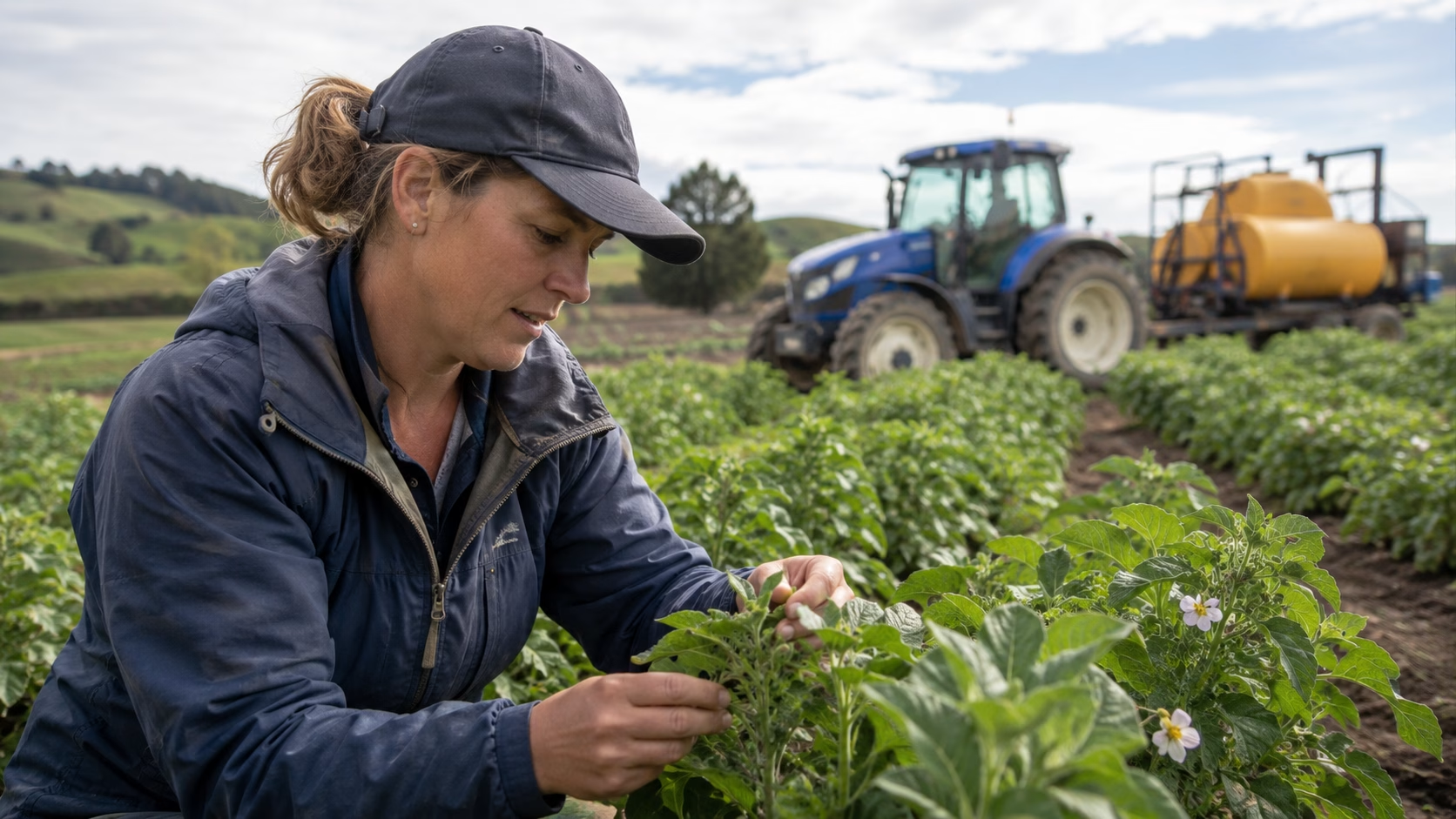
New Zealand farmers, growers and rural businesses are being promised faster access to agricultural chemicals and other hazardous-substance products as the Environmental Protection Authority works through a long-running assessment backlog.
Environment Minister Nicola Grigg says the latest EPA performance figures show significant improvement in processing applications for products used to control weeds, pests, insects and plant diseases.
The number of hazardous-substance release applications waiting to be assessed has fallen from 96 at the beginning of the 2025/26 financial year to 61 by 30 June 2026.
That represents a reduction of 36.5 percent over the year.
The queue is now at its lowest level since early 2022.
The EPA also completed 66 release application decisions during 2025/26, its highest annual total since 2018/19.
For farmers and growers, the practical significance is simple: products that could previously spend years moving through assessment may increasingly reach a decision faster.
But the latest EPA report also shows the system is not yet fully caught up.
Several performance targets were missed, including targets for complex assessments and the total number of undecided applications.
Government says farmers have waited too long
Grigg said farmers and growers had repeatedly raised concerns about long approval times.
“For years, farmers and growers have told us they were frustrated by lengthy approval processes that delayed access to new products and innovations,” she said.
She said the EPA had made substantial improvements since the beginning of the current government term.
According to the Minister, faster processing does not mean environmental or public-health protections are being weakened.
The Government’s position is that regulatory decisions should be made more efficiently while retaining New Zealand’s existing environmental and health safeguards.
That distinction will be important as reforms to the Hazardous Substances and New Organisms Act progress through Parliament.
What the EPA numbers actually show
The EPA’s quarterly report covering 1 April to 30 June 2026 shows steady progress across several measures.
During the full 2025/26 year, the agency decided:
- 51 rapid-assessment applications
- 9 Category A applications
- 1 Category B application
- 5 Category C applications
- 66 release applications in total
The 66 decisions were up from 62 in 2024/25 and well above the three-year average of 38.7.
The EPA said this was the highest number of release application decisions since 2018/19.
It also completed 51 rapid assessments, the highest figure for that pathway since 2015/16.
The agency says staff recruited over the past year are gaining experience and capacity, allowing more complicated applications to be picked up while routine containment applications continue to be processed.
The backlog has fallen for six consecutive quarters
One of the clearest signs of progress is the size of the application queue.
The EPA began the 2024/25 financial year with 121 applications waiting.
That number was reduced to 96 by 30 June 2025.
Over the following year, it fell again to 61.
During 2025/26:
- 66 applications were decided
- 11 were withdrawn
- 42 new applications were lodged
For six consecutive quarters, the EPA decided more applications than it received.
That is significant because a regulator can only permanently reduce a backlog when completed applications consistently outnumber new ones.
The EPA says that has now been happening since January 2025.
But the difficult cases still take time
The strongest progress has been in lower-complexity and rapid pathways.
More complicated agricultural products remain a challenge.
Category B and Category C applications require quantitative scientific assessment.
Category C applications require a full quantitative assessment of both the active ingredient and the product formulation.
The EPA says these assessments can take more than 12 months.
In some cases, they have taken considerably longer.
For example, Syngenta Crop Protection’s Vibrance Premium application was lodged in June 2021 and formally received in June 2022.
It was approved with controls on 1 April 2026.
The product is used as an agricultural pesticide treatment for seed potatoes and contains sedaxane, an active ingredient that was new to New Zealand.
Another application, BASF’s Seclira, was lodged in April 2021 and formally received in December 2023.
It was approved in June 2026.
Seclira is an insecticide designed to control insects including the brown marmorated stink bug and contains dinotefuran, another active ingredient new to New Zealand.
These examples help explain why the debate is not simply about administrative paperwork.
Approvals can involve toxicology, ecotoxicology, environmental exposure, worker safety and risks to non-target species.
EPA still missed several targets
The Government is highlighting the improvements, but the EPA’s own report shows there is still unfinished work.
For 2025/26, the agency set a target of completing 70 lower-complexity hazardous-substance applications.
It completed 60.
It also targeted nine higher-complexity Category B and Category C applications.
Only six were completed.
The target for applications remaining undecided was 60.
At the end of June, 61 remained in the queue.
The EPA also missed its annual target for the percentage of priority chemicals reassessed and fell short on permits for ozone-depleting substances, synthetic greenhouse gases and hazardous waste.
However, it exceeded its target for chemical reassessments and group-standard amendments, completing nine against a target of three.
It also achieved its target of assessing all eligible applications using international regulator pathways.
Overseas regulatory decisions are increasingly being used
One of the EPA’s strategies for speeding up decisions is greater use of information from trusted overseas regulators.
Seven applications were decided using an international regulator rapid pathway in 2025/26, compared with five the previous year.
One example was ProLink XR Briquets Mosquito Growth Regulator.
The application was decided in six working days after formal receipt.
The EPA used information from the Australian Pesticides and Veterinary Medicines Authority.
The product contains the insect growth regulator (S)-methoprene and is used to help control exotic mosquitoes that could pose public-health or biosecurity risks.
The EPA says it now reviews every application to determine whether an international regulator pathway could be used, even where the applicant has not specifically requested it.
That approach could become increasingly important if the Government wants New Zealand farmers to gain faster access to products already assessed in comparable overseas jurisdictions.
Why farmers care about approval times
Agricultural and horticultural producers rely on crop-protection products to manage insects, weeds, fungal diseases and invasive species.
Delays can become commercially significant when overseas competitors already have access to newer products.
For growers, that can mean fewer tools to manage resistance, lower productivity or greater crop losses.
It can also make New Zealand less attractive for companies deciding where to launch new agricultural technologies.
Grigg said efficient approval processes are therefore about more than regulatory performance.
“These products play an important role in helping farmers, growers and other industries manage weeds, pests and invasive species, protect productivity, and continue producing high-quality goods for New Zealand and overseas markets,” she said.
Faster cannot simply mean weaker
There is another side to the issue.
Many substances being assessed are hazardous precisely because they may pose risks to people, animals, waterways, soil or non-target species.
The EPA report shows that some applications involve chemicals with potentially significant environmental profiles.
One Category B application involves pymetrozine, an insecticide whose active ingredient was not renewed in Europe and had outdoor-use approval cancelled in Canada.
Another application involves a seed treatment whose active ingredient has high environmental toxicity.
The EPA is also reassessing chemicals already approved in New Zealand.
That includes synthetic pyrethroid insecticides, aquatic herbicides and substances used across agriculture, horticulture and commercial settings.
This means speed cannot be the only measure of regulatory performance.
The real test is whether decisions become faster without compromising the quality of scientific assessment.
EPA updating its risk-assessment tools
The EPA is also modernising its toxicology and ecotoxicology models.
The agency says the project is designed to produce more consistent, robust and transparent risk assessments.
The updated models are intended to align with international practice while incorporating New Zealand-specific factors.
The work moved into its formal delivery phase in May 2026.
The EPA has also been engaging with industry groups and its Māori network as part of the project.
It is progressing a separate $250,000 support contract with Environmental Resources Management to help maintain business-as-usual performance while the new modelling work is delivered.
HSNO law changes coming
The Government is now seeking to lock some of these efficiency gains into legislation.
Changes to the Hazardous Substances and New Organisms Act are currently before Parliament.
The Government says the amendments are intended to streamline application processes and make the regulatory system more responsive.
Grigg said the aim is to give farmers and growers faster access to innovation while preserving environmental safeguards.
The EPA is already working with officials on implementation planning and is acting as a joint adviser to the Primary Production Select Committee.
The committee is expected to report back on the Hazardous Substances and New Organisms Amendment Bill in September.
What happens next
The EPA has seven Category C and eight Category B applications formally received and moving through different stages of assessment.
Many are expected to be targeted for completion during 2026/27.
Among them are products intended for grapes, avocados, onions, apples, cereals, pasture, maize and other agricultural or horticultural uses.
Some contain active ingredients that would be new to New Zealand.
Others involve aerial application methods or chemicals with environmental concerns requiring closer assessment.
That makes the next year important.
The EPA has clearly reduced the backlog.
The Government can reasonably point to improved throughput.
But the more difficult challenge now is completing the complex applications that have historically taken the longest.
For farmers and growers, faster access to useful technology could improve productivity and competitiveness.
For the public, the expectation will be equally clear.
Faster decisions must still be safe decisions.
References
Environmental Protection Authority, Hazardous Substances Quarterly Report, 1 April 2026 to 30 June 2026.
Office of Environment Minister Nicola Grigg, Faster access to innovation for farmers and growers, 13 August 2026.
Environmental Protection Authority, hazardous substances assessment and reassessment programme.
Hazardous Substances and New Organisms Act 1996.
Hazardous Substances and New Organisms Amendment Bill, Primary Production Select Committee.