By Geet G | Webfit News
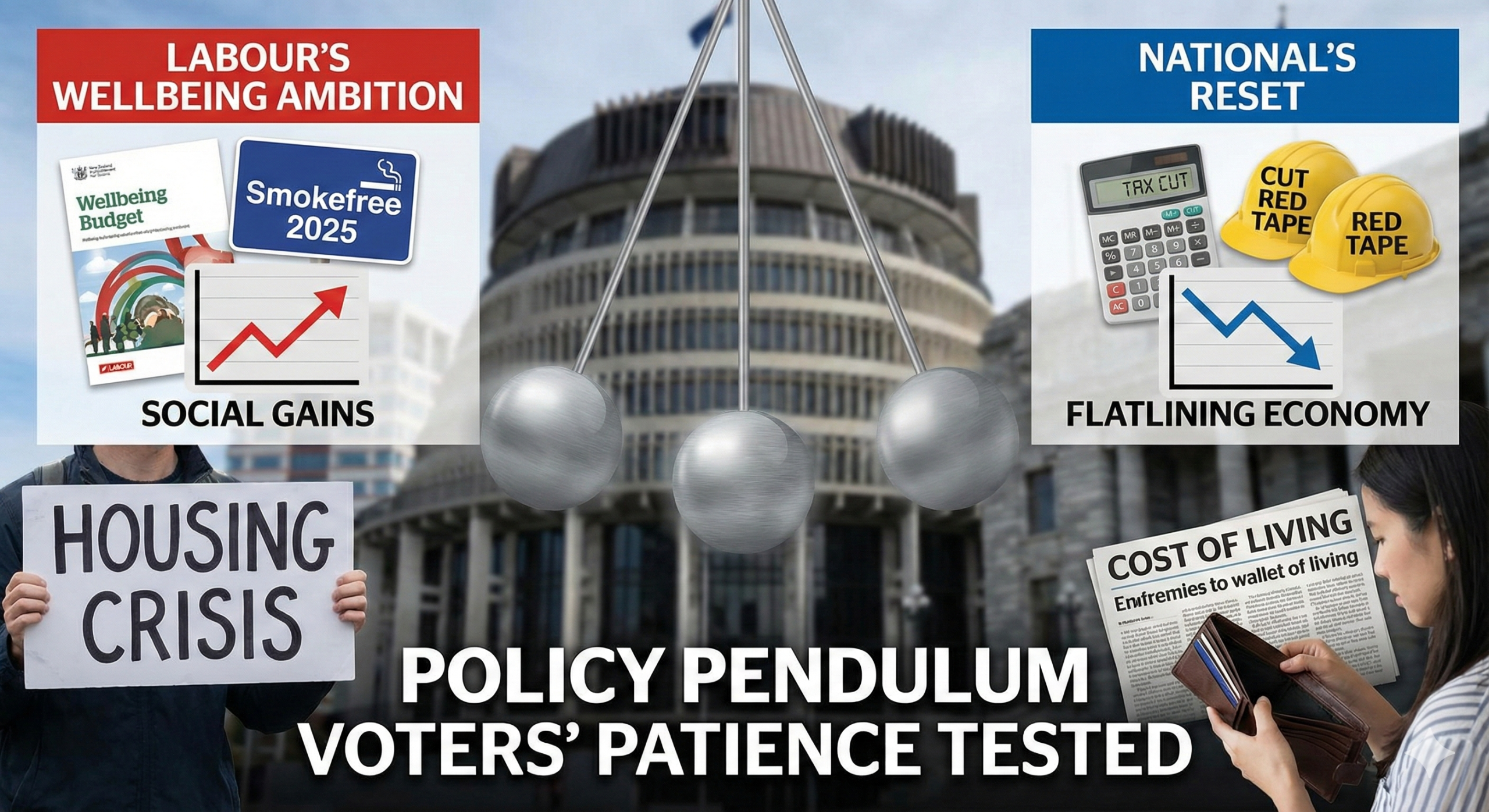
When New Zealand voters removed the Labour government in 2023, many believed the political direction of the country had changed for years.
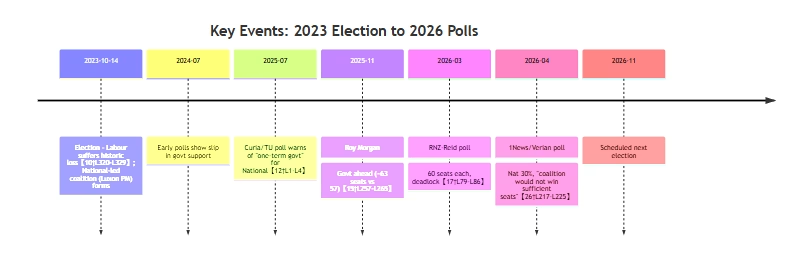
Labour had suffered one of the sharpest declines in modern political history. Public frustration over inflation, crime, economic pressure, housing affordability, and post-pandemic fatigue pushed voters toward a National-led coalition that promised discipline, stability, and a country “back on track.”
For a while, it looked like a decisive reset.
But as New Zealand moves deeper into 2026, something unusual is happening.
The government is no longer fighting only the opposition. It is now fighting economic pressure, geopolitical shocks, coalition tensions, public frustration, and growing voter anxiety all at the same time.
And suddenly, a question that once sounded unrealistic is starting to enter serious political discussion:
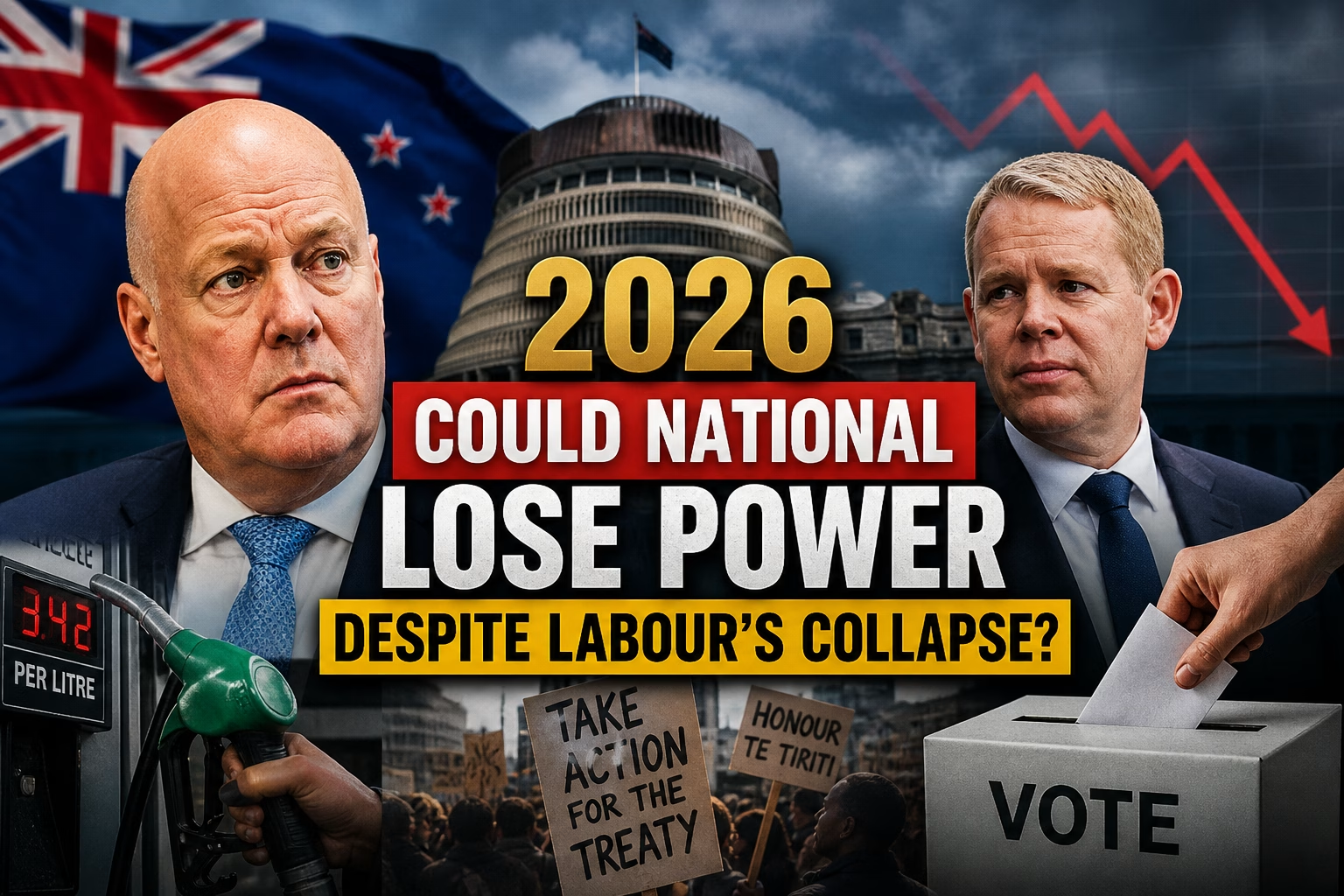
Could National actually lose power after just one term, despite Labour’s collapse?
Historically, that would be extraordinary.
But politically, it is no longer impossible
The Iran War / Fuel Shock Link
The Gender Divide
- housing
- healthcare
- cost of living
- social policy
- Treaty issues
The Biggest Missing Thing: Fear
Tamil Nadu 2026 Election: Did Vijay Break a 60-Year Political System… or Just Shock It? – WebfitNews
| Demographic Segment | Coalition Bloc (Nat/ACT/NZF) (%) | Opposition Bloc (Lab/Grn/TPM) (%) |
| All Women | 40.5 | 55.5 |
| Women 18-49 | 29.0 | 64.0 |
| Women 50+ | 51.5 | 47.0 |
| All Men | 54.0 | 41.5 |
| Men 18-49 | 39.5 | 55.0 |
| Men 50+ | 70.5 | 26.5 |
Labour Lost in 2023. But That Does Not Guarantee National Wins Again
One of the biggest mistakes in politics is assuming voters permanently “belong” to one side after a landslide defeat.
They do not.
In 2023, many New Zealanders were not passionately voting for National. They were voting against Labour.
That distinction matters.
The Labour government under Chris Hipkins inherited massive post-pandemic pressure after the Jacinda Ardern era. Inflation surged globally. Interest rates climbed. Food prices exploded. Public patience collapsed.
By election day, many voters simply wanted change.
National successfully positioned itself as the calmer and more economically disciplined alternative.
But elections are not permanent contracts.
They are performance reviews.
And now the National-led coalition itself is being judged.
| Party | 2023 Result | 2026 Poll | Change in seats |
|---|---|---|---|
| National | 48 seats<br/>38.08% vote | 38 seats<br/>30.8% | –10 |
| Labour | 34 seats<br/>26.91% | 44 seats<br/>35.6% | +10 |
| Green | 15 seats<br/>11.60% | 12 seats<br/>10.1% | –3 |
| ACT | 11 seats<br/>8.64% | 9 seats<br/>7.0% | –2 |
| NZ First | 8 seats<br/>6.08% | 13 seats<br/>10.6% | +5 |
| Te Pāti Māori | 6 seats<br/>3.08% | 4 seats<br/>3.2% | –2 |
| Total (blocs) | 67 (Govt) 55 (Opp) | 60 (Govt) 60 (Opp) |
Key Legislation Affected by the Treaty Clause Review (May 2026)
| Act of Parliament | Scope of Change | Agency Responsible |
| Land Transport Management Act 2003 | Section 4 | Ministry of Transport |
| Pae Ora (Healthy Futures) Act 2022 | Sections 5 and 6 | Ministry of Health |
| Climate Change Response Act 2002 | Section 3A | Ministry for the Environment |
| Education and Training Act 2020 | Multiple Sections | Ministry of Education |
| Oranga Tamariki Act 1989 | Section 4(1)(f) | Oranga Tamariki |
| Kāinga Ora–Homes and Communities Act 2019 | Multiple Sections | Ministry of Housing |
| Local Government Act 2002 | Section 4 | Internal Affairs |
The Cost-of-Living Crisis Never Truly Disappeared
This is the government’s biggest problem.
Many ordinary New Zealanders still feel financially squeezed.
Rent remains high.
Groceries remain expensive.
Insurance premiums continue rising.
Rates bills have climbed sharply in many councils.
Mortgage pressure still hurts thousands of households.
And then came the global fuel shock linked to tensions in the Middle East and disruptions around the Strait of Hormuz.
Petrol prices rising again in 2026 hit voters psychologically very hard.
People may tolerate abstract economic explanations.
They do not tolerate seeing $150 disappear at the petrol station every week.
That frustration becomes political very quickly.
Especially in commuter-heavy cities like Auckland.
| Economic Metric | Pre-War Forecast (Late 2025) | Mid-War Forecast (May 2026) |
|---|---|---|
| GDP Growth (2026) | 2.5% | 1.3% |
| Annual CPI Inflation | 2.8% – 3.1% | 4.8% (Projected) |
| Official Cash Rate (OCR) | 2.25% (On Hold) | 4.0% – 4.5% (Projected) |
| Household Spending Growth | 2.8% | 0.8% |
| Unemployment Rate | 4.4% | 5.6% |
| Petrol Price per Litre | $2.40 – $2.60 | $3.42 – $3.70 |
National’s Economic Story Is Becoming More Complicated
The coalition came into office promising stability and recovery.
Lower inflation.
Improved confidence.
Economic discipline.
But the international environment changed rapidly.
Global uncertainty, slowing growth, fuel volatility, and trade risks have made economic management harder than expected.
The government now faces a difficult balancing act:
- Voters want lower living costs
- Businesses want confidence
- The Reserve Bank remains cautious
- Global instability keeps affecting prices
That creates political danger because voters often judge governments emotionally, not technically.
If people feel poorer, governments struggle.
Even if Treasury forecasts improve on paper.
| Political Party | 2023 Election Result (%) | December 2025 (%) | January 2026 (%) | March 2026 (%) |
|---|---|---|---|---|
| National Party | 38.08 | 33.0 | 34.5 | 26.5 |
| Labour Party | 26.91 | 32.5 | 30.5 | 34.0 |
| Green Party | 11.60 | 12.0 | 10.5 | 11.0 |
| ACT New Zealand | 8.64 | 7.5 | 8.5 | 10.0 |
| New Zealand First | 6.08 | 10.0 | 9.0 | 11.0 |
| Te Pāti Māori | 3.08 | 2.5 | 3.0 | 3.0 |
| Others / TOP | 5.61 | 2.5 | 4.0 | 4.5 |
| Coalition Bloc Total | 52.80 | 50.5 | 52.0 | 47.5 |
| Opposition Bloc Total | 41.59 | 47.0 | 44.0 | 48.0 |
The 2026 Iran War and the Domestic Energy Crisis
The primary catalyst for the government’s decline in early 2026 is the outbreak of a criminal war between the United States/Israel and Iran. The conflict resulted in the closure of the Strait of Hormuz in March 2026, effectively disrupting up to a quarter of the global energy supply. For New Zealand – an island nation with no domestic oil refinery following the 2022 closure of Marsden Point—this geopolitical shock translated into an immediate and devastating domestic fuel crisis.
The average price of petrol in Wellington and Auckland rose by 40% in just four weeks, reaching $3.42 per litre by late March, with major banks such as Westpac predicting it would exceed $3.70 within days. Diesel prices experienced an even more dramatic shift, nearly doubling to $3.43 per litre. The implications for New Zealand’s transport-heavy economy have been catastrophic. Because the nation relies entirely on fuel shipments from Singapore and South Korea – both of which are heavily impacted by the Hormuz closure – New Zealand is now facing the very real prospect of fuel rationing, with most shipments from the Persian Gulf expected to cease by April 20, 2026.
The Coalition Itself Is Becoming a Risk
The National-ACT-New Zealand First arrangement was always politically delicate.
Now those tensions are becoming more visible publicly.
Winston Peters continues operating with an independent style that sometimes overshadows the Prime Minister.
Meanwhile, David Seymour pushes aggressively on ideological reforms, especially around Treaty interpretation, deregulation, and government restructuring.
That creates two risks for National:
First, voters begin seeing the government as unstable or fragmented.
Second, moderate swing voters may start feeling uncomfortable with the sharper ideological direction of some coalition policies.
Under MMP, coalition management is not secondary politics.
It is central politics.
And right now, unity does not always look convincing.
The Treaty Debate Is Reshaping Political Energy
The debate around Treaty clauses and Māori representation has become one of the most emotionally charged political issues in New Zealand.
Supporters of the government argue reforms are about equality and democratic consistency.
Opponents see them as a rollback of Māori rights and constitutional recognition.
What matters politically is not just the policy itself.
It is the mobilisation it creates.
Large protests.
Youth activism.
Growing Māori political engagement.
University organising.
Liberal urban backlash.
Issues that energise people emotionally often influence turnout far more than technical economic policy.
And younger voters increasingly care deeply about identity, representation, and social fairness.
Younger New Zealanders Are Becoming More Unpredictable
This may become one of the defining political stories of the decade.
Younger voters are increasingly disconnected from traditional political loyalty.
Many feel locked out of housing.
Many feel wages are not keeping pace with living costs.
Many see Australia as financially more attractive.
Many are frustrated with both major parties.
That frustration creates volatility.
Some move left.
Some disengage entirely.
Some support smaller parties.
And under MMP, smaller shifts can completely reshape governments.
This is especially important because National’s strongest support still tends to come from older demographics, particularly older property-owning voters.
The long-term demographic trend is becoming more complicated for the centre-right.
Labour’s Recovery Is Less About Excitement and More About Opportunity
Here is the uncomfortable truth for National:
Labour does not necessarily need to become wildly popular to return to power.
It simply needs voters to become disappointed enough with the current government.
That is how many governments lose under MMP.
Not through one dramatic scandal.
But through cumulative frustration.
Labour is slowly repositioning itself as the “safer” and less chaotic alternative.
That does not mean voters have forgotten the failures of the previous Labour government.
But political memory fades faster when current pressure intensifies.
Auckland Could Decide the Entire Election
If National loses significant ground in Auckland, the path to re-election becomes extremely difficult.
Auckland contains many of the country’s most politically sensitive voter groups:
- Young renters
- Migrant communities
- Professionals under mortgage stress
- Indian and Chinese voters
- Public transport users
- Families hit by childcare and insurance costs
The city also reflects almost every major national pressure point:
Housing.
Traffic.
Cost of living.
Infrastructure frustration.
Healthcare wait times.
Economic anxiety.
Auckland does not always vote emotionally in the same direction as the rest of New Zealand.
But when Auckland becomes frustrated, governments usually feel it quickly.
The MMP System Makes Everything Less Predictable
This election may not simply become a National vs Labour contest.
Minor parties could become decisive again.
Winston Peters has repeatedly proven he can reshape governments under MMP.
The Greens remain influential among younger urban voters.
Debbie Ngarewa-Packer and Rawiri Waititi continue strengthening Māori political mobilisation.
And if smaller parties gain momentum, coalition mathematics can suddenly change very fast.
That is why even a weakened Labour Party cannot be politically dismissed yet.
The Webfit News Perspective
National still has a realistic pathway to winning in 2026.
Labour’s reputation damage from 2023 has not disappeared.
Christopher Luxon still benefits from incumbency and economic credibility among many voters.
And opposition parties remain fragmented in several areas.
But something important has changed.
The election no longer looks “safe.”
The government is increasingly being judged not against Labour’s past failures, but against present-day voter stress.
That is a very different political environment.
If fuel prices remain high, economic pressure deepens, coalition tensions continue, and younger voters mobilise strongly, New Zealand could witness one of the most surprising election outcomes in modern MMP history.
A National government losing after one term once sounded politically unrealistic.
In 2026, it sounds possible.