By Geet G | Webfit News
As New Zealand moves closer to the 2026 general election, one political question is quietly becoming louder inside Wellington circles, media discussions, and even among National Party supporters themselves:
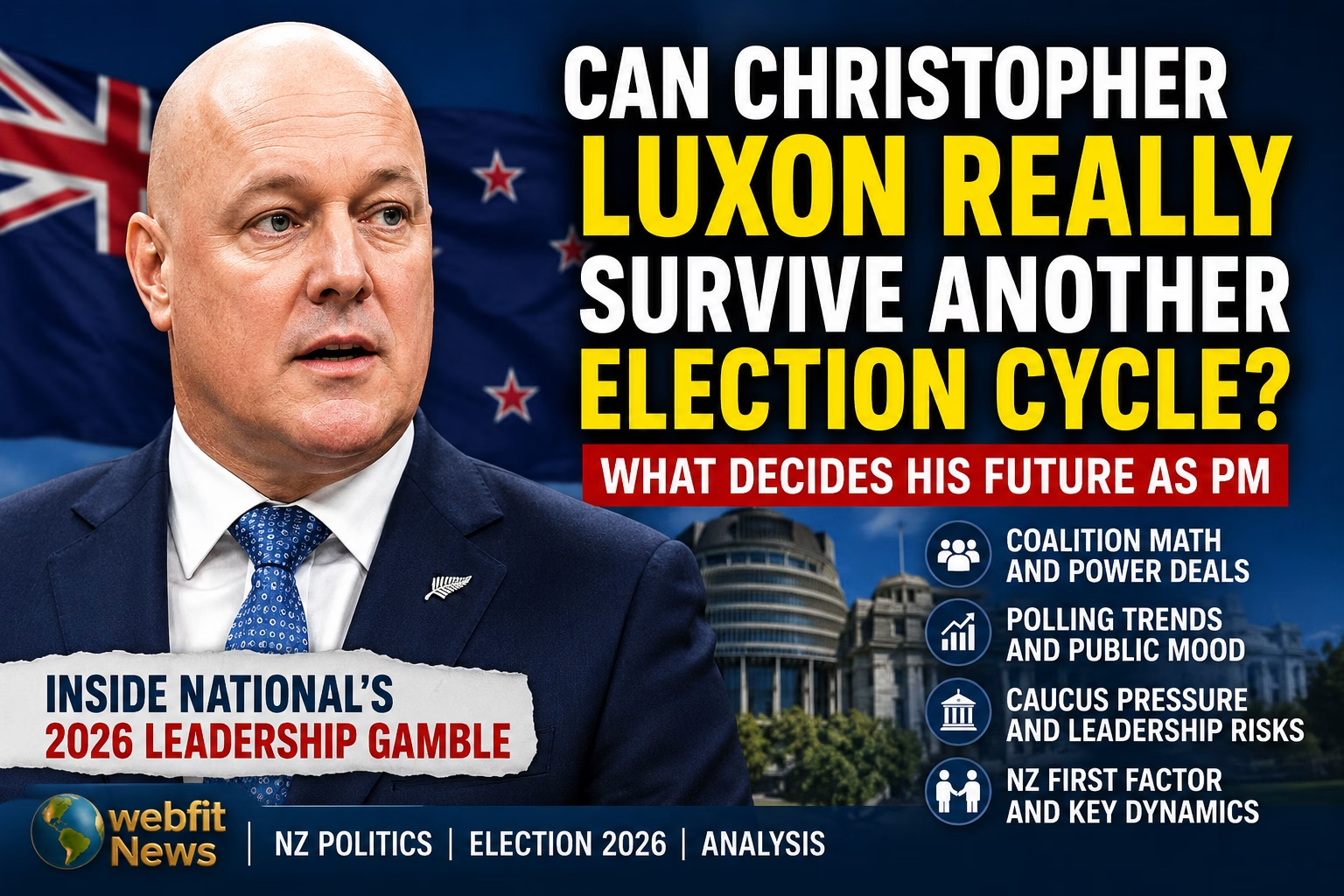
If National returns to power, will Christopher Luxon still remain Prime Minister long term?
Right now, Luxon is unquestionably the public face of the National Party. Since becoming leader in November 2021, he has led National through one of the most politically volatile periods in recent New Zealand politics.
But unlike the John Key era, where National projected long-term stability and confidence, Luxon’s leadership exists under a very different reality.
The numbers are tighter.
The coalition mathematics are more fragile.
And the public mood is less forgiving.
National’s Leadership Turbulence Since 2017
One uncomfortable truth for National is this:
The party has struggled to maintain stable leadership since losing power in 2017.
In less than a decade, National has gone through multiple leaders:
- Bill English
- Simon Bridges
- Todd Muller
- Judith Collins
- Christopher Luxon
That level of turnover matters politically because it creates an image problem.
Voters begin questioning whether the party itself truly knows who should lead the country.
Luxon was initially seen as the “reset candidate.” A former Air New Zealand CEO with corporate experience, strong communication skills, and a clean public image.
For a while, it worked.
But politics is brutal. Corporate leadership and political leadership are not the same game.
And over the past year, Luxon’s popularity has clearly softened.
The Polling Problem
Recent New Zealand polling shows National sitting around the high-20s to low-30s range, often behind Labour.
At the same time, Luxon’s “preferred Prime Minister” ratings have weakened compared with earlier years.
That does not automatically mean defeat.
New Zealand’s MMP system is coalition-driven, not presidential.
A party leader does not need overwhelming personal popularity to become Prime Minister. They simply need enough parliamentary numbers to build government.
And this is where the story becomes more complicated.
Because Luxon’s future may depend less on public popularity and more on coalition survival.
The Coalition Reality
Under current political mathematics, National is unlikely to govern alone.
The most realistic path back to power remains:
- National
- ACT
- NZ First
That creates a difficult balancing act.
David Seymour’s ACT Party continues pulling National toward stronger free-market and harder-right policies.
At the same time, Winston Peters remains one of the most unpredictable figures in New Zealand politics.
This matters because coalition governments are not just about winning elections.
They are about surviving them afterward.
A strong National-led coalition with a comfortable majority would likely secure Luxon’s leadership for years.
But a razor-thin majority changes everything.
In that situation, every disagreement becomes dangerous.
Every poll matters more.
Every coalition partner gains leverage.
And in New Zealand politics, fragile coalitions can quickly become unstable governments.
Why Luxon’s Position Is Still Stronger Than Critics Suggest
Despite criticism, there is still a major reason why Luxon remains difficult to remove.
There is no obvious replacement right now.
That is the key point many political observers miss.
Nicola Willis remains highly respected inside National and continues strengthening her profile. But there is currently no visible internal campaign to replace Luxon.
Unlike the Bridges-Muller-Collins years, there is no active civil war happening publicly inside caucus.
In fact, Luxon recently survived a caucus confidence vote in 2026, which was a critical moment politically.
That vote mattered because it showed MPs were still willing to back him despite declining polling.
And history shows something important in New Zealand politics:
Winning leaders usually survive.
Losing leaders usually do not.
Helen Clark stayed after victories.
John Key stayed after victories.
Jacinda Ardern remained secure after Labour’s landslide win in 2020.
But after defeats, leadership pressure rises very quickly.
Bill English stepped aside after losing in 2017.
Simon Bridges was eventually rolled.
Judith Collins lost caucus confidence after electoral collapse.
National knows this history very well.
What Could Actually Threaten Luxon?
At the moment, there are five genuine risks to Luxon’s long-term survival if National returns to power.
1. A Weak Coalition Majority
This is probably the biggest risk.
If National forms government with only a tiny majority, every coalition negotiation becomes high stakes.
One internal rebellion or partner dispute could destabilise the government quickly.
2. Continued Low Personal Popularity
If Luxon becomes Prime Minister but remains personally unpopular with voters, National MPs may eventually panic about the next election cycle.
Political parties are ruthless when survival is at stake.
3. Economic Pressure
The next government may inherit serious economic challenges:
- High living costs
- Housing pressure
- Weak productivity growth
- Infrastructure strain
- Healthcare funding pressure
If voters continue struggling financially, governments lose political capital very fast.
4. Coalition Conflict With NZ First
Winston Peters is experienced, tactical, and highly influential under MMP.
If tensions rise publicly between Peters and Luxon, instability headlines could dominate political coverage.
5. Internal Succession Pressure
Even without open rebellion, parties quietly prepare succession plans.
If National MPs begin believing another leader polls better with voters, pressure can build behind the scenes very quickly.
Could National Replace Luxon Even After Winning?
Technically, yes.
Politically, it would be extremely risky.
New Zealand voters generally dislike leadership coups unless there is a major justification.
If National wins under Luxon and then removes him shortly afterward, the public could see the party as unstable or internally divided again.
That memory still hurts National from the post-2017 years.
Which is why most analysts believe Luxon’s chances of remaining Prime Minister are still relatively high if he successfully leads National back into government.
So What Are The Actual Chances?
Based on current political conditions, the realistic outlook appears roughly like this:
Strong National-Led Victory
Chance Luxon remains PM: Very High
Narrow Coalition Government
Chance Luxon remains PM: Moderate to High
Weak Polling After Election Win
Chance Luxon remains PM long term: Uncertain
Major Coalition Breakdown or Crisis
Chance Luxon survives full term: Much Lower
At this stage, the most likely outcome remains that Luxon stays as Prime Minister if National forms government.
But this is not the same level of political dominance New Zealand once saw under John Key.
This would likely be a more fragile and constantly negotiated leadership environment.
The Bigger Political Reality For New Zealand
The deeper issue here is not only about Christopher Luxon.
It reflects a wider shift happening in New Zealand politics.
The era of politically untouchable leaders appears to be fading.
Voters are more volatile.
Public patience is shorter.
Coalition governments are more complicated.
Social media accelerates political pressure daily.
Modern leaders now operate in permanent political turbulence.
For Luxon, the challenge is no longer just winning power.
It is proving that he can hold it together once he gets there.
And under MMP politics, that may be the harder battle.