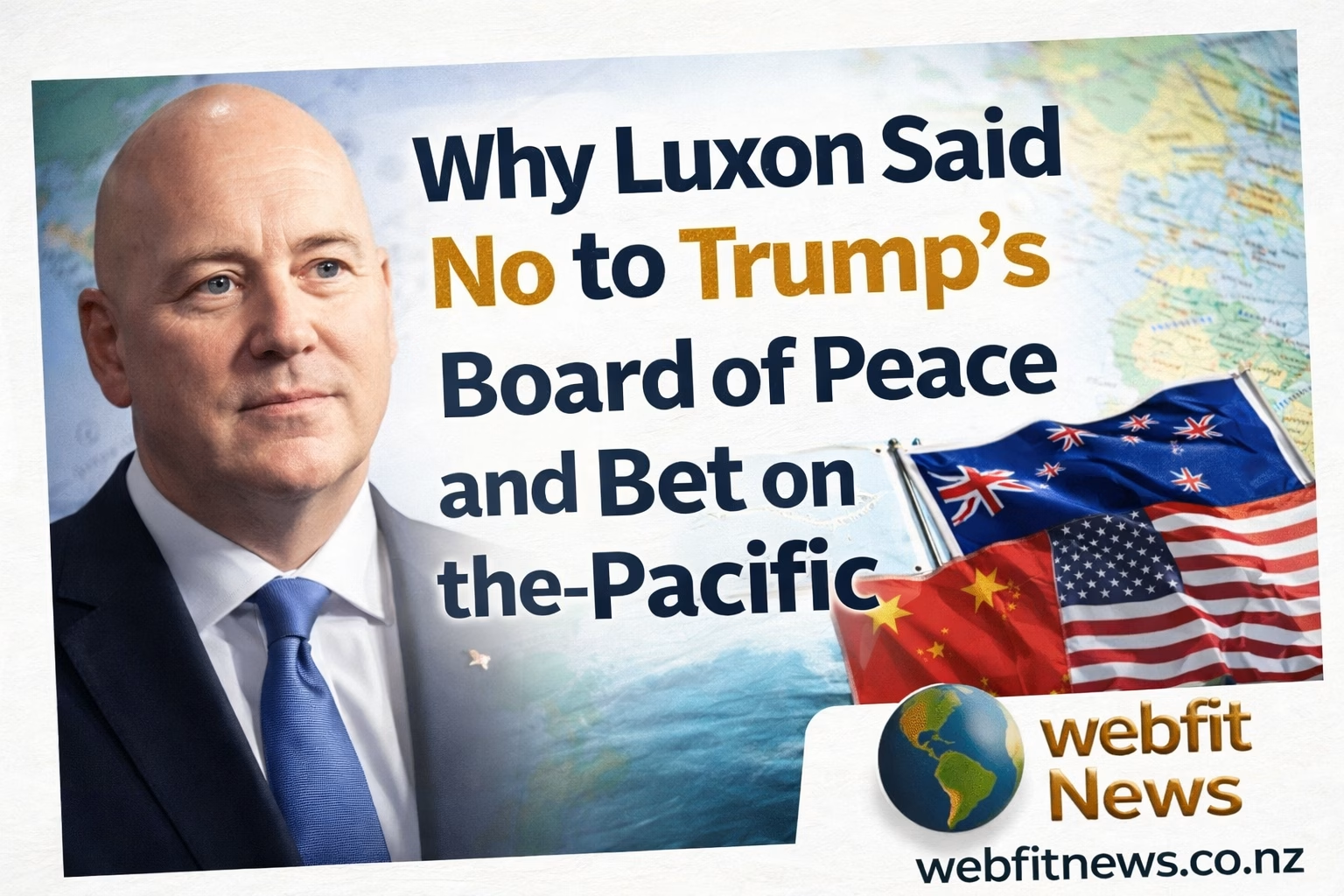
As January 2026 draws to a close, New Zealand finds itself at a defining crossroads in foreign policy. On January 30, Prime Minister Christopher Luxon formally declined an invitation from United States President Donald Trump to join the newly created “Board of Peace,” a body proposed to oversee post-war Gaza and reshape international conflict management.
Wellington framed the decision carefully, stating that New Zealand would not join the board “in its current form.” Behind that phrasing sits a deliberate and consequential choice. Rather than seeking influence inside a US-led, non-traditional structure, the Luxon government has doubled down on a strategic pivot toward the Indo-Pacific, arguing that New Zealand’s long-term security and prosperity are better served through regional partnerships anchored in institutions, not personalities.
The Board of Peace and the Challenge to Multilateralism
The Board of Peace emerged in late 2025 as the centrepiece of President Trump’s “Comprehensive Plan to End the Gaza Conflict.” While the plan initially won international backing for helping secure a ceasefire and the release of hostages, alarm grew once it evolved into a permanent governing body.
Finalised at the World Economic Forum in Davos on January 22, 2026, the Board’s charter marked a sharp break from post-war multilateral norms. It named Trump as Chairman for life, granted him sole authority to invite members and appoint successors, and required permanent members to contribute US$1 billion to a fund controlled by the chair.
For New Zealand, a country whose global standing has long rested on the United Nations and the rules-based order, the structure posed a fundamental contradiction. The absence of Palestinian representation, the inclusion of authoritarian leaders on the invitation list, and the explicitly transactional “pay-to-play” model made the proposal politically and ethically untenable for a small democracy.
Why the UN Still Matters to Wellington
Officials at the Ministry of Foreign Affairs and Trade compared the Board of Peace directly with established institutions such as the UN Security Council. Their assessment was blunt. The Board shifted power away from collective decision-making toward a concert-of-powers model where small states hold little leverage.
While the UN Security Council endorsed aspects of the Gaza ceasefire through Resolution 2803, it stopped short of granting the Board a clear legal mandate. The absence of Chapter VII language raised the risk that any force operating under the Board would be viewed internationally as an occupying authority rather than a peacekeeping mission.
Foreign Minister Winston Peters summarised the government’s position by saying New Zealand would “monitor developments” but would not grant legitimacy to a structure that bypasses international law.
The Indo-Pacific Pivot Explained
Having declined the Middle East-focused offer, Luxon used his 2026 State of the Nation address to articulate a wider strategic shift. He warned that the global rules-based system is fracturing and argued that New Zealand must prioritise resilience over efficiency.
The Indo-Pacific now accounts for roughly 60 percent of global GDP and the majority of global growth. For Wellington, this reality demands a reallocation of diplomatic, economic, and defence resources closer to home.
The government has identified three core shifts.
First, New Zealand aims to reposition itself as a connector between the Pacific and Asia. The long-standing idea of being “friends to all” is increasingly viewed as unrealistic in a region where major powers are forcing binary choices.
Second, the government has tied economic policy directly to national security. Undersea cables, shipping lanes, ports, and digital infrastructure are now treated as strategic assets. Officials point to organised crime and drug trafficking in the Pacific as evidence that governance gaps quickly become security threats.
Third, fiscal discipline at home is being framed as a prerequisite for influence abroad. Luxon has been clear that without a stable domestic economy, New Zealand risks vulnerability to economic coercion and trade pressure.
Trade Pressure and the End of Transactional Diplomacy
The economic context matters. Since April 2025, New Zealand exports have faced a US universal tariff regime that now sits at 15 percent. Wine, meat, and dairy exporters have felt the impact directly, with margins squeezed and demand stagnating.
Joining the Board of Peace was quietly discussed in some circles as a possible route to tariff relief. The government rejected that logic. Officials argued that transactional diplomacy creates short-term wins at the cost of long-term sovereignty.
Instead, Wellington has accelerated diversification. The India–New Zealand Free Trade Agreement, concluded in late 2025 and due for signature in early 2026, is central to this approach. Covering the vast majority of exports and accompanied by a major investment commitment, the agreement is viewed not just as an economic deal but as a geopolitical anchor in Asia.
Security, Interoperability, and Regional Trust
New Zealand’s defence posture reinforces this pivot. The government has committed $1.5 billion to modernising the New Zealand Defence Force, including new maritime helicopters and long-range aircraft designed to operate seamlessly with Australian, Japanese, and US forces.
Recent agreements with Japan and Singapore underline a shift toward “spoke-to-spoke” security ties rather than reliance on a single hub. These partnerships prioritise interoperability, logistics sharing, and intelligence cooperation, allowing New Zealand to remain relevant without abandoning its independent voice.
AUKUS Pillar II and the Technology Question
The most sensitive decision still ahead involves possible participation in AUKUS Pillar II. Unlike the nuclear submarine component, Pillar II focuses on advanced technologies such as artificial intelligence, quantum systems, and cyber capabilities.
Government briefings suggest cautious interest. Officials see alignment with Pillar II as consistent with New Zealand’s Indo-Pacific focus, provided it does not compromise the country’s nuclear-free stance or political autonomy. A final decision is expected later in 2026.
Domestic Politics and Public Skepticism
This strategic bet is unfolding in an election year, with voters heading to the polls in November 2026. Opposition parties have criticised the government for what they describe as hesitation and mixed messaging, particularly over the timing of the Board of Peace rejection.
Public sentiment toward the United States has cooled sharply since Trump’s return to office. Polling shows declining trust and growing concern about American unpredictability. In contrast, confidence in Australia and in New Zealand’s own judgement remains high.
The Luxon government’s approach can be summed up as cautious realism. Avoid loud confrontations, avoid symbolic gestures, and focus on outcomes that strengthen New Zealand’s position in its own region.
Gaza, “New Gaza,” and New Zealand’s Red Line
Another factor behind the rejection of the Board was the vision promoted for post-war Gaza. Plans presented in Davos emphasised large-scale redevelopment and market-driven growth, while leaving questions of Palestinian self-determination unresolved.
For New Zealand, which continues to support a two-state solution, the model crossed a clear line. Diplomats warned that participation would damage relationships with key Indo-Pacific partners such as Indonesia and Malaysia, where public support for Palestinian rights remains strong.
By stepping back, Wellington has preserved its ability to support humanitarian efforts through the UN while avoiding entanglement in a structure many view as colonialism repackaged.
A Multiplex World and a Small State’s Strategy
Analysts increasingly describe today’s global system as “multiplex,” defined by overlapping alliances rather than a single dominant power. In this environment, small states survive by diversifying relationships and avoiding over-dependence.
New Zealand’s refusal to join the Board of Peace is not a rejection of the United States. It is a rejection of personalised power and transactional governance. The Indo-Pacific bet reflects a belief that institutions, regional trust, and legal frameworks still matter, even as the global order frays.
What Comes Next
The success of Luxon’s strategy will be judged on three fronts. First, whether the India FTA delivers real economic resilience. Second, whether decisions on AUKUS Pillar II enhance capability without eroding independence. Third, whether economic recovery translates into tangible gains for households before voters go to the polls.
Saying no to the Board of Peace allowed New Zealand to say yes to a larger strategic direction. It is a gamble, but one rooted in geography, realism, and the belief that even small nations can still choose their own path.
The Webfit News Perspective
At Webfit News, we see this moment as more than a foreign policy decision. It reflects a broader shift in how New Zealand defines its place in the world.
As global power becomes more personalised and transactional, small countries face pressure to align quickly and quietly. New Zealand’s choice suggests a different instinct: slow down, assess the structure, and ask who really benefits in the long run.
The Indo-Pacific pivot is not risk-free. But it signals that Wellington still believes in institutions, regional balance, and the idea that independence is preserved not by loud slogans, but by careful, consistent choices. That tension, between pragmatism and principle, will define New Zealand’s foreign policy story well beyond 2026.