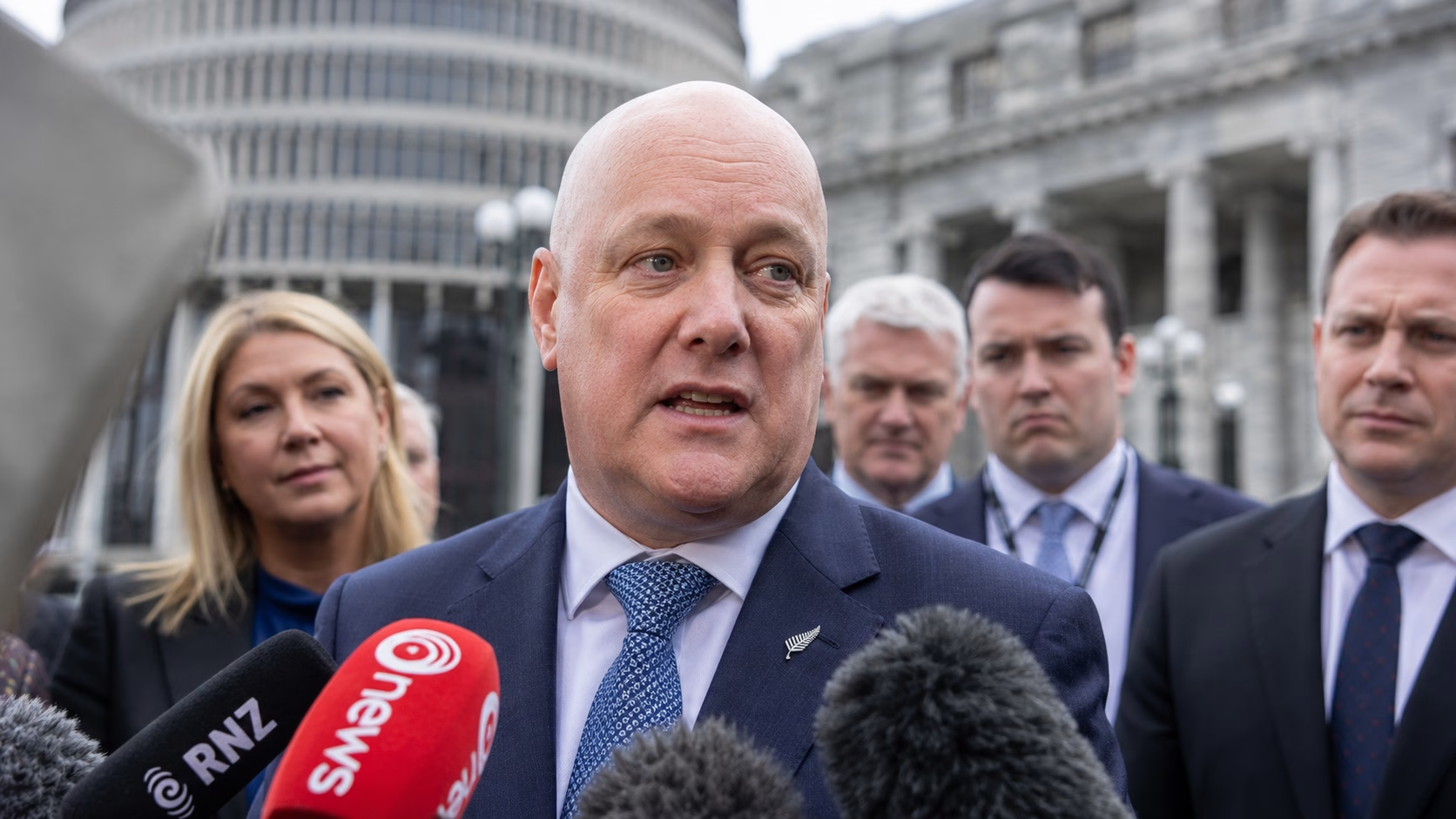
Christopher Luxon has survived a second National Party confidence vote in four months. The immediate threat to his leadership is over. The bigger political consequence may be that National MPs have now tied themselves much more tightly to him, with less room to change course before voters go to the polls on 7 November.
Prime Minister Christopher Luxon has survived another confidence vote inside the National Party caucus, ending, at least for now, intense speculation that senior MPs could move against him before the 2026 General Election.
Luxon emerged from Wednesday morning’s caucus meeting saying he had the “full support” of National MPs and describing the party as united and focused on winning the election on 7 November. 1News confirmed shortly after midday that Luxon would remain National leader following the vote.
Reuters also reported that Luxon had secured caucus support after calling MPs together in Wellington as speculation about his leadership intensified. It is the second confidence vote involving Luxon’s leadership this year, following another vote in April.
That detail matters.
Luxon was not “voted into office four months ago”, as some reports have suggested. He has been Prime Minister since the National-led coalition took office following the 2023 election. What happened in April was an earlier National caucus confidence vote, which he also survived.
The obvious headline today is that Luxon survived.
But the more interesting political question is what National has now done to itself.
National has chosen certainty over another reset
Leadership changes can sometimes give struggling governments a short-term political reset.
National MPs had that option available to them today.
1News reported before the meeting that senior MPs were considering whether Luxon should be asked to resign, while Erica Stanford and Chris Bishop were among the names being discussed as possible alternatives if the leadership became vacant.
The caucus chose not to take that path.
That means National has effectively made a strategic decision: whatever weaknesses voters see in Luxon, changing leaders less than three months before an election carried an even greater risk.
There is logic to that calculation.
A leadership replacement in August would require a new Prime Minister to establish authority, reorganise the political operation, potentially reshuffle Cabinet responsibilities and introduce themselves to voters as the country’s leader while simultaneously fighting an election campaign.
National would also have spent valuable campaign weeks answering questions about why it removed the Prime Minister it had defended only months earlier.
By backing Luxon again, the caucus has avoided that immediate chaos.
But it has also dramatically reduced its future flexibility.
This vote may have closed National’s escape hatch
This is the part of today’s story that could become more important than the vote itself.
National MPs have now formally backed Luxon twice in 2026.
If the party’s polling deteriorates again in September or October, replacing him becomes politically much more difficult.
A third leadership crisis would raise an obvious question: if MPs had serious enough doubts to remove Luxon later, why did they endorse him again on 12 August?
That means today’s confidence vote does more than secure Luxon’s job.
It transfers part of the political responsibility for his leadership onto the wider National caucus.
From this point, MPs cannot easily argue that Luxon’s leadership was simply something imposed upon them.
They have considered the question and chosen him.
In practical terms, National MPs have now moved closer to collectively owning the election result.
Winning caucus confidence is not the same as winning public confidence
The distinction between internal party confidence and voter confidence is crucial.
On the same morning that Luxon survived the caucus vote, a new 1News Verian poll showed his preferred Prime Minister rating falling one percentage point to 17 percent.
Labour leader Chris Hipkins also dropped one point, to 15 percent, meaning Luxon still remained ahead of him on that measure.
Those numbers show why the political picture is more complicated than simply saying Luxon is finished.
His personal numbers are weak, but there is no opposition leader overwhelmingly dominating the preferred Prime Minister contest either.
There is also considerable variation between polls.
A Taxpayers’ Union-Curia poll conducted from 1 to 4 August projected that National, ACT and New Zealand First could still command 61 seats in a 120-seat Parliament, just enough for a majority. That poll also recorded an improvement in Luxon’s preferred Prime Minister rating.
So New Zealand currently has something politically unusual.
A Prime Minister facing serious questions about his leadership can simultaneously be personally unpopular, lead a party trailing Labour in several polls, and still have a plausible pathway to forming the next government.
That is partly the reality of MMP politics.
The election may not actually be a Luxon versus Hipkins contest
New Zealand elections are often presented as a contest between two potential prime ministers.
The 2026 election is becoming something more complicated.
Under MMP, government formation depends on parliamentary blocs rather than simply which major party receives the most votes.
The recent Curia poll projected the governing National, ACT and New Zealand First bloc at 61 seats.
It also showed the emerging Opportunity Party at 6.1 percent, potentially giving it eight seats if it crossed the 5 percent threshold.
Luxon has ruled out working with the Opportunity Party because of significant policy differences, particularly around taxation.
That creates a second challenge for National.
The party does not simply need Luxon to become more popular.
It needs enough voters to support National, ACT and New Zealand First in combinations capable of producing a governing majority.
This means voters could dislike Luxon’s leadership but still return his government.
They could also prefer Luxon to Hipkins personally but vote in a way that produces a Labour-led government.
That is why preferred Prime Minister polling alone can give an incomplete picture of the election.
National’s real problem may be discipline, not leadership
Another underappreciated aspect of today’s vote is how National arrived here.
The crisis was not triggered by one catastrophic event.
Instead, pressure accumulated through a series of political problems, poor polling and internal frustration.
Recent controversy included Luxon’s comments suggesting the possibility of a referendum on New Zealand’s MMP electoral system. Reuters reported the comments were made without consulting colleagues and produced criticism from both ACT and New Zealand First.
Luxon also attracted criticism after telling a business audience to “be adult” rather than relying on government assistance.
At the same time, senior National MP Chris Bishop publicly urged colleagues to stop anonymously briefing journalists against the leadership.
That points to a broader problem.
Changing the leader would not automatically fix caucus leaking, coalition tensions, campaign discipline or inconsistent political messaging.
If National genuinely believes Luxon should lead it into November, the next test is whether the party can stop debating itself publicly.
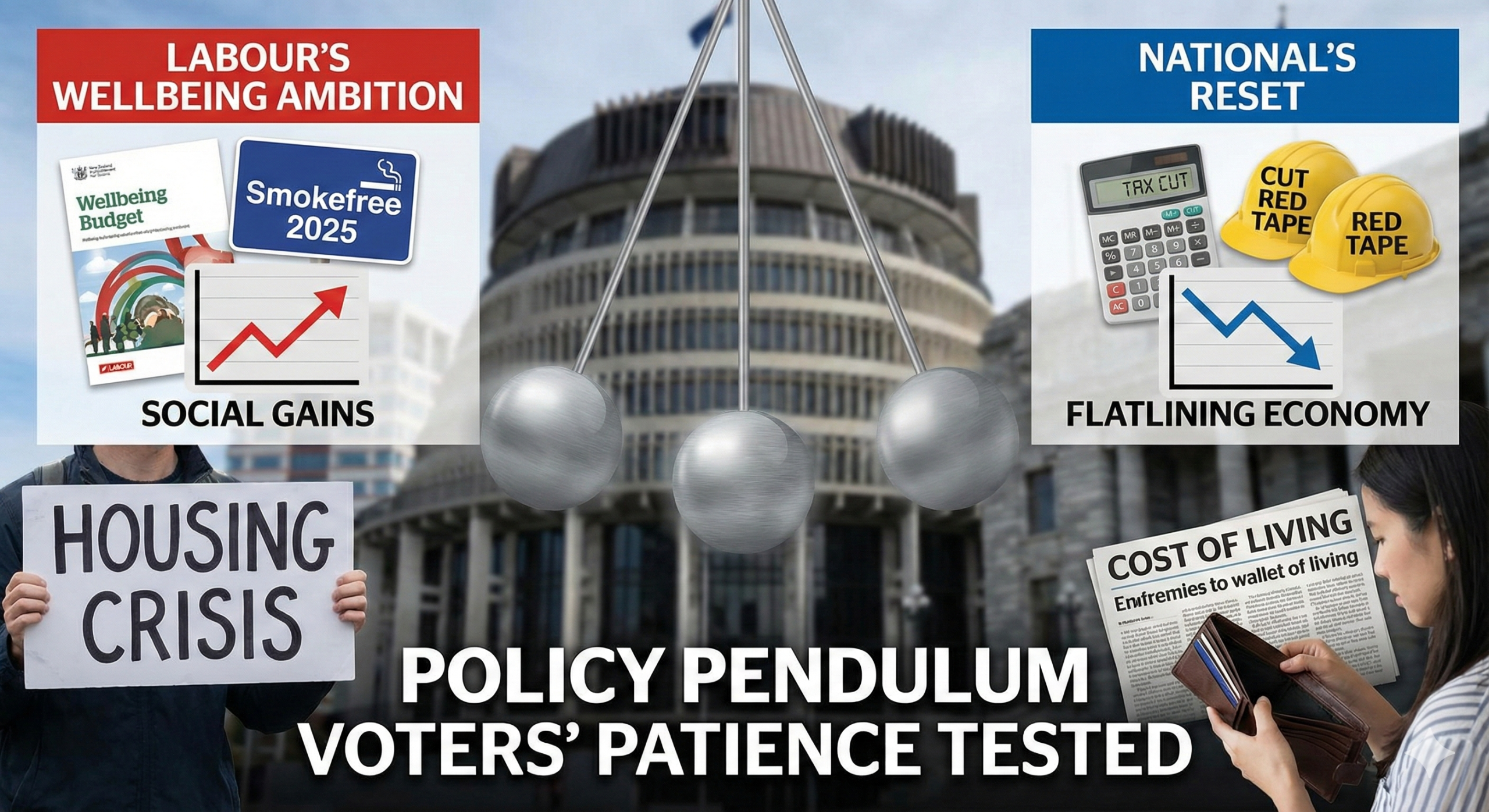
The economy remains the harder opponent
National’s leadership drama is politically compelling, but it may still be secondary to the conditions voters experience every day.
Reuters reported that unemployment is at an 11-year high, while inflation remains above the Reserve Bank’s 1 to 3 percent target range.
Those conditions help explain why National continues to struggle despite being the incumbent major party of the centre-right.
A leadership change could alter presentation.
It cannot immediately change unemployment, household costs, mortgage pressure or economic confidence.
That may ultimately explain why National MPs decided against rolling Luxon.
If the party’s central political problem is the economy rather than the identity of its leader, installing someone new in August might create instability without solving the underlying voter frustration.
What today really changed
Christopher Luxon won today’s confidence vote.
That is significant.
But it would be a mistake to interpret the result as evidence that National’s political problems have disappeared.
The vote settled one question:
Who will lead National today?
It did not settle the more important questions:
Can Luxon improve National’s support?
Can the caucus remain disciplined?
Can the coalition present itself as stable?
Can economic conditions improve quickly enough for voters to feel the difference?
And can National prevent another leadership debate from consuming precious campaign time?
The most important consequence of today’s meeting may therefore be this:
National has made its choice.
After backing Luxon twice in four months, changing leader again before 7 November would now carry an enormous political cost.
Luxon has survived the caucus.
The next confidence vote is the one National cannot control.
It will be held by New Zealand voters on 7 November 2026.
NZ Election 2026: Where do you stand on Christopher Luxon’s leadership?
With the General Election approaching on 7 November 2026, Webfit News wants to hear directly from New Zealanders.
Do you still have confidence in Christopher Luxon as Prime Minister?
Take part in our quick reader poll and see how others are voting.
👇 Have your say now
https://poll.webfitnews.co.nz/polls/luxon-leadership-pulse-2026
Your voice matters. Add your view to the conversation.
#WebfitNews #ChristopherLuxon #NZElection2026 #NewZealandPolitics #HaveYourSay
References
1News, 12 August 2026, live coverage of the National Party caucus confidence vote and Christopher Luxon’s leadership.
Reuters, 12 August 2026, reporting on Luxon’s confidence vote, polling and economic conditions.
1News, April 2026, reporting on Luxon’s first National Party caucus confidence vote.
Reuters, 7 August 2026, Taxpayers’ Union-Curia polling and projected parliamentary numbers.
1News, August 2026, reporting on National caucus tensions and potential leadership alternatives.
1News, August 2026, Chris Bishop comments on internal National Party leaking.