
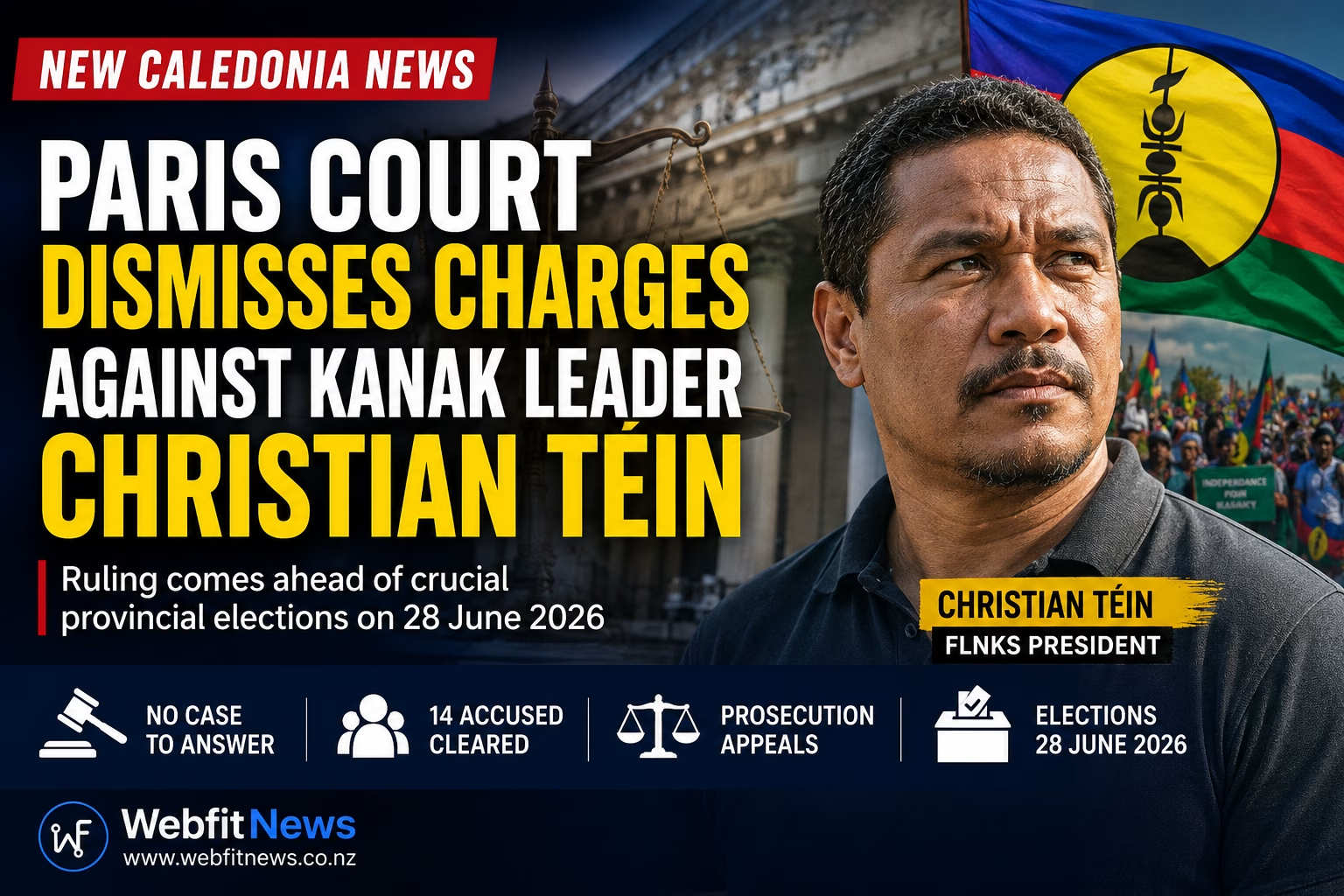
A Paris court has dismissed all charges against prominent pro-independence Kanak leader Christian Téin and 13 co-accused in connection with the violent unrest that shook New Caledonia in 2024, marking a significant development in one of the Pacific region’s most closely watched political disputes.
The ruling, delivered by a panel of judges in Paris on Friday, found there was insufficient evidence to support the allegations against Téin and the other defendants. French media reported that the judges concluded there was effectively “no case to answer” after nearly two years of investigation.
The decision comes at a sensitive time for New Caledonia, a French territory in the South Pacific, as voters prepare to head to the polls later this month for provincial elections that could influence the territory’s political future.
Allegations Linked to 2024 Unrest
Christian Téin became a central figure in the political crisis that erupted in May 2024 when widespread protests against proposed electoral reforms escalated into riots and violence.
At the time, Téin was leading the CCAT, or Field Action Coordinating Group, a movement established by the pro-independence political party Union Calédonienne. French prosecutors alleged that the organisation operated as a coordinated structure intended to destabilise New Caledonia’s institutions and public services.
Authorities accused members of the group of involvement in a range of serious offences, including alleged complicity in attempted murder, destruction of property, and armed theft connected to the unrest.
However, after examining the evidence gathered during the lengthy investigation, the Paris court concluded that there was insufficient proof to proceed with criminal charges against any of the 14 individuals.
French prosecutors have reportedly lodged an appeal against the decision.
Arrest, Detention and Political Rise
Téin and several other CCAT leaders were arrested in June 2024 in the capital, Nouméa, before being transferred to mainland France.
They remained in detention for extended periods while investigations continued. Téin himself spent approximately a year in custody before being allowed to return to New Caledonia in December 2025.
Despite his detention, Téin’s political influence continued to grow.
In August 2024, while still imprisoned in Mulhouse, France, he was elected President of the FLNKS, the Kanak and Socialist National Liberation Front. The FLNKS remains the principal coalition advocating for New Caledonian independence from France.
His election from prison highlighted both his standing within the independence movement and the broader political significance of the legal proceedings.
Following the court’s ruling, defence lawyers welcomed the outcome, describing it as recognition of the extensive work carried out by the investigating judges in Paris.
Lawyers representing Téin argued throughout the process that the case was politically motivated and aimed at silencing a leading voice within the independence movement.
Electoral Reform at the Heart of the Crisis
The unrest that erupted in 2024 stemmed from a highly contentious proposal by the French Government to alter voting eligibility rules for New Caledonia’s provincial elections.
Since the signing of the Nouméa Accord in 1998, special electoral arrangements have limited participation in provincial elections to long-term residents. These restrictions were designed to protect the political representation of the indigenous Kanak population.
The French Government’s proposal sought to expand the electoral roll by allowing additional residents to vote.
Pro-independence groups strongly opposed the move, arguing that it would dilute the voting power of indigenous Kanaks and gradually reduce their political influence.
What began as peaceful demonstrations quickly escalated into widespread unrest across Nouméa and surrounding areas.
Economic and Human Cost
The violence had severe consequences for New Caledonia.
According to official estimates, 14 people lost their lives during the unrest. Hundreds of businesses were looted, damaged, or destroyed, while thousands of jobs were affected.
Economic activity suffered a major setback, with New Caledonia’s Gross Domestic Product reportedly declining by approximately 13.5 percent.
Authorities estimated total damage at around €2.2 billion, making it one of the most significant crises in the territory’s recent history.
The unrest also prompted repeated delays to provincial elections originally scheduled to take place earlier.
Provincial Elections Loom
Attention is now shifting to provincial elections scheduled for 28 June 2026.
The vote will determine the composition of New Caledonia’s three provincial assemblies and subsequently shape the makeup of the territorial Congress, government, and presidency.
The elections are regarded as particularly important because they will influence future discussions regarding New Caledonia’s political status and relationship with France.
Earlier this year, the French Parliament approved a limited modification to the special electoral roll by allowing locally born residents who have since reached voting age to participate.
However, the reform satisfied neither side of the political divide.
The FLNKS argued that any changes to voting rules should only occur within a broader political settlement regarding New Caledonia’s future. Meanwhile, pro-France groups argued the reforms did not go far enough and sought broader voter eligibility.
Against this backdrop, the dismissal of charges against Christian Téin is likely to have significant political implications.
While the legal battle may not be entirely over due to the prosecution’s appeal, the ruling removes a major legal cloud hanging over one of the territory’s most prominent political figures just weeks before voters head to the polls.
As New Caledonia approaches another pivotal moment in its history, questions surrounding self-determination, democratic representation, and relations with France remain at the centre of public debate.
Source: RNZ, French Pacific Desk, reporting by Patrick Decloitre; information published via Scoop Media.