By Webfit News Desk
Published: December 2025
Rare earth elements rarely make headlines. Yet behind the screens we use, the cars we drive, and the weapons that underpin modern defence, these obscure minerals have become one of the most powerful geopolitical tools of the 21st century.
Over the past three decades, China has quietly but decisively turned rare earths from a niche industrial input into a strategic lever over the United States and its allies. By late 2025, that leverage is no longer theoretical. It has been tested, deployed, and proven.
This is the story of how Beijing built its rare earth advantage and how Washington discovered, belatedly, how exposed it had become.
Rare Earths: Small Materials, Outsized Power
Rare earth elements, a group of 17 metals, are essential to modern technology. They are used in electric vehicle motors, wind turbines, smartphones, advanced radar systems, and precision-guided weapons.
They are not rare in geological terms. What is rare is the ability to extract, separate, and process them at scale.
This distinction sits at the heart of China’s power.
As of 2024–2025 estimates:
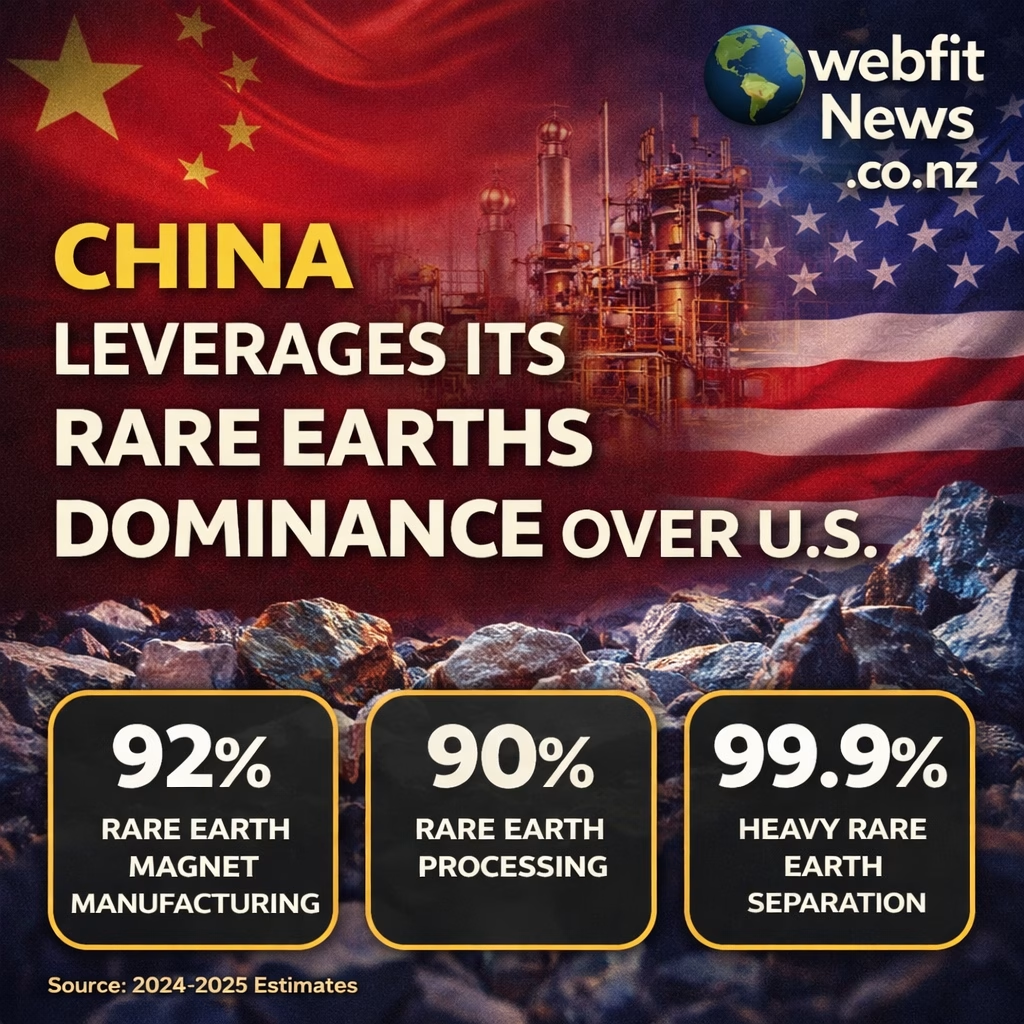
- China controls 60–70% of global rare earth mining
- 85–90% of global processing and separation
- Around 92% of rare earth magnet manufacturing
- Nearly 100% of heavy rare earth separation, including dysprosium and terbium, which are critical for high-temperature defence and energy systems
In strategic terms, China does not just mine rare earths. It controls the chokepoints that turn ore into usable technology.
The Long Game: How China Built Its Advantage
China’s dominance did not happen overnight.
In the 1980s and 1990s, while Western countries focused on environmental regulation and short-term cost efficiency, China pursued a different path. Under Deng Xiaoping, rare earths were identified as a strategic asset, famously described as China’s equivalent of Middle Eastern oil.
Beijing followed through with policy.
It tolerated environmental damage, subsidised production, and allowed prices to fall below global competitors’ costs. Western producers could not compete. One by one, they shut down.
By 2002, the United States had effectively lost its independent rare earth mining and processing capability.
A defining moment came with the sale of Magnequench, a US company that pioneered neodymium magnet technology. Sold in the mid-1990s to a consortium linked to Chinese state entities, the company’s factories and intellectual property were relocated to China within a decade.
The consequence was profound. China did not just acquire materials. It acquired manufacturing knowledge and technological leadership.
From Mining to Monopoly: The Processing Bottleneck
Rare earth leverage is not about who owns the ground. It is about who controls the chemistry.
Separating rare earth elements is technically demanding. Hundreds of solvent extraction stages are required to achieve the purity needed for advanced magnets. The process is energy-intensive, chemically hazardous, and environmentally costly.
China invested heavily in this midstream processing capability while the West retreated.
By the mid-2010s, China consolidated its rare earth industry into six major state-backed groups, giving Beijing direct control over production quotas and pricing. This allowed China to:
- Flood markets to bankrupt competitors
- Restrict supply to drive prices higher
- Align output with national industrial strategy
By 2025, China had moved further downstream, dominating not just processing but the manufacturing of high-performance magnets used in electric vehicles and defence systems.
Intellectual Property and the Technology Moat
China’s advantage today is not simply cost-based. It is technological.
Chinese firms now hold tens of thousands of rare earth-related patents, covering separation techniques, alloy formulations, and magnet manufacturing processes. Many of these patents are incremental improvements that create dense legal barriers for new entrants.
One key area is grain boundary diffusion, a process that allows magnets to retain strength at high temperatures while using significantly less heavy rare earth material. This technique is critical for EV motors and wind turbines.
While early patents originated outside China, Chinese firms now dominate the practical, scalable implementation of the technology.
For Western manufacturers, this creates a dilemma. Even if they build new facilities, they risk patent infringement or inferior performance.
When Leverage Became a Weapon: The 2024–2025 Trade Escalation
The strategic imbalance became unmistakable during the 2024–2025 escalation in US–China trade tensions.
As the United States tightened controls on semiconductor exports, China responded not with tariffs, but with targeted export restrictions on critical materials.
Over a two-year period, Beijing restricted exports of:
- Gallium and germanium, vital for radar and semiconductors
- Graphite, essential for EV batteries
- Antimony, used in ammunition and night vision systems
- Rare earth processing technologies and magnet equipment
The most significant move came in October 2025, when China imposed broad controls not just on materials, but on the technology required to process them. The rules asserted extraterritorial reach, potentially blocking third-country companies using Chinese rare earth inputs from supplying US markets.
The message was clear. China could disrupt entire global supply chains without firing a shot.
The Defence Exposure: A Wake-Up Call for Washington
Nowhere is US vulnerability clearer than in defence.
Modern weapons systems rely heavily on rare earth magnets. This includes fighter jets, missile guidance systems, submarines, and advanced radar.
In 2022 and again in subsequent audits, the US Department of Defense discovered that key components in the F-35 fighter jet contained Chinese-sourced rare earth alloys, violating procurement rules.
The issue was not malice. It was dependence.
There were simply no alternative suppliers capable of producing certain materials at scale.
By 2025, Pentagon reviews confirmed that stockpiles of processed heavy rare earths were insufficient for prolonged conflict scenarios.
The Cost of Catching Up
Washington has responded with funding, legislation, and strategic urgency.
The Inflation Reduction Act and direct Department of Defense investments have supported domestic producers such as MP Materials in California and Australia’s Lynas Rare Earths.
But rebuilding capability is proving slow and expensive.
Environmental compliance costs in the US are significantly higher. Wastewater treatment, radiation containment, and permitting delays add years and hundreds of millions of dollars to projects.
MP Materials, despite being the leading Western producer, reported substantial losses in 2025 as it transitioned away from Chinese processing. Heavy rare earth separation capability is not expected to be fully operational until 2026.
Lynas’s US-based processing plant, backed by Pentagon funding, remains stalled amid regulatory uncertainty.
A Fragile Pause, Not a Resolution
In November 2025, Beijing and Washington agreed to a one-year suspension of their most severe trade measures.
China temporarily lifted rare earth export controls. The US eased certain semiconductor restrictions.
Markets stabilised. Supply chains breathed.
But the underlying structures remain unchanged.
China retains the processing monopoly. The export control frameworks remain legally in place. The pause expires in late 2026.
Analysts widely describe the situation as a “strategic ceasefire”, not a settlement.
The Bigger Lesson
China’s rare earth dominance was not an accident. It was the result of patient state strategy, industrial policy, and a willingness to absorb costs others avoided.
The United States is now racing to rebuild capabilities it once led and later abandoned.
The outcome is not yet determined. But the lesson is already clear.
In a world where technology defines power, control over the materials beneath that technology matters as much as innovation itself.
For now, China holds the upper hand.
And the clock is ticking.
Webfit News will continue to follow global supply chain, technology, and geopolitical developments shaping the future of energy, defence, and economic security.