Wellington | December 22, 2025
A benefit policy affecting people who spend long periods in the hospital is facing renewed scrutiny. Patients and advocates say the reduced payment is not enough to meet basic living and medical costs.
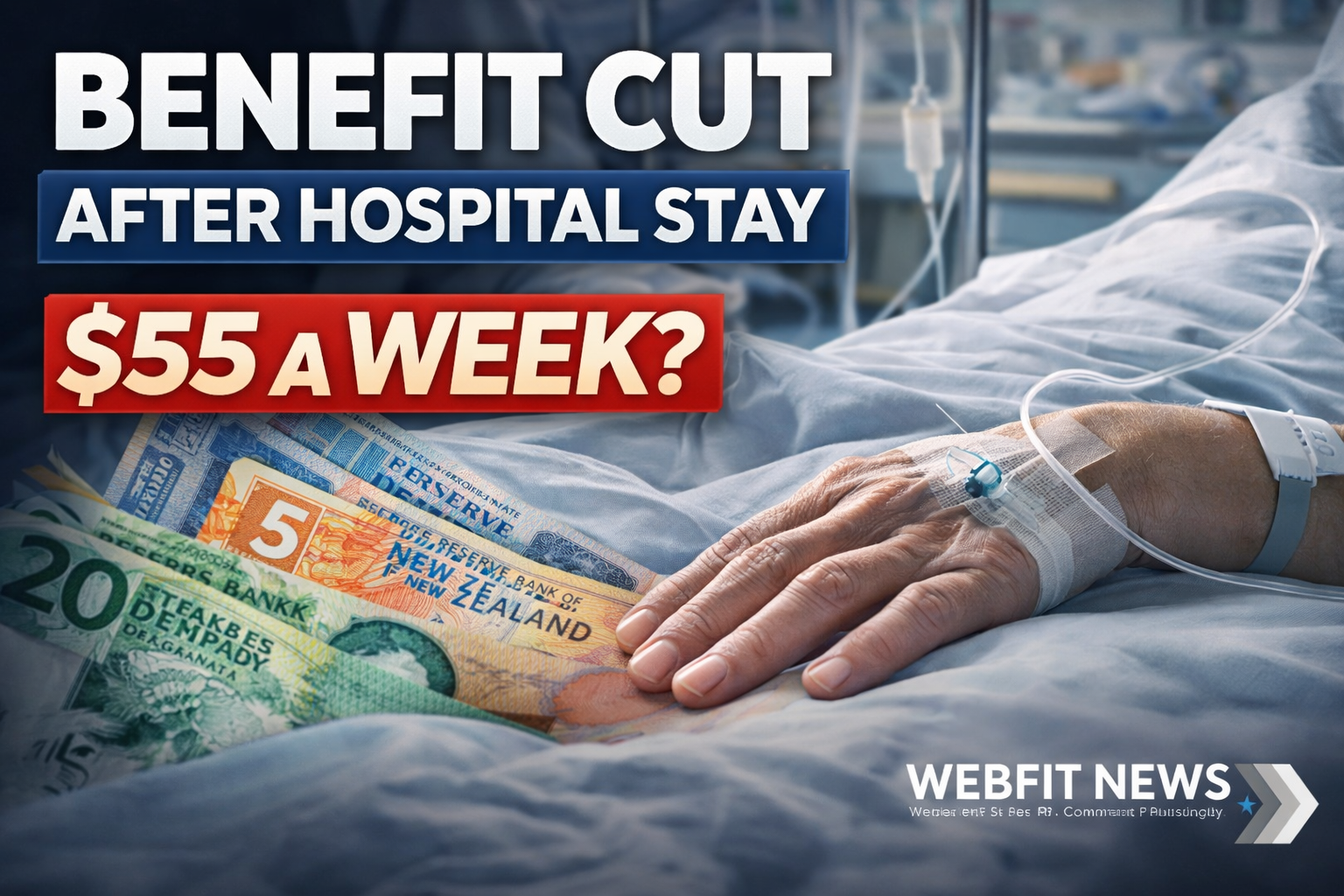
Under current rules, a person who stays in hospital for more than 13 weeks has their main benefit reduced automatically. The payment drops to a “hospital rate” of about $55 a week after tax.
The policy assumes that hospitals cover most living and healthcare costs. For many patients, that assumption does not reflect reality.
For some, the impact is severe.
“I Cannot Survive on $55 a Week.”
Rhiannon Purves is a 34-year-old woman from Wellington. She has spent several months bedridden in the hospital.
She lives with myalgic encephalomyelitis/chronic fatigue syndrome (ME/CFS). The illness causes extreme fatigue, pain, and cognitive difficulties. Many people with the condition cannot work or live independently.
Purves says she learned about the benefit reduction through an email. Her supported living payment of about $480 a week was due to drop to the hospital rate four weeks later.
She says the change caused significant distress and worsened her health.
According to Purves, $55 a week does not cover essential medications. It also does not meet other costs such as phone bills, hygiene products, or specialist appointments not funded by the hospital.
Because of her condition, she cannot speak on the phone. She relies on email to communicate. She says repeated attempts to seek help were delayed, and her payment was reduced before her situation was reviewed.
Ministry Response
The Ministry of Social Development has confirmed that the hospital rate applies automatically after 13 weeks. Exceptions exist for people with a partner, a dependent child, or veteran status.
A ministry spokesperson said the hospital rate is meant to cover personal expenses. Healthcare costs are usually the responsibility of the health provider.
The ministry says higher payments can be considered in some cases. This requires verification from a health professional. The verification must explain why the costs are essential and why the hospital cannot cover them.
The ministry acknowledged delays in responding to Purves’ application. It said communication could have been clearer about what information was required.
Calls for Human Review, Not Automation
Beneficiary advocates say the issue goes beyond one individual case.
Advocate Kay Brereton says automatically reducing benefits without a direct conversation is inappropriate. She says this is especially true for disabled people and those with complex medical needs.
She argues that case managers should review each situation carefully. This includes checking whether a person still pays rent, insurance, medical, or disability-related costs while in hospital.
Advocates warn that hospitals do not cover everything. Patients often still pay for personal care, unfunded treatments, transport, communication, and specialist consultations.
Impact on People With ME/CFS and Long Covid
Health advocates say people with ME/CFS and Long Covid face particular difficulties.
ME Support estimates that more than 45,000 New Zealanders live with ME/CFS. Numbers are rising as Long Covid cases increase.
Many people experience severe disability. Access to specialist care is limited.
Vanessa Atkinson, general manager of ME Support, says situations like Purves’ are not rare. She says benefit changes made without consultation can be devastating. This is especially true for people who lack the energy or capacity to navigate complex systems.
She also points to limited public health support for ME/CFS and Long Covid. This leaves many people financially and medically vulnerable.
A Broader Question
The Ministry of Social Development says support options exist for people with higher costs. Advocates disagree.
They argue the system places the burden on the sickest people to prove their need. Often, this happens when they are least able to do so.
As awareness grows around chronic illness, disability, and Long Covid, questions are being raised. Many are asking whether automated benefit rules are appropriate for people facing long hospital stays.
📰 Webfit News will continue to follow developments and policy responses in this area.
Independent. Neutral. Community-focused.