
By Webfit News | February 2, 2026
The 68th Annual Grammy Awards, held on February 1, 2026, at the Crypto.com Arena in Los Angeles, will be remembered as far more than a celebration of musical excellence. This was a night that quietly rewrote the rules of recognition in global music, marked the end of a broadcast era, and reflected a deeper cultural shift in how language, identity, and influence are valued within the industry.
From historic wins in Spanish-language music to record-breaking achievements in hip-hop, and from institutional transitions to overt political statements, the 2026 Grammys offered a rare moment of clarity about where the music world stands and where it is heading.
The Recording Academy: From Industry Recognition to Cultural Authority
The Recording Academy, formally established in 1957 as the National Academy of Recording Arts and Sciences, was created to address a gap in recognition within the entertainment industry. While film and television professionals had formal pathways to acclaim, recording artists and technical contributors lacked an equivalent peer-driven honor.
The first Grammy Awards took place in 1959 and presented just 28 categories. Over the decades, the institution expanded in both scale and scope, launching initiatives such as MusiCares to support artists’ well-being and forming the Latin Recording Academy to recognize the global reach of music beyond English-language markets.
Today, the Academy comprises roughly 12,000 voting members, including performers, producers, engineers, and songwriters across genres. It remains the only major music award voted on entirely by working music professionals, a fact that continues to give the Grammys both credibility and controversy.
A Ceremony of Final Chapters
The 2026 ceremony was defined by transition.
It marked the final year of Trevor Noah as host, concluding a six-year tenure that brought consistency and measured commentary during a volatile period for the industry. It was also the final Grammy broadcast on CBS, ending a partnership that began in 1973.
Beginning in 2027, the Grammys will move to ABC under a new 10-year deal with Disney, with expanded integration across streaming platforms. The shift reflects an unavoidable reality for legacy awards shows: younger audiences consume culture digitally, globally, and on demand.
This year’s broadcast, streamed simultaneously on Paramount+, served as a bridge between old television dominance and a streaming-first future.
The General Field: Excellence Without Borders
Album of the Year: Bad Bunny Makes History
The defining moment of the night came when Bad Bunny won Album of the Year for Debí Tirar Más Fotos, becoming the first artist to win the category with a fully Spanish-language album.
The win was not symbolic. It was decisive.
The album, deeply rooted in Puerto Rican identity and memory, blends traditional rhythms with modern production, rejecting the idea that global success requires linguistic compromise. The victory validated years of gradual acceptance of non-English music within the American mainstream.
This was not a breakthrough. It was a confirmation that the center of global music has shifted.
Record of the Year: Kendrick Lamar and SZA
Record of the Year went to Kendrick Lamar and SZA for Luther, a technically meticulous and emotionally layered track that sampled the late Luther Vandross.
The award recognized not just performance, but sound engineering, production restraint, and musical continuity. It reflected the Academy’s increasing appreciation for works that bridge generations rather than chase trends.
Song of the Year: Billie Eilish and Finneas
Wildflower earned Billie Eilish and Finneas O’Connell their third Song of the Year win, tying the all-time record.
The track’s minimalism stood out in a year dominated by maximalist production. Its success reinforced a recurring Grammy pattern: songwriting excellence still matters when it cuts through spectacle with emotional precision.
Best New Artist: Olivia Dean
British singer-songwriter Olivia Dean claimed Best New Artist, emerging from a diverse nominee field that spanned global pop and genre-fluid experimentation.
Her win reflected the Academy’s preference for longevity over virality. Dean’s grounded vocal style and narrative songwriting positioned her as an artist built for a long career rather than a short cultural moment.
Kendrick Lamar: A New Benchmark in Hip-Hop History
With five wins on the night, Kendrick Lamar surpassed Jay-Z to become the most awarded rapper in Grammy history, reaching 27 career wins.
His victories spanned Best Rap Album, Best Rap Song, and Best Melodic Rap Performance, underscoring his rare ability to dominate both artistic and technical categories.
More importantly, Lamar’s success symbolized a shift in how hip-hop is institutionally valued. Once treated as a disruptive outsider, the genre is now firmly embedded as a pillar of musical excellence.
When Music Meets Politics: Bad Bunny’s Speeches
Beyond trophies, Bad Bunny’s presence carried political weight.
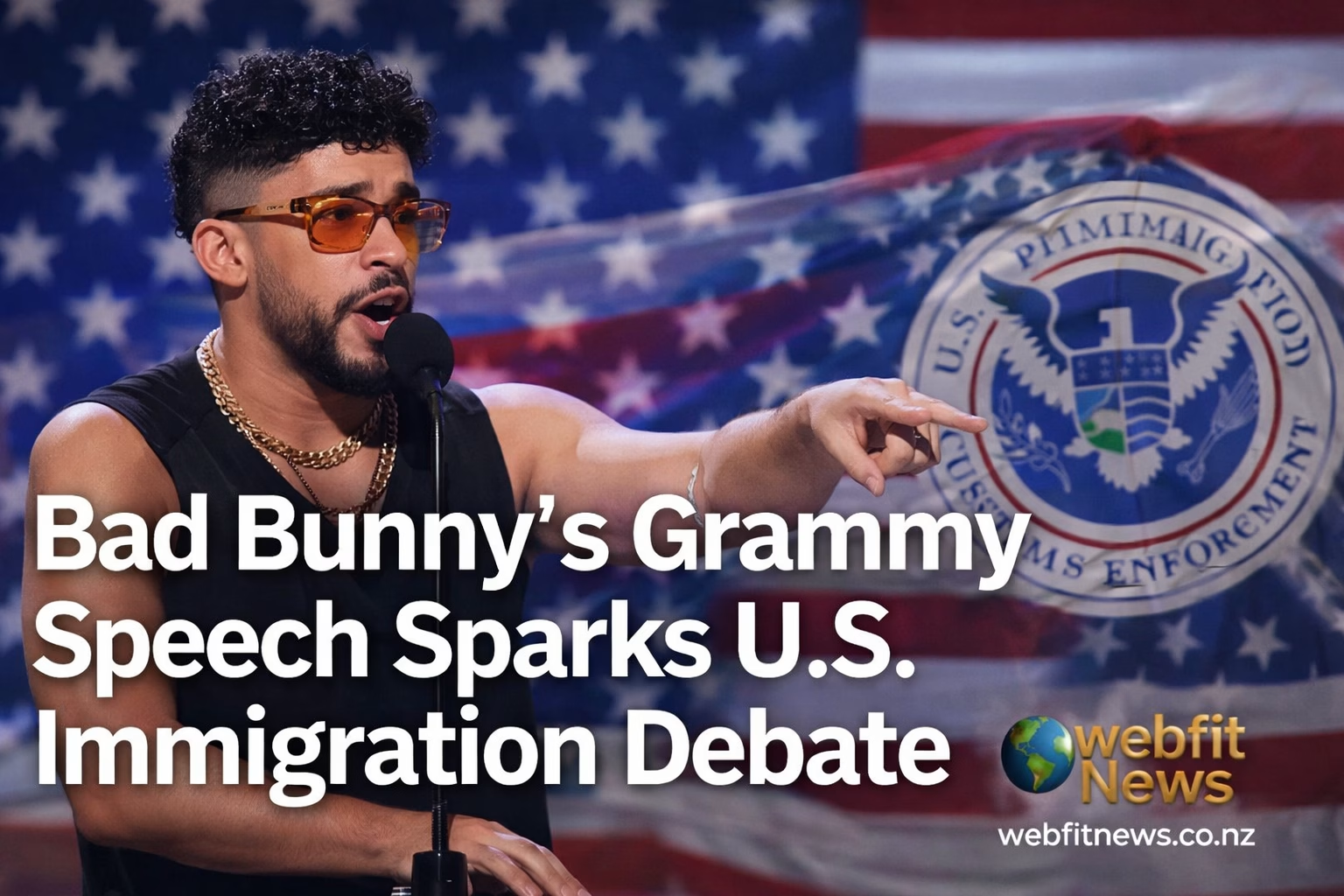
During his acceptance speech for Best Música Urbana Album, he openly criticized U.S. immigration enforcement, declaring solidarity with immigrant communities. The moment drew a standing ovation and sparked immediate global discussion.
Unlike performative activism, his remarks were consistent with long-held positions and personal choices, including scaling back U.S. performances in protest. The Grammys, once cautious about political expression, allowed the moment to stand without interruption.
It signaled a growing acceptance that music and politics are not separate worlds.
Genre Excellence Beyond the Spotlight
The night also showcased depth across categories:
- Lady Gaga won Best Pop Vocal Album for Mayhem, reinforcing her continued evolution rather than nostalgia.
- Leon Thomas and Kehlani led the R&B categories, blending traditional soul with modern production.
- The Cure and Turnstile demonstrated that rock remains relevant when innovation replaces repetition.
These wins highlighted a broader Academy trend: rewarding genre integrity over commercial dominance.
K-Pop, Film, and the Expanding Definition of “Global”
A notable milestone came with Golden from the animated film KPop Demon Hunters winning Best Song Written for Visual Media.
Though fictional in origin, the win marked the first Grammy awarded to a K-pop styled track, acknowledging the genre’s influence on global soundscapes.
The ceremony also saw Steven Spielberg enter the EGOT club with a win for Best Music Film, underscoring the enduring relationship between cinema and music.
Education, Legacy, and Memory
The Music Educator Award went to Jennifer Jimenez, a Florida-based band director whose work emphasized music as a safe space and life skill. The recognition reaffirmed the Academy’s commitment to sustainability beyond celebrity.
The In Memoriam segment honored legends including Roberta Flack and D’Angelo, bridging the past with the present and reinforcing the Grammys’ role as a cultural archive, not just a popularity contest.
What the 2026 Grammys Ultimately Represent
The 68th Grammy Awards were not flawless, but they were revealing.
They showed an institution more comfortable with linguistic diversity, more open to political expression, and more aware of a global audience that no longer looks to America alone for cultural leadership.
As the Grammys prepare to enter a new broadcast era in 2027, the message from 2026 is clear: excellence in music is no longer defined by language, geography, or genre. It is defined by impact, integrity, and authenticity.
That shift, more than any trophy, is what will define this ceremony’s legacy.
Bad Bunny’s Immigration Remarks at the 2026 Grammys Split America
The most controversial moment of the 68th Grammy Awards did not involve a surprise win or a perceived snub. It came from the podium.
When Bad Bunny accepted his award for Best Música Urbana Album, he used his speech to deliver a blunt political message, calling out U.S. immigration enforcement with the words “ICE out” and speaking directly about the dignity of immigrant communities. Inside the Crypto.com Arena, the response was immediate and visible. The audience stood and applauded.
Online, the reaction was sharply divided.
Within minutes, the moment began trending across platforms, triggering a familiar but increasingly tense national debate about politics, culture, and who gets to speak at America’s most visible entertainment events.
A Country Split in Real Time
Conservative commentators and political figures accused the Grammys of “platforming politics,” arguing that an award show should focus on art rather than policy. Some questioned whether the Recording Academy had crossed a line by allowing political statements on a global broadcast.
On the other side, immigration advocates and Latino communities praised the moment as overdue and necessary. For them, Bad Bunny’s remarks reflected lived reality rather than ideology, especially for communities long affected by immigration enforcement policies.
The divide was not subtle. It followed the same fault lines seen across broader American discourse, amplified by the visibility of the Grammy stage.
The Grammys’ Quiet Editorial Choice
What made the moment more significant was not just what Bad Bunny said, but how the Grammys responded.
There was no cutaway.
No disclaimer.
No distancing statement from the Recording Academy.
The broadcast allowed the speech to run uninterrupted.
In an era where live television often avoids controversy through delay or deflection, this was a quiet but deliberate editorial choice. The Academy neither endorsed nor censored the message, effectively allowing the moment to stand on its own.
That silence carried weight.
Not a One-Off Moment
Bad Bunny’s remarks did not come out of nowhere.
Over recent years, he has:
- Publicly criticized U.S. immigration policies
- Reduced touring commitments in the United States
- Consistently centered Spanish language and Puerto Rican identity in his work rather than tailoring it for English-speaking markets
His music and public positioning have followed a clear trajectory. The Grammys speech was a continuation, not a departure.
That context matters because it reframes the controversy. This was not a celebrity improvising a political statement. It was an artist aligning his platform with values he has repeatedly articulated.
The Deeper Question the Grammys Exposed
At its core, the backlash was not just about immigration.
It was about discomfort.
Bad Bunny’s Album of the Year win already challenged long-held assumptions about language and mainstream success. His speech pushed that challenge further, asking whether global artists are expected to mute their political identity in order to remain acceptable on American stages.
The controversy raised an uncomfortable question for the industry and its audience:
Can global artists be fully celebrated for their work while being discouraged from speaking about the realities that shape their lives?
Why This Moment Will Linger
The 2026 Grammys will be remembered for historic wins and institutional transitions, but Bad Bunny’s speech will likely outlast both. It revealed how award shows have become cultural battlegrounds, where silence itself is a statement.
For the Recording Academy, the moment signaled a shift toward allowing artists to define their own voice, even when that voice unsettles parts of the audience.
For viewers, it forced a reckoning with an evolving truth. Music is no longer just entertainment. It is identity, politics, and global reality intersecting in real time.
And the Grammys, intentionally or not, gave that intersection a microphone.
https://www.instagram.com/reel/DUPvXxZgI5b/?utm_source=ig_web_copy_link&igsh=MzRlODBiNWFlZA==